

Microsoft Advertising, the platform most people still search for as Bing Ads, runs at roughly €1.20–€1.35 CPC, which is about 30 to 40 percent cheaper per click than Google. That gap is not a quality discount. It comes from fewer advertisers competing in the same auction, and it sits on top of an audience that skews older, higher-income, more desktop, and more B2B than Google's. For a lot of Shopify brands that combination produces a CPA roughly 20 to 30 percent below Google.
This guide covers what Microsoft Ads (Bing Ads) actually cost in 2026, how to budget for a test, which bidding strategies to use, and why conversion tracking, not just clicks, decides whether the cheaper traffic turns into real revenue. If you are comparing channels, it sits alongside our ad cost benchmarks overview.
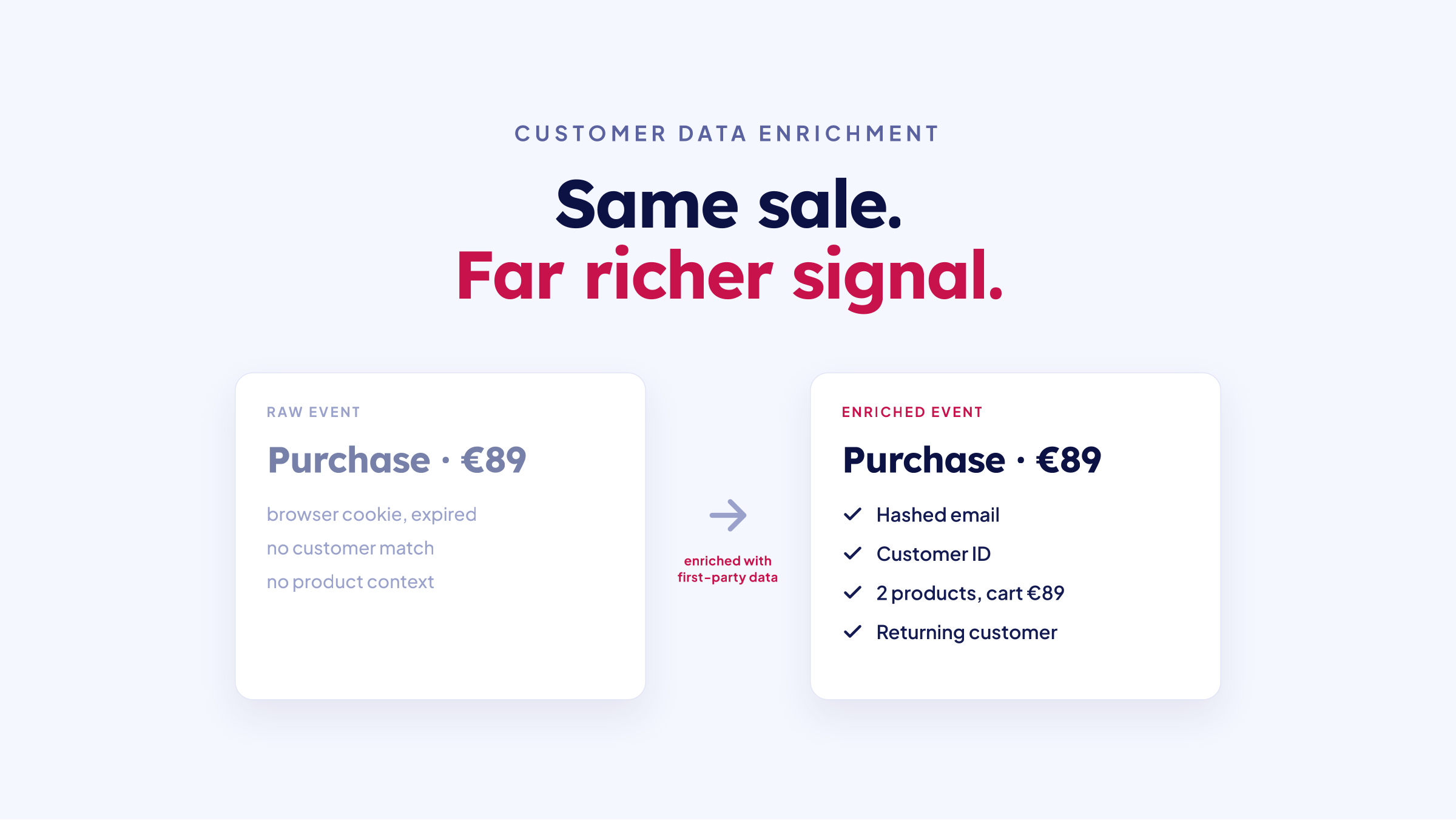
This is where TrackBee comes in. It captures your conversions server-side and enriches them with first-party data, so Microsoft Ads sees the sales the browser pixel misses and you get an honest cost per acquisition.
A note on the name: Bing Ads was renamed Microsoft Advertising in 2019. The product and ad network are now officially "Microsoft Advertising," but search demand still leans heavily on the legacy "Bing" name. We use both interchangeably here, because they are the same thing.
Microsoft Ads Cost Overview
The headline for 2026 is the relative position, not the absolute number. Microsoft Ads are consistently cheaper per click than Google, the audience is not lower quality, and the cost-per-acquisition tends to land below Google as well.
Average cost benchmarks for 2026:
| Metric | Range |
|---|---|
| CPC (cost per click, search) | €1.20–€1.35 |
| CPC vs. Google | ~30–40% cheaper |
| CPA (cost per acquisition) | roughly 20–30% below Google |
| CPM (Microsoft Audience Network) | ~€3 (low confidence, see below) |
| Minimum daily budget | €5–€10/day |
| Recommended monthly test budget | ~€435/month |
A few honest caveats on these numbers, because Microsoft cost data is thinner and noisier than Google's:
-
CPC is a range, not a point. Published figures cluster between roughly €1.20 and €1.35, and individual verticals move that around. We do not report a single "average" because the underlying sources disagree, and there is no first-party benchmark report that isolates Microsoft cleanly.
-
The CPC discount vs. Google is the reliable part. Every source agrees Microsoft is cheaper per click. The exact percentage varies by vertical, but ~30–40% is the directionally safe claim.
-
CPM is low confidence. Microsoft search is bought on a CPC basis. The only CPM figure worth quoting is the Microsoft Audience Network (native/display), and even that (~€3) comes from a single aggregator source. Treat it as a rough indicator, not a benchmark.
Actual costs vary by:
-
Advertiser competition: the single biggest driver. Fewer advertisers means lower auction pressure and lower CPC.
-
Industry / vertical: legal, insurance, and finance are the priciest. Ecommerce, retail, and travel are the cheapest. One important exception below.
-
Ad relevance and quality score: the same mechanic as Google. Higher relevance and a better landing page lower your effective CPC.
-
Bid strategy and conversion volume: automated bidding needs data before it optimizes well.
The retail exception, flagged for DTC:
retail is the one vertical where Bing CPC can match or even exceed Google. If you sell physical products, do not assume the cross-platform discount applies to your exact keywords. Test, measure, and let your own CPA decide.
Microsoft Ad Formats and Their Cost Structures
Microsoft Advertising covers search, shopping, and a native display network. For a Shopify store, the first two do most of the work.
Search Ads (Expanded Text / Responsive Search Ads) The core format. Text ads on Bing search results, billed per click. This is where the 30–40% CPC discount vs. Google lives. If you already run Google Search, this is the most direct like-for-like channel to test. Best for: Capturing existing search intent at a lower cost per click.
Microsoft Shopping Campaigns (Product Ads / PLAs) Product listing ads with image, price, and title, fed by a Microsoft Merchant Center store. The DTC workhorse, exactly like Google Shopping. Shopping CPCs run lower than search, and you can import an existing Google Shopping setup rather than rebuild from scratch. Best for: Ecommerce catalogs, bottom-funnel intent, the most efficient Shopify entry point.
Microsoft Audience Network (MSAN) Native display placements across Microsoft properties (MSN, Outlook, Edge) and partner sites, plus syndicated reach. Bought on a CPM-ish basis and used for awareness and retargeting, not primary intent capture. This is the only part of Microsoft Advertising where a CPM figure (~€3, low confidence) is meaningful. Best for: Top and mid-funnel reach to the affluent desktop audience, retargeting.
Dynamic Search Ads Microsoft generates ad targeting from your website content, useful for catalogs too large to manage keyword by keyword. Best for: Large product ranges, gap-filling against your manual keyword coverage.
For most Shopify DTC brands:
start with Shopping plus Search, mirroring whatever already works on Google. The Audience Network is a secondary layer once the intent-driven campaigns are profitable.
Budget Requirements: Minimum and Recommended
Microsoft's budget floor is low, which is part of the appeal. There is no large minimum campaign commitment like some platforms impose.
Minimum budgets:
-
Daily budget: €5–€10/day is enough to start and is consistent across sources.
-
There is no formal high minimum to launch a campaign.
Practical budget for testing: A meaningful test needs enough conversion volume for bidding to optimize, not just enough to spend. Budget around €435/month (roughly €15/day) per campaign for a few weeks before drawing conclusions. That is the level where you accumulate the ~30 conversions automated bidding needs to settle.
Why the test is cheap to run: Because clicks cost 30–40% less than Google, the same monthly budget buys meaningfully more traffic and more conversion data. A €435/month test on Microsoft surfaces signal that would cost noticeably more on Google search. That is the core argument for adding the channel: low downside, fast read.
Scaling budget: Once a campaign is profitable on your tracked CPA, scale gradually and keep watching CPA rather than CPC. Cheaper clicks are only useful if they convert, which is why measurement (covered below) matters more than the click price.
Bidding Strategies Explained
Microsoft consolidated its bid strategies in 2025, and the structure is cleaner than it used to be. For campaigns created after that change, standalone Target CPA and Target ROAS are being sunset and now live as settings inside the two automated strategies.
Manual CPC / Maximize Clicks You control the bid, or let Microsoft maximize click volume within budget. Recommended for low-volume accounts that have not yet accumulated enough conversions for automation to work. Use when: You are new to the channel and below ~30 conversions.
Enhanced CPC (eCPC) Still available. Adjusts your manual bids up or down based on the likelihood of a conversion. A reasonable bridge between fully manual and fully automated. Use when: You want some automation but still want a manual bid anchor.
Maximize Conversions (Target CPA inside) The volume path. Microsoft bids to get as many conversions as possible within budget. Target CPA is now an optional setting inside this strategy rather than a standalone bid strategy. Use when: You have steady conversion volume and want to optimize for cost per acquisition.
Maximize Conversion Value (Target ROAS inside) The value path. Microsoft bids toward total conversion value, with Target ROAS as an optional setting inside it. Best for stores with varied product margins or order values. Use when: You care about revenue and ROAS, not just conversion count.
Recommendation for Shopify stores: Start on Manual CPC or Enhanced CPC, accumulate ~30 conversions, then graduate to Maximize Conversions (with Target CPA) or Maximize Conversion Value (with Target ROAS). All automated strategies depend on clean conversion data, which is the recurring theme of this guide.
The Easiest Way to Test: Google Ads Import
The reason Microsoft is low-effort to trial is the Import Center, updated in May 2026, which now imports from Google Ads (and Meta) without starting from scratch.
Because of the 2025 bidding consolidation, the old Target CPA and Target ROAS strategies now fold into the two automated ones, so imported campaigns map cleanly:
-
Target CPA campaigns import as Maximize Conversions, with the CPA carried over.
-
Target ROAS campaigns import as Maximize Conversion Value, with the ROAS percentage intact.
In practice, a Shopify advertiser can clone an already-optimized Google Ads account into Microsoft in minutes, then run it against the cheaper clicks. It is the lowest-effort way to find out whether the channel works for your store, with almost none of the build cost of starting from zero.
What Drives Microsoft Ad Performance
Microsoft cost and performance are shaped by a different mix than Google, and that mix explains why the cheaper clicks are not a trap.
1. Lower advertiser competition (the number one driver). Far fewer advertisers bid on Microsoft than on Google. Less auction pressure means lower CPC. This is the root cause of the 30–40% gap, and it has nothing to do with traffic quality.
2. Ad relevance and quality score. The same mechanic as Google. A more relevant ad and a stronger landing page lower your effective cost per click.
3. Audience skew (the quality lever). Microsoft search users skew older (a large majority aged 35 and older), higher-income (a meaningful share in six-figure households), more desktop, and more B2B and corporate. That is an affluent, intent-rich, purchase-ready audience. Cheaper clicks reaching a higher-converting demographic is why CPA can run below Google even when conversion rates are broadly comparable.
4. Industry and vertical. Pricey verticals (legal, insurance, finance) sit well above the average. Ecommerce and travel sit below it. Remember the retail exception: for some product keywords, Bing CPC can match or beat Google's, so let your own data lead.
5. Bid strategy and conversion volume. Automated bidding needs roughly 30 conversions to optimize. Low-volume accounts that jump straight to automation can waste spend until the data accumulates, which is why we recommend starting manual.
For most DTC brands Microsoft is not a primary growth engine the way Meta or Google can be. It is an efficiency lever. Cheaper clicks plus a higher-converting demographic produce incremental, profitable volume. The catch is that all of that efficiency depends on Microsoft's bidding seeing your real conversions, which is where tracking comes in.
Microsoft Ads Tracking: Why Server-Side UET Matters
Microsoft tracks conversions through the UET tag (Universal Event Tracking), the browser-based pixel you place on your Shopify store. UET feeds conversions back into Microsoft's bidding so Target CPA and Target ROAS can optimize. Like every browser-based tag, it has a blind spot.
The UET tag faces the same limitations as every other client-side pixel:
-
Ad blockers and tracking-prevention features stop it loading on a meaningful share of sessions.
-
Browser privacy restrictions and ITP-style cookie limits fragment cross-session attribution.
-
Consent banners block the tag from firing until or unless a shopper opts in.
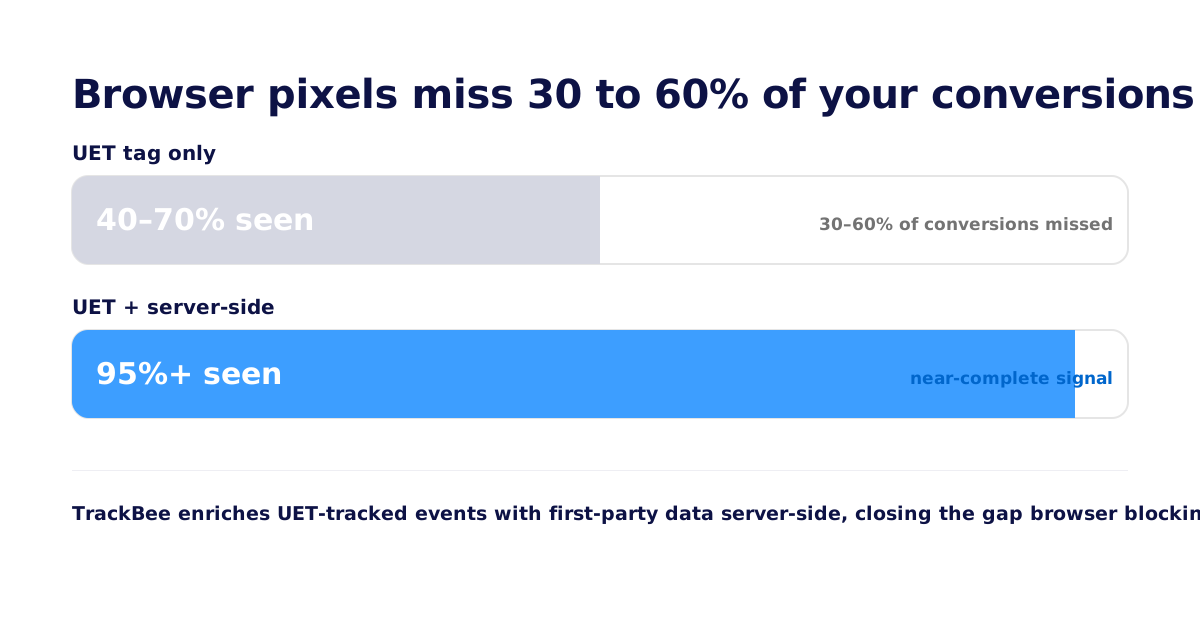
Across Shopify stores, browser pixels typically miss 30% to 60% of actual conversions, depending on traffic mix and setup. On Microsoft, where so much of the value comes from automated bidding optimizing toward your CPA or ROAS target, that gap is expensive. If the UET tag only sees half to two thirds of your purchases, Microsoft is optimizing toward an incomplete picture of who actually buys. The cheaper clicks are real, but the algorithm cannot steer them efficiently if half the conversion signal never arrives.
Server-side tracking closes that gap. Instead of relying on the browser alone, conversion events are sent server-to-server, where ad blockers and browser restrictions cannot interfere. TrackBee captures those conversions on the server, deduplicates against the UET tag, and enriches the UET-tracked events with first-party data so Microsoft receives a complete, high-quality conversion signal. Cleaner data into Microsoft's bidding means better Target CPA and Target ROAS optimization, which means your real CPA can land even lower than the benchmark suggests.
This is the same server-side thesis that powers Meta's Conversions API and Google's Enhanced Conversions, applied to Microsoft's UET. To see how it fits together across every channel, read full-funnel tracking for Shopify, or start with the fundamentals in what is server-side tracking and how to install it for Shopify. See also the Microsoft Ads integration.
Microsoft vs. Google vs. Meta: Cost Comparison
Here is how Microsoft sits next to the two channels most Shopify brands already run. Channel order follows Meta, then Google, then Microsoft.
| Meta | Microsoft (Bing) | ||
|---|---|---|---|
| Average CPM | ~€10–€12 (ecom) | ~€2.70 (Display) | ~€3 (Audience Network, low conf.) |
| Average CPC | €0.65–€1.65 | €0.40 EU ecom to €4+ search | €1.20–€1.35 |
| CPC vs. Google | varies | baseline | ~30–40% cheaper |
| Minimum budget | €18–€45/day | €10–€45/day | €5–€10/day |
| Audience intent | Discovery + intent mix | Active search intent | Active search intent |
| Audience skew | Broad | Broad | Older, higher-income, desktop, B2B |
Practical implications for Shopify advertisers:
-
Meta reaches users in browse and discovery mode. Strong for prospecting and retargeting, higher CPM, see our Facebook ads cost guide for the full picture.
-
Google captures the most active search intent and the largest reach, at the highest cost per click on competitive terms. The detail is in our Google ads cost guide.
-
Microsoft captures the same kind of search intent as Google, on a smaller but affluent audience, for materially cheaper clicks.
The most efficient play for most DTC stores is to keep Google and Meta as the primary engines, then add Microsoft as a low-cost efficiency layer, ideally by importing your best Google campaigns and letting the cheaper clicks compound. It rarely replaces Google. It frequently improves blended efficiency.
Frequently Asked Questions
How much do Microsoft Ads (Bing Ads) cost in 2026? Average search CPC sits around €1.20–€1.35, with daily budgets starting from €5–€10. There is no large minimum to launch. Because clicks cost roughly 30–40% less than Google, a modest €435/month test budget goes a long way toward generating usable conversion data.
Microsoft Ads vs Google Ads cost, which is cheaper? Microsoft is cheaper per click, by roughly 30–40% on average, because fewer advertisers compete in the auction. CPA tends to run roughly 20 to 30 percent below Google as well, helped by an audience that skews higher-income and more purchase-ready. The exception is retail, where Bing CPC can occasionally match or exceed Google, so test your own keywords.
What is the minimum budget to test Microsoft Ads? You can start at €5–€10/day. For a meaningful read, budget around €435/month per campaign over a few weeks, enough to accumulate the ~30 conversions automated bidding needs to optimize.
Does Microsoft Ads have lower-quality traffic than Google? No. The cheaper clicks come from less advertiser competition, not worse traffic. Microsoft's search audience skews older, higher-income, more desktop, and more B2B, which often converts efficiently. For many DTC brands the lower CPC plus a more affluent audience produces a CPA below Google's.
Can I import my Google Ads campaigns into Microsoft Advertising? Yes. The Import Center, updated in May 2026, imports from Google Ads (and Meta) without starting from scratch. Target CPA campaigns map to Maximize Conversions and Target ROAS campaigns map to Maximize Conversion Value, with your targets carried over. It is the fastest, lowest-effort way to test the channel with already-optimized campaigns.
Microsoft Ads Work When the Tracking Does
Microsoft Ads are one of the cheaper sources of high-intent search traffic available to a Shopify store, and the Import Center makes them trivial to test. But the discount only turns into profit if Microsoft's bidding can see your real conversions. UET runs in the browser, and the browser misses 30% to 60% of the conversions that actually happen.
Server-side tracking with TrackBee recovers that missing signal, enriches your UET events with first-party data, and feeds Microsoft's bidding the complete picture it needs to optimize toward your CPA and ROAS targets. The efficiency comes from cheaper clicks, measured properly.


.png)