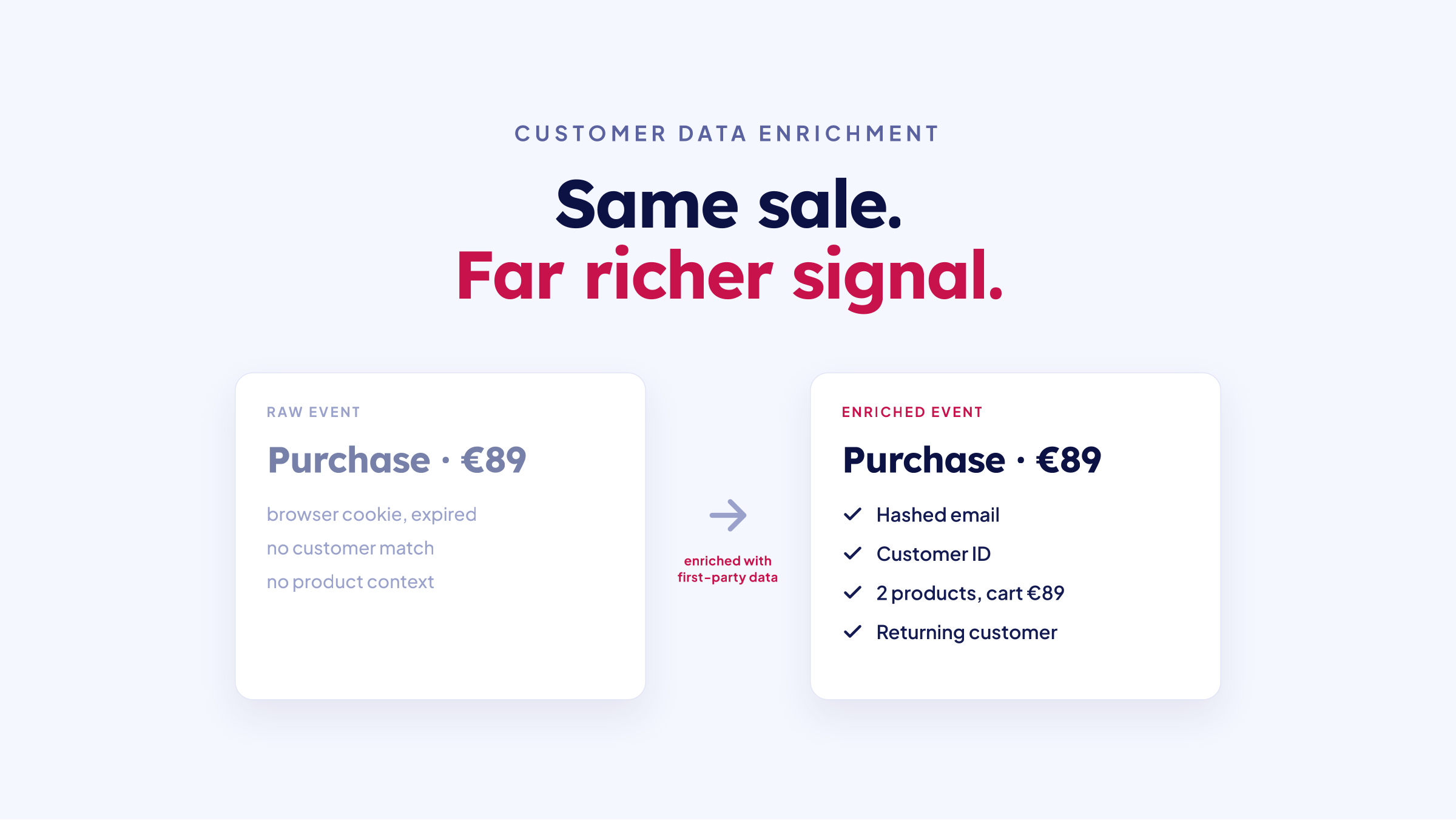

Short answer: Full-funnel tracking captures every event from product view through add-to-cart, checkout and purchase, then sends that complete stream, enriched with first-party data, to Meta, Google, TikTok, Pinterest and Klaviyo. Platforms learn from the whole journey, not just purchases, so giving them the full picture lets them optimise far more effectively.
Most Shopify stores track purchases. Some track add-to-cart events. Very few track the complete customer journey - from the first product view to the final purchase confirmation - with the consistency and data quality that advertising platforms need to actually optimize campaigns.
That gap has real consequences. Meta, Google, and TikTok don't just learn from purchase events. They learn from the entire funnel. When you give them only half the picture, they optimize for half the picture. Full-funnel tracking closes that gap - and the performance difference is significant.
What Full-Funnel Tracking Actually Means
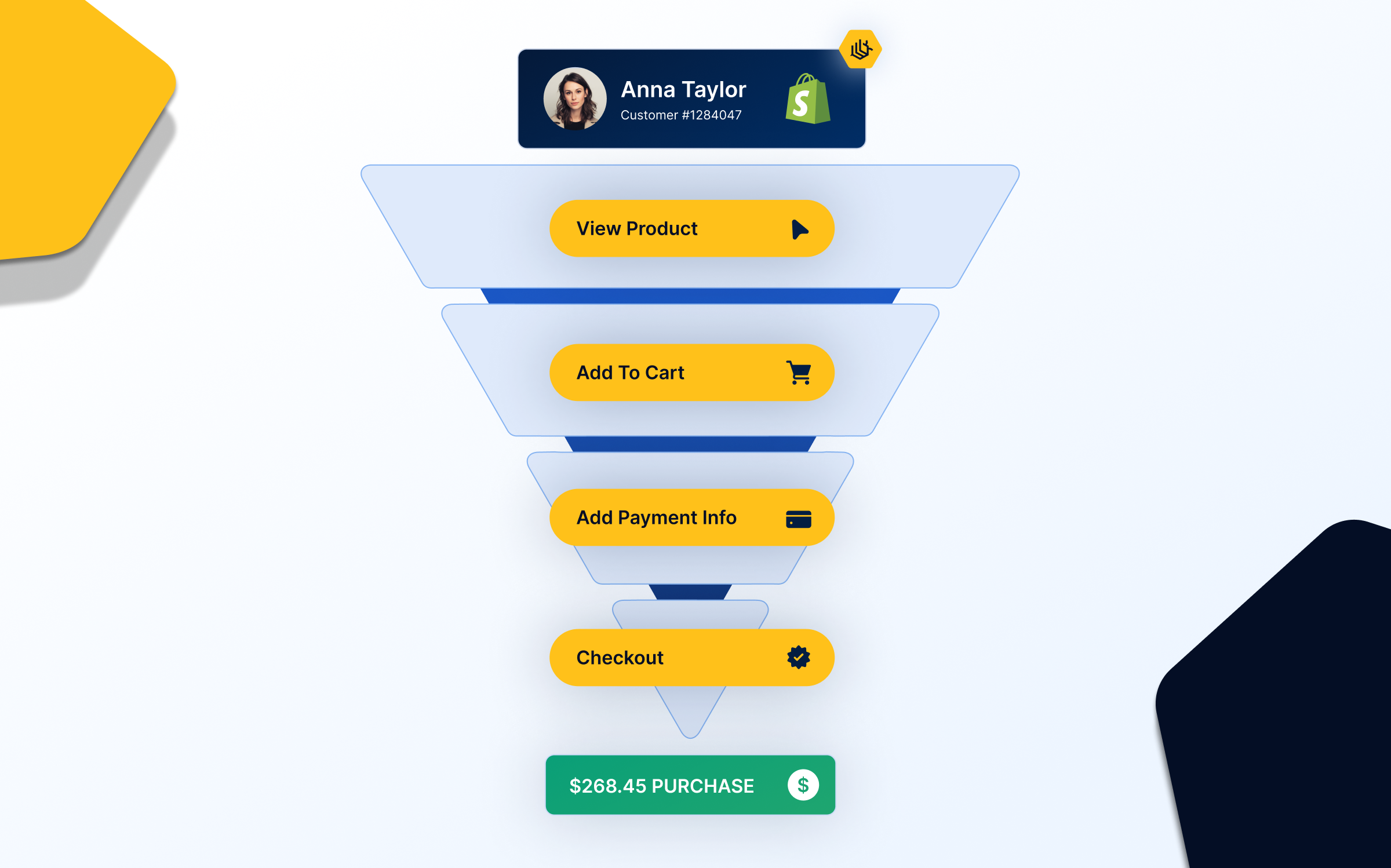
Full-funnel tracking means capturing every conversion-relevant event in your customer's journey - not just the end result - and sending that complete event stream to your marketing platforms.
In Shopify e-commerce, the standard conversion funnel looks like this:
| Event | What it signals |
|---|---|
| View Product | Interest and browsing intent |
| Add to Cart | Active product consideration, high purchase intent |
| Initiate Checkout | Strong purchase intent, barrier-to-conversion identified |
| Purchase | Completed conversion, long-term customer value |
Each event tells a different story about your customer's intent. Together, they give advertising algorithms the complete picture they need to find and target high-value users earlier in the funnel - before the purchase event ever fires.
The problem: most Shopify stores lose a substantial portion of these mid-funnel events to ad blockers, iOS restrictions (including iOS 26's expanded Link Tracking Protection that strips click IDs more aggressively), and browser limitations. Client-side pixels fire inconsistently. Add-to-cart events are missed. Initiate checkout events don't reach Meta. By the time a customer reaches purchase, the algorithm has received a fragmented, incomplete record of that customer's journey.
Why Partial Tracking Hurts Campaign Performance
Understanding why full-funnel data matters requires understanding how ad platform algorithms actually work.
Meta, Google, and TikTok use your event data to train machine learning models. These models identify patterns in the behavior of users who convert - what they browsed before buying, how they navigated your funnel, what signals indicated high purchase intent. The algorithms then use those patterns to find similar users and bid more aggressively for them.
When you send only purchase events, the algorithm has to work backward from the endpoint alone. It knows who bought, but not who showed intent without buying, not what mid-funnel behaviors predicted conversion, and not where in the funnel potential customers are dropping off.
When you send complete funnel events, the algorithm builds a richer model:
-
Add-to-cart events tell it which audiences are actively considering your products
-
Initiate-checkout events identify the highest-intent users who are one step from purchasing
-
View-product events build broad audience models for prospecting
This richer model means smarter bidding, more accurate audience targeting, and more efficient use of your ad budget. The difference isn't marginal - it's the difference between an algorithm guessing and an algorithm knowing.
For context on why event data quality matters so much to platform algorithms, see: Why profitable ad campaigns need event deduplication and two tracking methods.
How TrackBee Powers Full-Funnel Tracking Server-Side
TrackBee acts as a central data layer between your Shopify store and all of your marketing platforms. Instead of relying on individual client-side pixels to capture each event - and accepting the data loss that comes with browser-based tracking - TrackBee captures all funnel events at the server level, enriches them, and distributes them to every connected platform simultaneously.
What happens when a customer interacts with your store:
-
Event captured server-side - the event fires at the server level, independent of the visitor's browser. Ad blockers don't apply. iOS restrictions don't apply. Cookie policies don't limit what's collected.
-
Shopper profile matched and updated - TrackBee matches the event to an existing shopper profile (or creates a new one). The profile accumulates data across sessions and devices: click IDs, email, UTM parameters, behavioral history.
-
Event enriched - first-party data from the shopper profile is appended to the event: email address, customer name, IP address, fbclid/gclid, UTM source/medium/campaign. Enriched events match to real users at much higher rates on advertising platforms.
-
Deduplication - if the same event was also captured by a client-side pixel, TrackBee ensures platforms receive it exactly once. No double-counting, no algorithm confusion.
-
Distributed to all platforms - the enriched, deduplicated event is sent simultaneously to Meta (Conversions API), Google Ads (Enhanced Conversions), TikTok (Events API), Pinterest (CAPI), Klaviyo, and GA4.
The result: every platform receives the same high-quality, complete, enriched event stream - not the partial, fragmented data that client-side tracking produces. For a foundational overview of how tracking works, see our Data Tracking 101 guide.
Learn more about the mechanics of server-side tracking: What is server-side tracking and how to install it for Shopify.
Full-Funnel Data for Each Platform
Full-funnel tracking has distinct benefits for each platform TrackBee integrates with.
Meta Ads
Meta's algorithm is heavily dependent on receiving the full funnel. View-content and add-to-cart events inform Advantage+ audience selection and help Meta identify high-intent users before they've reached the purchase stage. Complete funnel data also dramatically improves Event Match Quality - Meta's score for how accurately events are matched to real users - which directly improves targeting precision and reduces wasted impressions.
Read the full guide: How to improve Meta's Event Match Quality score.
Google Ads
Google Enhanced Conversions receives enriched, server-side conversion data that improves attribution in cookieless environments. Full-funnel data enables smarter smart bidding - Google's algorithms use all conversion signals (not just purchases) to make real-time bid decisions. More complete funnel signals mean more accurate Target CPA and Target ROAS performance.
See our guide: The ultimate Google Enhanced Conversions guide.
TikTok Ads
TikTok's Events API benefits significantly from mid-funnel events. Add-to-cart signals are particularly valuable for TikTok's audience optimization, helping the algorithm identify high-purchase-intent users earlier in the funnel.
Klaviyo
For Klaviyo, full-funnel tracking means more than better campaign data - it means more flow triggers. Browse abandonment and cart abandonment events must fire consistently for Klaviyo's automated flows to trigger. With client-side tracking, these events are among the most frequently lost. Server-side tracking makes them reliable.
The impact is direct: more events captured → more triggers fired → more abandonment emails sent → more revenue recovered. See our guides for:
Pinterest Conversions API receives enriched event data that improves campaign targeting and measurement, particularly valuable for DTC brands in lifestyle, fashion, home, and beauty categories. For a complete setup guide, see Pinterest conversion tracking for Shopify.
GA4
Server-side GA4 data via the Measurement Protocol gives you a more complete, accurate picture of your funnel in Google Analytics - less data sampling, less reliance on browser-based collection.
The Data Advantage in Action
The performance gap between partial tracking and full-funnel server-side tracking isn't theoretical. Here's what it looks like in practice.
Platform learning accelerates.
When Meta receives complete add-to-cart and checkout initiation events - not just purchases - its algorithm learns faster. Campaigns exit the learning phase more quickly, reach stable performance sooner, and respond better to budget scaling.
Audience sizes grow.
More captured events mean larger custom audiences in Meta and Google. Larger audiences give algorithms more room to optimize. Lookalike audiences built on enriched, complete event data are more accurate and higher-performing than those built on partial data.
Attribution becomes reliable.
When all funnel events are captured server-side across devices, attribution gaps close. You can see the actual multi-touch journey - not just the last touchpoint that happened to fire a client-side pixel.
Klaviyo revenue increases.
The compound effect of more browse abandonment triggers and more cart abandonment triggers shows up directly in Klaviyo's revenue reporting. HoneyBalm saw a 213% increase in abandonment revenue after implementing TrackBee's server-side tracking - a direct result of more complete event capture.
This is the data advantage: not just more data, but complete data - enriched, deduplicated, and consistently delivered to every platform that needs it.
Frequently Asked Questions
Does full-funnel tracking require any changes to my Shopify store's front end? No. TrackBee captures all funnel events server-side from Shopify's backend data. No front-end code changes are required.
Which events does TrackBee capture by default? TrackBee captures all standard e-commerce funnel events: ViewContent (product page views), AddToCart, InitiateCheckout, and Purchase - plus additional events like Search, ViewCategory, and custom events where applicable.
How does full-funnel tracking affect Meta's ROAS? More complete funnel signals give Meta's algorithm better training data. Better training data means more accurate audience targeting and bidding. Petrol Industries saw their Meta ROAS double after implementing TrackBee, driven entirely by improved data quality - not changes to their ad creative or strategy.
Will capturing more events increase my advertising costs? Not directly - you're charged based on clicks and impressions, not events captured. What changes is the quality of your targeting. Better signals → more efficient spend → lower CPAs and higher ROAS.
Can I see which events are being captured and sent to which platforms? Yes. TrackBee's dashboard shows event coverage, event counts by platform, and data quality metrics in real time.


.png)