.png)

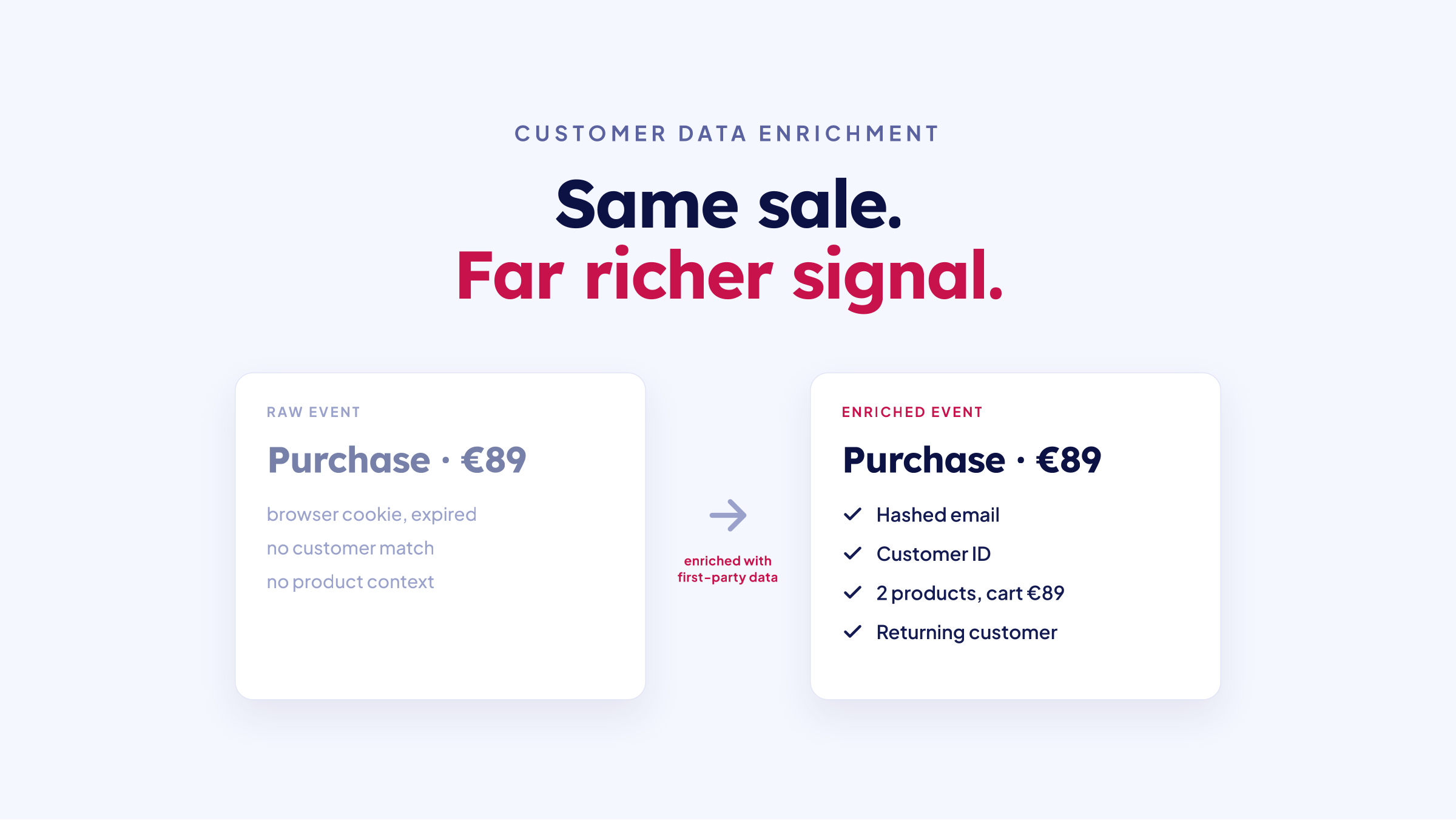
Short answer: Server-side tracking collects event data through your web server instead of the visitor's browser, sending purchases and other events directly to Meta, Google, TikTok, Klaviyo and more. Because it bypasses ad blockers, iOS restrictions and cookie limits that cost most stores 30 to 40 percent of conversion data, it restores the signal your campaigns need.
Most Shopify stores are losing 30–40% of their conversion data without knowing it. Ad blockers, iOS privacy restrictions, and cookie limitations silently strip away the events your ad platforms need to optimize your campaigns. The result: higher CPAs, weaker ROAS, and marketing decisions based on incomplete data.
Server-side tracking solves this. In this guide, you'll learn exactly how it works, why it matters for your Shopify store, and how to set it up - no developer required.
What Is Server-Side Tracking?
Server-side tracking is a method of collecting user event data through your web server rather than through the visitor's browser. Instead of relying on JavaScript pixels that run in the browser - and can be blocked, restricted, or corrupted - server-side tracking creates a direct, reliable connection between your server and your marketing platforms.
When a customer visits your Shopify store, views a product, adds an item to their cart, or completes a purchase, your server records those events and sends them directly to Meta, Google Ads, TikTok, Klaviyo, and other platforms - bypassing ad blockers, iOS restrictions, and cookie limitations entirely.
In short: server-side tracking captures what browser-based tracking misses. It's the difference between making marketing decisions with 60–70% of your data versus 100% of it.
How Client-Side Tracking Fails
To understand why server-side tracking matters, you need to understand what's breaking traditional tracking.
Client-side tracking relies on JavaScript code - the Meta Pixel, Google Analytics tag, TikTok Pixel - that loads in your visitor's browser. When everything works, these scripts collect event data and send it to advertising platforms. But increasingly, "everything working" is the exception, not the rule.
What's blocking your tracking data:
-
Ad blockers: Around 30–40% of internet users have ad blockers installed that prevent tracking scripts from loading at all
-
iOS App Tracking Transparency: Apple's privacy framework has drastically limited cross-app and cross-site tracking on iPhones and iPads
-
Safari Intelligent Tracking Prevention (ITP): Safari caps cookie lifetimes at 7 days, fragmenting your customer data
-
Cookie consent: When users decline consent, tracking stops - even if they convert. Since Google Consent Mode V2 enforcement in July 2025, platforms require explicit consent signals, adding another layer of data loss for client-side setups
-
iOS 26 Link Tracking Protection: Apple continues expanding Link Tracking Protection beyond Safari, stripping click IDs (fbclid, gclid) from URLs across more apps - making client-side attribution even less reliable on Apple devices
-
Script conflicts: Multiple third-party scripts competing in the browser can cause tracking failures
-
Slow page loads: Heavy tracking scripts contribute to load times that drive visitors away (54% of users leave a site that takes more than 3 seconds to load)
The cumulative effect: most Shopify stores running only client-side tracking are missing 30–40% of their conversions. Those missing events directly degrade the quality of your ad campaigns, your targeting, and your attribution.
How Server-Side Tracking Works
Server-side tracking moves data collection from the visitor's browser to your server. Here's what happens step by step:
-
A visitor interacts with your Shopify store - views a product, adds to cart, initiates checkout, or purchases
-
Your server captures the event - independently of what the visitor's browser allows or blocks
-
The event is enriched - customer identity, session data, UTM parameters, and behavioral context are added to create a richer data point
-
The enriched event is sent to your marketing platforms - Meta (via Conversions API), Google Ads (Enhanced Conversions), Klaviyo, TikTok Events API, and Pinterest
-
Deduplication runs - if the same event was also captured client-side, it's deduplicated so platforms receive each event exactly once
The result is a complete, accurate, and enriched data stream that platform algorithms can actually learn from.
Client-Side vs Server-Side: Key Differences
| Client-Side Tracking | Server-Side Tracking | |
|---|---|---|
| Where data is collected | Visitor's browser | Your web server |
| Blocked by ad blockers | Yes - significant data loss | No - minimal impact |
| Affected by iOS/ITP | Yes - major limitations | Minimal effect |
| Cookie dependency | High | Low |
| Website performance impact | Slows down page loads | Virtually no impact |
| Data quality | Incomplete, fragmented | Complete, enriched |
| Implementation complexity | Simple to add, hard to maintain | Easy with TrackBee |
| Long-term reliability | Declining | Growing |
Why Shopify Stores Need Server-Side Tracking
Incomplete data doesn't just mean worse reporting - it actively damages your ad campaigns.
Platform learning breaks down.
Meta, Google, and TikTok use your conversion events to train their bidding algorithms. When 30–40% of purchase events are missing, the algorithm is working with corrupted input. It targets the wrong audiences, wastes budget, and delivers weaker ROAS.
Retargeting becomes unreliable.
If your pixel misses half of your Add to Cart events, your abandoned cart audiences are half the size they should be. That's revenue left on the table.
Attribution is inaccurate.
When conversions aren't tracked, you can't see which channels, campaigns, or ads are actually driving results. Budget decisions get made on incomplete information.
Klaviyo flows underperform.
If browse and cart abandonment events don't fire consistently, your Klaviyo flows don't trigger. That means emails that should have been sent - and revenue that should have been recovered - simply vanish. Learn more in our guide to improving your Klaviyo browse abandonment flow.
The scale of the impact is real.
Petrol Industries, a Shopify fashion brand, saw their Meta ROAS double after implementing server-side tracking. Their Meta Event Match Quality Score jumped from 3.5–5.5 to 7–8.5 out of 10. HoneyBalm tracked 171% more Add to Cart events and saw a 213% increase in abandonment revenue through Klaviyo.
Session Enrichment and Shopper Profiles
Server-side tracking isn't just about recovering lost events - it's about making your data more valuable.
TrackBee builds persistent Shopper Profiles for every visitor to your store. These profiles are continuously enriched with each interaction, regardless of browser restrictions or device switches. Each profile stores:
-
Click IDs (fbclid, gclid, etc.)
-
Email address (when available)
-
First and last name
-
IP address
-
UTM source, medium, and campaign
-
Session history and behavioral patterns
-
Cross-device activity
This means that when a customer browses on their phone, abandons their cart, and returns two days later on their laptop to purchase - TrackBee connects those events into a single coherent profile. Platforms receive complete attribution data. Your Klaviyo flows fire correctly. Your ad algorithms get accurate signals.
This is what we call the data advantage: not just more data, but better data - data that platforms can actually use to optimize your campaigns.
Server-Side Tracking vs Server-Side Tagging
These terms are often confused. They're not the same thing.
Server-side tracking
is about data collection - capturing user events on your server instead of in the browser.
Server-side tagging
is about tag management - deploying and managing marketing tags through a server-side container (like Google Tag Manager server-side). It requires setting up and maintaining a tagging server, configuring containers for each platform, and managing complex rule sets.
Server-side tagging is powerful but technically demanding. TrackBee focuses on server-side tracking - giving you the full data quality benefits without the technical complexity of managing a tagging infrastructure.
For a deeper comparison of client-side and server-side approaches, see our guide: Client-side vs server-side tracking: essential differences for Shopify stores.
How to Install Server-Side Tracking for Shopify
Traditional server-side tracking requires setting up servers, configuring containers, and maintaining complex integrations. TrackBee removes all of that complexity. Setup takes five minutes - no developer needed.
Step 1: Create your TrackBee account Go to trackbee.io and sign up. The process takes about 60 seconds.
Step 2: Connect your Shopify store Follow the guided on-screen steps to link your store. TrackBee integrates directly with Shopify - no manual code required.
Step 3: Install the TrackBee app Install TrackBee from the Shopify App Store. The installation wizard handles all technical configuration automatically.
Step 4: Connect your ad platforms Select which platforms you want to feed data to - Meta, Google Ads, TikTok, Pinterest, Klaviyo, GA4 - and follow the guided connection steps.
That's it. TrackBee starts capturing server-side events immediately and you'll see improvements in your data within 24–48 hours.
Once installed, TrackBee is completely maintenance-free. It updates automatically, handles deduplication, and keeps itself synchronized with platform API changes. You never need to touch it again.
What to Expect After Installation
Within 24–48 hours of installing TrackBee, you'll start seeing:
More complete conversion data.
The 30–40% of events you were losing to ad blockers and iOS restrictions are now captured and sent to your platforms.
Higher Event Match Quality on Meta.
Enriched first-party data - including email, name, and IP - dramatically improves Meta's ability to match your events to real users. Most TrackBee customers see their EMQ scores jump significantly after installation. Read more about Meta Event Match Quality and how to improve it.
Better Google Enhanced Conversions.
Enhanced Conversion data flows automatically to Google Ads, improving attribution and bid optimization. See our Google Enhanced Conversions guide for details.
More Klaviyo flow triggers.
Browse abandonment and cart abandonment events fire consistently, meaning your email flows reach more of the right people at the right time.
Improved website performance.
With fewer tracking scripts running in the browser, page load times typically improve - which means lower bounce rates and higher conversion rates.
Frequently Asked Questions
Is server-side tracking GDPR compliant? Yes. Server-side tracking can be implemented in a privacy-compliant way. TrackBee processes data using first-party data principles and is compatible with standard consent frameworks.
Does server-side tracking create duplicate events? Not with TrackBee. TrackBee's deduplication system ensures each event is sent to advertising platforms exactly once, even when both client-side and server-side tracking capture the same event.
Do I need a developer to set up server-side tracking? No. TrackBee is built specifically for Shopify merchants and can be set up in five minutes without any technical expertise.
Will TrackBee conflict with my existing Shopify apps? No. TrackBee works alongside your existing tracking scripts and Shopify apps without conflicts. It enriches and extends your tracking rather than replacing it.
How is server-side tracking different from the Meta Pixel? The Meta Pixel is client-side - it runs in the visitor's browser and is blocked by ad blockers and iOS restrictions. Server-side tracking (via Meta's Conversions API) sends event data directly from your server to Meta, bypassing those restrictions. TrackBee uses both in combination for maximum coverage.
When will I see results? Most TrackBee users see measurable improvements in their tracking data within 24–48 hours of installation. Campaign performance improvements typically become visible within 2–4 weeks as your ad platforms learn from the improved data.


.png)