.png)

Short answer: Client-side tracking runs scripts in the visitor's browser and now leaks 30 to 40 percent of conversion data to ad blockers and iOS restrictions. Server-side tracking sends events directly from your server to Meta, Google, TikTok and other platforms, bypassing those limits. The result is more complete data, better optimisation and more reliable ROAS.
If you run paid ads for a Shopify store, you're probably tracking conversions the same way you always have - a Meta Pixel here, a Google Analytics tag there, maybe a TikTok Pixel. It worked fine for years. But the digital environment has changed, and that standard setup is now leaking 30–40% of your conversion data.
This guide breaks down the essential differences between client-side and server-side tracking, what those differences mean for your ROAS, and why more Shopify stores are making the switch.
What Is Client-Side Tracking?
Client-side tracking collects data in the visitor's browser. When someone lands on your Shopify store, JavaScript tracking scripts - like the Meta Pixel, Google Analytics tag, or TikTok Pixel - load and execute in their browser. Those scripts capture user events (page views, add to cart, purchases) and send the data directly from the visitor's device to advertising platforms.
For most of the internet's history, this approach worked well enough. But today, it faces serious challenges:
are installed by 30–40% of internet users. These tools actively prevent tracking scripts from loading, which means you simply never receive those events.
iOS privacy restrictions
- specifically Apple's App Tracking Transparency framework - have dramatically reduced the ability to track users across apps and websites on Apple devices. iPhones represent a huge share of Shopify traffic, and iOS users are systematically underrepresented in your conversion data.
Safari's Intelligent Tracking Prevention (ITP)
caps cookie lifetimes at 7 days. A customer who browses your store today and purchases 10 days later may not be attributed to your ad - even though your campaign drove that sale.
Cookie consent
means that visitors who decline tracking are invisible to your pixels. Even if they purchase. Google Consent Mode V2, enforced since July 2025, now requires explicit consent signals - adding yet another gate between your pixel and your data.
iOS 26 Link Tracking Protection
expands Apple's aggressive click ID stripping beyond Safari into more system-level contexts, making fbclid, gclid, and ttclid even less reliable on Apple devices.
Script performance issues
- every tracking script you add to your store is extra weight your visitor's browser has to load, interpret, and execute. Multiple scripts contribute to slower page loads, which increases bounce rates and reduces conversion rates.
The cumulative result: client-side tracking gives you a 60–70% accurate picture of what's actually happening in your store. You're making marketing decisions, allocating budget, and optimizing campaigns based on data that's missing a third of its events.
What Is Server-Side Tracking?
Server-side tracking moves data collection from the visitor's browser to your web server. Instead of relying on JavaScript that runs in a browser (and can be blocked, restricted, or degraded), your server independently captures user events and sends them directly to marketing platforms.
Here's the key difference: your server doesn't use browser cookies, doesn't rely on JavaScript loading successfully in a visitor's browser, and isn't subject to ad blockers. It captures events regardless of what's happening on the client side.
When a user adds a product to their cart on your Shopify store:
Client-side only: The event fires in their browser - but if they have an ad blocker, are on iOS with ATT enabled, or using Safari with ITP, that event may never reach Meta or Google. You've lost a signal.
Server-side: Your server independently records the add-to-cart event and sends it directly to Meta via the Conversions API and to Google via Enhanced Conversions - bypassing browser restrictions entirely.
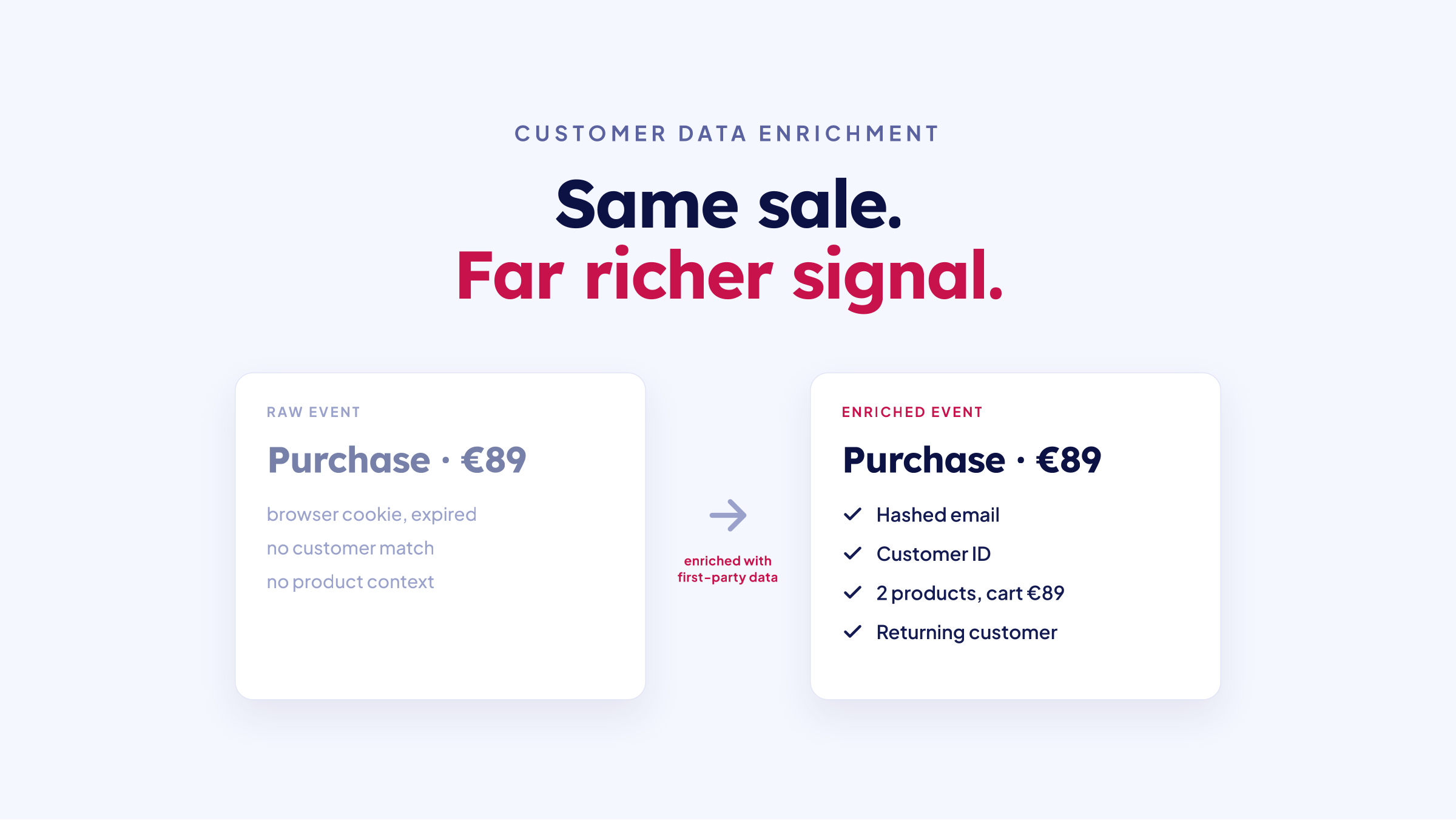
Server-side tracking also enables data enrichment - adding first-party data like email addresses, customer IDs, and UTM parameters to events before they're sent to advertising platforms. Enriched events dramatically improve matching rates and attribution accuracy.
To understand how this works within the context of full-funnel tracking, see: Full-funnel tracking for Shopify: how does it work?
Side-by-Side Comparison
| Client-Side Tracking | Server-Side Tracking | |
|---|---|---|
| Where data is collected | Visitor's browser | Your web server |
| Blocked by ad blockers | Yes - 30–40% of users | No - no browser dependency |
| Affected by iOS/ATT | Yes - significant data loss | Minimal impact |
| Cookie dependency | High - cookies required for attribution | Low - uses first-party identifiers |
| Safari ITP | Yes - 7-day cookie expiry | Not affected |
| Data quality | Incomplete, fragmented | Complete, enriched |
| Website performance | Adds load time per script | No meaningful impact |
| Implementation | Simple to add | Easy with TrackBee; complex without |
| Maintenance | Low initially; drift over time | None with TrackBee |
| Long-term reliability | Declining | Growing |
| Privacy compliance | Cookie-dependent | First-party data based |
Why the Gap Matters
The difference between client-side and server-side isn't just a data completeness issue - it's a campaign performance issue.
Platform learning requires complete signals
Meta's and Google's ad algorithms are machine learning systems. They learn which users convert by analyzing the pattern of events they receive. If your pixel only sends 65% of your purchase events, the algorithm is learning from incomplete training data. It builds inaccurate audience models. It bids less confidently. It targets users who look like your partial data set - not your actual best customers.
Complete data doesn't just improve reporting. It improves the algorithm's ability to find and target high-value customers. That's a direct ROAS lever.
Event Match Quality determines targeting precision
Meta uses Event Match Quality (EMQ) as a proxy for how accurately they can link your events to real people in their system. Client-side tracking typically produces EMQ scores in the 3–6 range. Server-side tracking with first-party data enrichment - email, name, IP - pushes EMQ scores to 7–9.
Higher EMQ = better audience matching = more efficient ad spend. Read more in our guide: How to improve Meta's Event Match Quality score.
Attribution gaps misallocate budget
When conversions aren't tracked, you can't see which campaigns, ad sets, or creative drove them. Channels that appear to underperform might actually be driving real conversions - they're just not being attributed correctly. Decisions made on incomplete attribution data lead to misallocated budgets: underfunding what works, continuing what doesn't.
Klaviyo flows don't trigger
Client-side tracking failures hit email marketing too. If your Shopify store's browse abandonment and cart abandonment events don't fire consistently, your Klaviyo flows simply don't trigger. That's abandoned cart revenue that's never recovered. Full server-side event coverage fixes this - see our guides to fixing Klaviyo browse abandonment and Klaviyo abandoned cart flows.
The Shopify-Specific Tracking Problem
Shopify stores face additional tracking challenges that make the client-side vs server-side decision especially consequential.
Shopify's checkout environment
limits what custom JavaScript can run on thank-you pages. This creates gaps precisely at the moment that matters most - purchase confirmation. Server-side tracking captures these purchase events directly from Shopify's order data, regardless of what happens on the client.
Cross-device customer journeys
are common in e-commerce. A customer browses on their iPhone during their commute, returns on their work laptop, and purchases. Client-side tracking with cookie-based identity has no way to connect those sessions. Server-side tracking with shopper profile enrichment can recognize that customer across both sessions - giving your platforms accurate attribution and your Klaviyo flows the right triggers.
Multiple tracking scripts
compound problems. Most Shopify stores run 5–15 tracking scripts. Each one adds load time. Each one creates another point of failure. Server-side tracking consolidates data collection, reducing browser script load and the failure surface.
How TrackBee Combines Both Approaches
The most effective tracking setup isn't purely client-side or purely server-side - it's both, working together with automatic deduplication.
TrackBee's approach:
Client-side tracking continues - your existing pixels and tags keep running as normal
Server-side tracking runs in parallel - TrackBee captures events at the server level, independent of browser conditions
Automatic deduplication - TrackBee ensures each event is sent to advertising platforms exactly once, even when captured by both methods simultaneously
Session enrichment - TrackBee builds persistent Shopper Profiles that connect events across sessions and devices, enriching each event with first-party data before it's sent to platforms
The result: maximum event coverage (from both methods) with maximum data quality (from enrichment) and zero duplication (from deduplication).
This is what makes TrackBee different from generic server-side solutions. It's built specifically for Shopify, installs in five minutes, and requires no ongoing maintenance. Learn more about what server-side tracking is and how to install it for Shopify.
Real Results: Petrol Industries Doubles Meta ROAS
Petrol Industries, a Shopify fashion brand, was running standard client-side tracking. Their Meta Event Match Quality Score sat at 3.5–5.5 out of 10 - indicating significant data loss and poor platform matching. They noticed consistent discrepancies between Shopify order data and what Meta and Google reported.
After implementing TrackBee's server-side tracking and session enrichment:
Meta ROAS increased by 100% - effectively doubling return on Meta ad spend
Google Ads ROAS improved by 20%
Meta EMQ jumped to 7–8.5 out of 10 - dramatically improving audience targeting
Conversion attribution gaps closed - Shopify and platform data now aligned
The improvement came entirely from data quality - not from changing their ads, creative, or bidding strategy. Better data → better platform training → better campaign performance.
Frequently Asked Questions
Can I run client-side and server-side tracking at the same time? Yes - and you should. The hybrid approach (both running simultaneously with deduplication) gives you the best of both: maximum event coverage and data quality. TrackBee handles this automatically.
Will switching to server-side tracking break my existing tracking setup? No. TrackBee works alongside your existing pixels and tags. It doesn't replace or remove your client-side tracking - it augments it.
Is server-side tracking more expensive? TrackBee's plans are designed to pay for themselves through improved ad performance. The ROAS improvements that come from better data typically far exceed the cost of the platform.
Does server-side tracking work with Google Analytics 4? Yes. TrackBee captures server-side events and sends them to GA4 via the Measurement Protocol, giving you more complete data in your analytics. Read more about TrackBee's GA4 integration. If you're evaluating GA4-focused tracking tools, our comparison of Littledata alternatives covers the difference between analytics-first and ad-platform-first solutions.
How long until I see the difference? Most TrackBee users see measurable data improvements within 24–48 hours of installation. Campaign performance improvements - as your platforms retrain on the better data - typically become visible within 2–4 weeks.


.png)