.png)


Short answer: Apple's iOS and Safari changes, including App Tracking Transparency and Intelligent Tracking Prevention, strip click IDs and shorten cookie lifetimes, which most DTC stores feel hard given heavy iOS traffic. Server-side tracking collects events through your server instead of the browser, so it keeps delivering attribution and platform learning that these privacy features otherwise break.
Apple has made a series of privacy-focused changes to iOS and Safari that collectively make tracking iPhone users significantly harder. For Shopify stores with meaningful iOS traffic - which is most DTC brands - these changes have a direct impact on attribution, platform learning, and campaign efficiency.
This guide explains exactly what changed, why it matters for your Meta and Google campaigns, and what server-side tracking does to mitigate the impact.
The iOS Privacy Changes That Affect Tracking
Apple has introduced multiple overlapping privacy features across iOS and Safari updates that affect ad tracking:
App Tracking Transparency (ATT) Introduced with iOS 14.5, ATT requires any app (including the Facebook app, Instagram app, and the Safari browser) to explicitly ask users for permission to track them "across apps and websites owned by other companies." Most users decline this permission prompt. The result: a large majority of iOS app users have opted out of cross-app tracking.
Safari Intelligent Tracking Prevention (ITP) Safari on iOS (and macOS) limits the lifetime of cookies set by JavaScript. First-party cookies set by JavaScript are limited to 7 days. After 7 days, the cookie expires. A customer who visited your store on day 1 and returns on day 8 - in the same browser, on the same device - is treated as a new visitor by cookie-dependent tracking.
Link Tracking Protection (iOS 17+) Apple introduced Link Tracking Protection in iOS 17, initially for Safari Private Browsing, iMessage, and Mail. This feature strips user-specific tracking parameters from URLs when links are shared between apps. The specific parameters stripped include:
-
fbclid- Facebook/Meta click ID -
gclid- Google click ID -
twclid- Twitter click ID -
msclkid- Microsoft Ads click ID -
mc_eid- Mailchimp email ID
These click IDs are the identifiers that connect an ad click to a subsequent conversion. When they're stripped from the URL, attribution can't link the conversion back to the ad.
Safari Advanced Tracking and Fingerprinting Protection When users enable "Advanced Tracking and Fingerprinting Protection" in Safari settings, Safari functions more like privacy-focused browsers (Brave, Firefox Focus) - blocking URL parameters, tracking scripts, and cookies by default. This is a more extreme setting, but its availability influences the direction of future default behavior.
iOS 26 Link Tracking Protection (2026) Apple is expanding Link Tracking Protection in iOS 26. What started as a Safari Private Browsing feature in iOS 17 is being extended to more contexts across the operating system. Click ID stripping (fbclid, gclid, ttclid) is becoming more aggressive and applies in more browsing scenarios. For Shopify advertisers relying on click-level attribution, this makes server-side tracking and first-party data enrichment even more critical - the click IDs that survive to the landing page are shrinking, while server-side Shopper Profiles preserve attribution regardless.
What's Actually Being Blocked
The combined effect of these features:
For your Meta Pixel:
-
iOS users who've declined ATT: Meta's Pixel cannot run in Meta's own apps. Click IDs from Meta ad clicks are stripped on iOS 17 in Safari Private Browsing and Messages.
-
iOS users browsing in Safari: ITP limits the Pixel's ability to maintain cookie-based identity across sessions beyond 7 days.
-
Practical result: A meaningful share of iOS-originating conversions either don't reach Meta's Pixel at all, or can't be attributed to the originating ad click.
For your Google Tag:
-
gclid parameters are stripped by iOS 17's Link Tracking Protection in Safari Private Browsing.
-
Google's cross-site tracking is limited by ITP on Safari.
-
Google Analytics 4 sessions from iOS users are fragmented - each visit after 7 days appears as a new user.
For your Klaviyo flows:
-
Klaviyo tracks browser sessions using cookies. When iOS/Safari limits cookie lifetime to 7 days, a customer who visited last week and hasn't been back is essentially anonymous when they return. Their "Viewed Product" or "Added to Cart" events can't be connected to their Klaviyo profile.
-
The practical effect: browse abandonment and cart abandonment flows may not trigger for iOS customers whose sessions have expired.
The Business Impact on Your Campaigns
iPhones represent a disproportionate share of Shopify traffic for most DTC brands. Fashion, beauty, lifestyle - these categories over-index on iOS users. The tracking limitations aren't a fringe problem.
Platform learning degradation: Both Meta and Google use conversion events to train their bidding algorithms. If 30–40% of your conversions - disproportionately from iOS users - don't reach the platforms, the algorithms learn from a biased sample. They optimize toward desktop and non-Apple users because that's the population they're seeing conversions from.
Over time, this means campaigns spend less efficiently on iOS traffic - not because iOS users don't convert, but because the algorithm hasn't seen evidence that they do.
Attribution gaps: iOS-originating conversions that don't reach your ad platforms appear in Shopify as orders without attributed ad spend. This creates a systematic gap between platform-reported ROAS and actual business ROAS. The gap is real money that's being unattributed - and it affects budget decisions.
Email flow failures: Browse and cart abandonment flows that don't fire for iOS customers represent a specific, quantifiable revenue loss. The customer was on your site. They had behavioral intent. But the Klaviyo session expired before they triggered the flow - or the event didn't fire at all.
What Server-Side Tracking Recovers
Server-side tracking addresses the iOS problem at the infrastructure level:
Event capture that doesn't depend on browser permissions: TrackBee captures events at the server level - from Shopify's backend, independent of what the visitor's browser allows or blocks. A customer who has declined ATT, is using Safari with ITP active, and has an ad blocker running still generates a Shopify order when they purchase. TrackBee captures that purchase event from the Shopify backend and sends it to Meta, Google, and Klaviyo via server-side APIs.
The customer's browser blocking didn't prevent the event. Server-side capture is orthogonal to browser permissions.
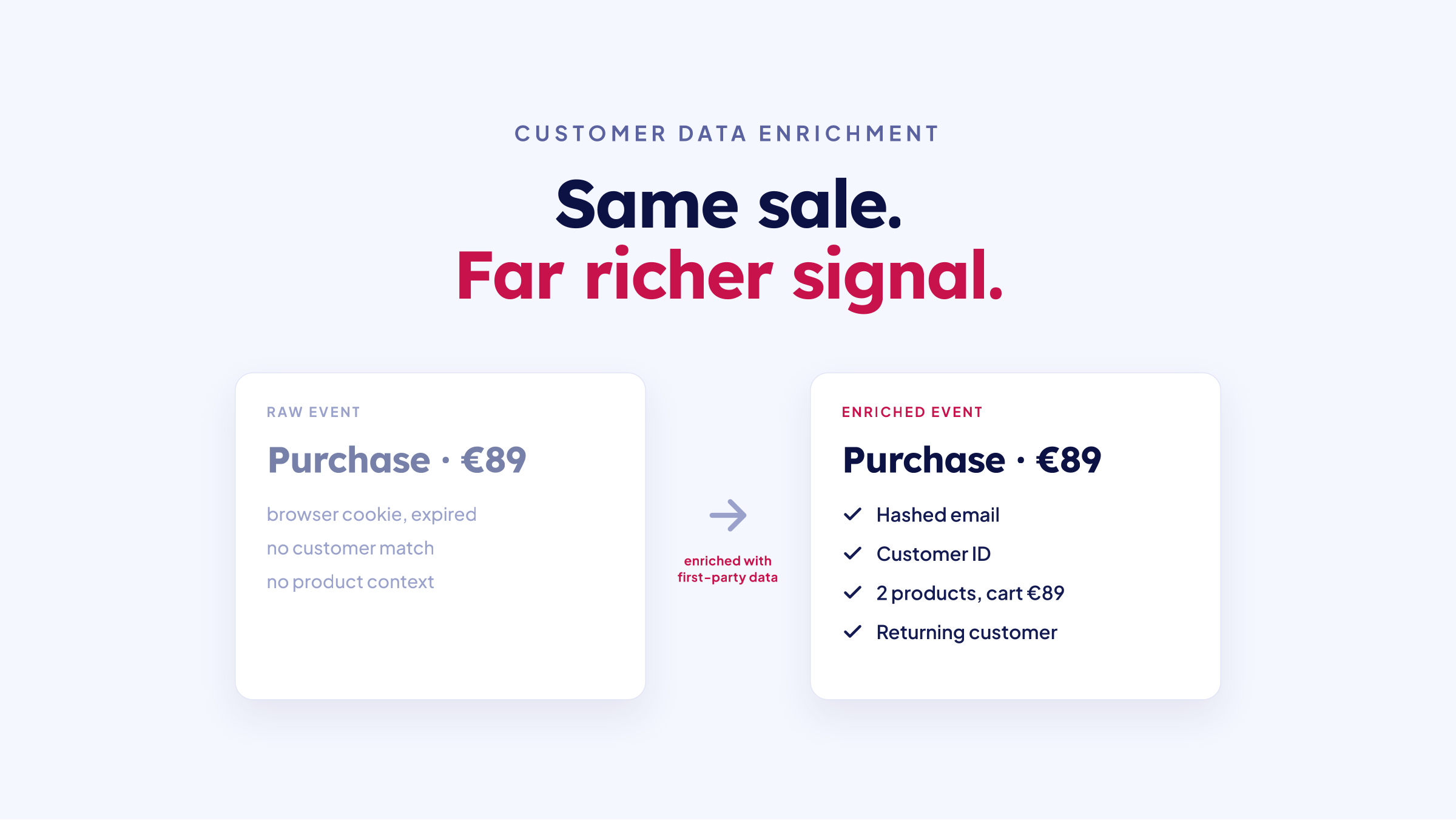
First-party data enrichment: When an event is captured server-side, TrackBee enriches it with all available first-party data from the customer's Shopper Profile: hashed email, name, IP address, and any click IDs stored from the original ad interaction.
The critical case: if a customer clicked a Meta ad (receiving a fbclid), that fbclid is stored in their Shopper Profile at the time of the click. When they purchase 3 days later on a different session - after the fbclid has been stripped or the session has expired - TrackBee's profile still contains the original fbclid. The purchase event is sent to Meta with that fbclid attached, correctly attributing the conversion to the original ad interaction.
This is the mechanism that allows server-side tracking to restore attribution that iOS restrictions would otherwise break.
Persistent cross-session identity: TrackBee's Shopper Profiles persist beyond Safari's 7-day cookie limit. A customer who visits on day 1 and returns on day 10 is recognized by TrackBee's profile - not as a new visitor, but as a returning customer whose behavioral history and identity is known. Their actions on day 10 are attributed to the correct profile and can trigger Klaviyo flows correctly.
Practical Steps to iOS-Proof Your Tracking
Step 1: Enable server-side tracking Install TrackBee to run server-side event capture alongside your existing client-side pixels. This captures the events that iOS restrictions prevent your browser-based tracking from capturing.
Step 2: Enable Meta's Conversions API (via TrackBee) Meta's Conversions API sends events server-to-server, bypassing browser restrictions entirely. TrackBee handles this connection automatically. Ensure deduplication is configured so Meta receives each event once.
Step 3: Verify your Meta Aggregated Event Measurement setup Meta's AEM allows you to prioritize up to 8 conversion events for reporting within iOS privacy constraints. Make sure "Purchase" is your highest-priority event. This is configured in Meta Events Manager under Data Sources.
Step 4: Enable Google Enhanced Conversions Enhanced Conversions use hashed email addresses to match conversions to Google users - bypassing the gclid limitation for users who are logged into Google accounts. This partially recovers iOS attribution for Google campaigns. TrackBee's Conversion Booster implements Enhanced Conversions server-side. See: The ultimate guide to Google Enhanced Conversions.
Step 5: Monitor the gap Compare your Shopify order volume to what Meta and Google report. The gap (Shopify orders minus platform-reported conversions, accounting for expected cross-attribution) is a rough indicator of your tracking loss. After implementing server-side tracking, this gap should narrow measurably within 48–72 hours.
Frequently Asked Questions
Will Apple's tracking restrictions get stricter over time? Yes - and iOS 26 confirms this. The trajectory has consistently been toward more restriction, not less. Each iOS update since iOS 14 has added or strengthened privacy features, and iOS 26 extends Link Tracking Protection to more browsing contexts. Planning your tracking infrastructure around the assumption that restrictions will only increase is the right long-term posture.
Does server-side tracking violate Apple's privacy policies? No. Server-side tracking captures first-party data (from your own store's backend) and processes it server-side without relying on the client-side tracking mechanisms that Apple restricts. TrackBee's approach uses first-party data principles and is compatible with Apple's privacy framework.
Should I remove my Meta Pixel now that I have server-side tracking? No. Keep the Meta Pixel running. The hybrid approach (Pixel + Conversions API via TrackBee, with deduplication) gives you maximum event coverage. The Pixel captures events that it can; the server-side API captures what the Pixel misses. Remove neither.
How much iOS traffic does my store actually have? Check Google Analytics 4 under Reports > Tech > Device category or platform. You'll see the breakdown of iOS vs. Android vs. Desktop. For most DTC brands in fashion, beauty, and lifestyle, iOS represents 50–70% of mobile traffic. Mobile typically represents 60–70% of total Shopify traffic.
Does iOS tracking loss affect my Google Analytics data? Yes. GA4 sessions from iOS Safari users fragment after 7 days due to cookie expiration. Returning iOS visitors appear as new users after the cookie limit. This inflates your "new user" count and makes retention metrics look worse than they are. Server-side event tracking via GA4 Measurement Protocol partially addresses this.


.png)