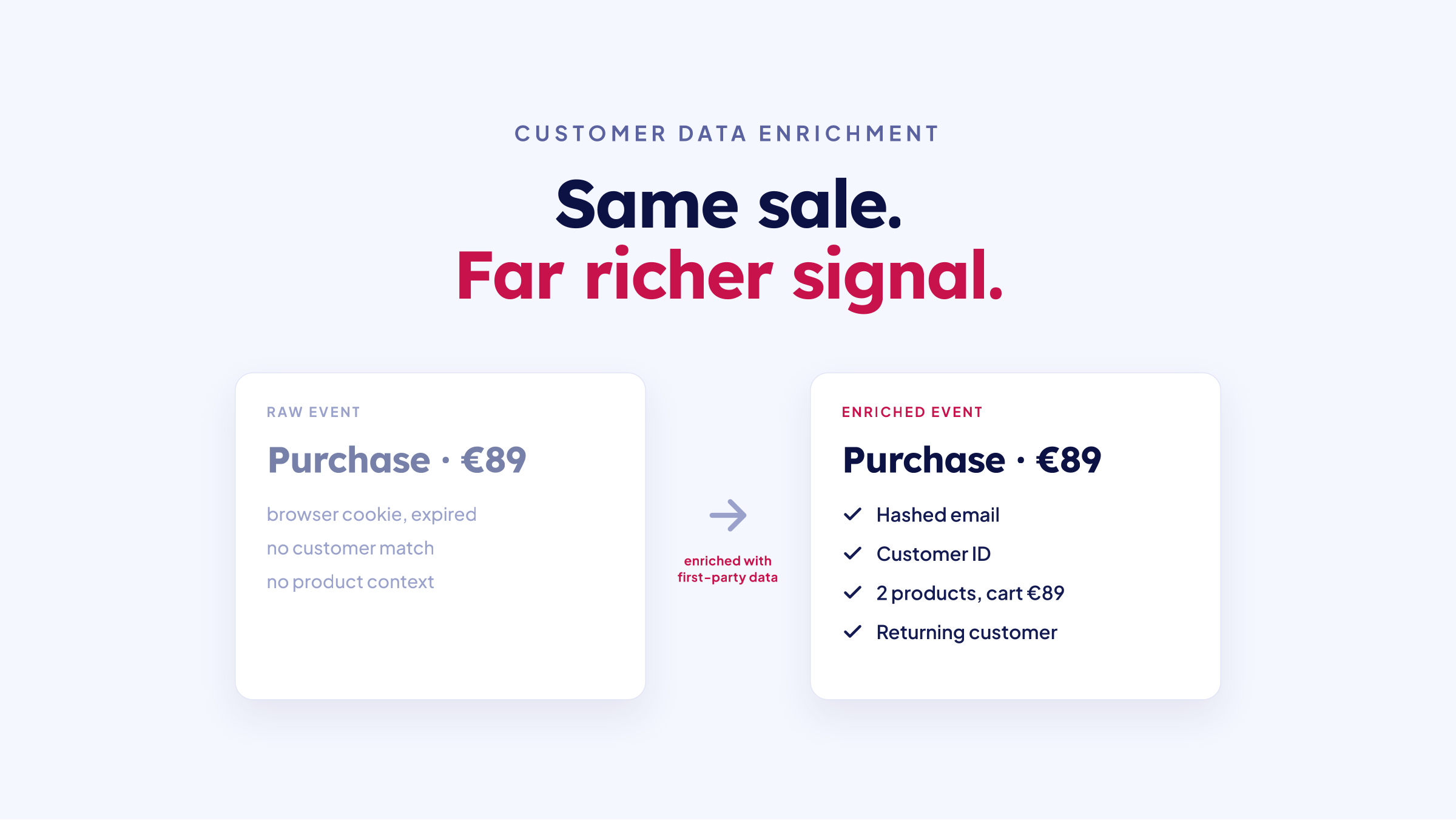
Short answer: Server-side tracking recovers the 30 to 40 percent of conversion data that ad blockers, iOS restrictions and cookie limits strip from client-side tracking, capturing events at the server level where browsers cannot block them. That complete data improves campaign performance, audience targeting and email revenue. This guide covers nine concrete benefits Shopify stores see after switching.
Tracking has a data loss problem. Ad blockers, iOS privacy restrictions, and cookie limitations are silently removing 30–40% of your conversion events before they ever reach Meta, Google, or Klaviyo. That loss isn't just a reporting issue - it's actively degrading your campaign performance, your audience targeting, and your email marketing revenue.
Server-side tracking fixes this at the root. Here are the nine concrete benefits Shopify stores see after making the switch.
1. Complete Data Collection: Recover What You're Losing
The most immediate benefit of server-side tracking is simple: you stop losing data.
With client-side tracking, roughly 30–40% of your conversion events are intercepted by ad blockers, suppressed by iOS privacy settings, or lost to browser restrictions before they reach your advertising platforms. Every missed purchase event is a signal your ad algorithm never receives. Every missed add-to-cart is a potential email trigger that never fires.
Server-side tracking captures these events at the server level - independent of what's happening in the visitor's browser. Ad blockers can't intercept server-to-server communication. iOS can't restrict it. Safari's ITP has no effect on it.
The real-world impact: TrackBee customers typically see 30–40% more events captured compared to client-side tracking alone. That additional data directly feeds your ad platforms, improving their ability to optimize your campaigns.
For a detailed breakdown of why client-side tracking fails, see: Client-side vs server-side tracking: essential differences for Shopify stores.
2. Session Enrichment: Build Customer Profiles That Last
Beyond recovering lost events, server-side tracking makes each event more valuable.
TrackBee builds persistent Shopper Profiles for every visitor to your Shopify store. Each profile accumulates data across multiple sessions and devices, regardless of browser limitations:
-
Click IDs (fbclid, gclid, ttclid)
-
Email addresses and customer identity
-
First and last name
-
IP addresses and device fingerprints
-
UTM parameters (source, medium, campaign)
-
Session history and behavioral patterns
The practical effect: when a customer browses your store on their phone, leaves without purchasing, and returns three days later on their laptop to buy - TrackBee connects those events. Platforms receive accurate attribution. Your Klaviyo flows fire for the right people. Your algorithms understand the complete customer journey.
This is what separates session enrichment from basic event capture. You're not just tracking more - you're tracking better.
3. Better Ad Targeting: Feed the Algorithm What It Needs
Platform algorithms - Meta's, Google's, TikTok's - are machine learning systems. They optimize campaigns by learning patterns from your conversion data. The quality of that learning depends entirely on the quality of the input data.
When 30–40% of your purchase events are missing, the algorithm is working with corrupted training data. It builds audience models based on the subset of customers whose events got through. That's not a representative sample - it's a biased one, skewed toward users who happen not to use ad blockers or iOS devices.
Complete server-side data gives algorithms the full picture. They build more accurate lookalike audiences. They bid more confidently on high-intent signals. They allocate budget to the placements and audiences that actually convert.
Meta-specific: Higher-quality event data improves your Event Match Quality Score - Meta's measure of how accurately they can link your events to real users. EMQ scores typically jump from 3.5–5.5 (client-side only) to 7–8.5 (with TrackBee's enriched server-side data). Higher EMQ = better audience matching = more efficient ad spend.
Read the full breakdown: How to improve Meta's Event Match Quality score.
4. Increased Email Marketing Revenue
Klaviyo's power depends entirely on the quality of the event triggers feeding it. Browse abandonment flows, cart abandonment sequences, and post-purchase campaigns only fire when the underlying tracking events are captured reliably.
With client-side tracking, browse and cart abandonment events are among the most frequently lost - they depend on JavaScript firing correctly in the visitor's browser at the exact moment they leave. Ad blockers, consent denials, and browser restrictions make this consistently unreliable.
Server-side tracking captures these events at the server level, independent of browser conditions. The result:
-
More browse abandonment triggers → more emails sent → more revenue recovered
-
More cart abandonment triggers → larger abandoned cart audiences → better flow performance
-
Cross-device identity resolution → reach customers even when they switch devices between browsing and purchasing
Real result: HoneyBalm tracked 171% more Add to Cart events after implementing TrackBee. Their abandonment revenue increased by 213% through Klaviyo.
See the tactical guide: How to improve your Klaviyo browse abandonment flow and recover more revenue.
5. Improved Website Performance
Every client-side tracking script your store runs is additional work for your visitor's browser. Multiple pixels loading simultaneously - Meta, Google, TikTok, Pinterest - contribute to slower page loads, higher Cumulative Layout Shift (CLS), and increased Total Blocking Time (TBT).
These performance metrics have direct consequences: 54% of users abandon a website that takes more than 3 seconds to load. Slower stores convert worse and rank lower in Google Search.
Server-side tracking reduces the script load on your visitors' browsers. With TrackBee, one of our customers saw their performance improve measurably:
-
Cumulative Layout Shift dropped from 0.635 to 0.154
-
Total Blocking Time decreased from 3,472ms to 2,101ms
Better Core Web Vitals mean better user experience, lower bounce rates, and potentially higher organic search rankings - a secondary benefit of a tracking decision.
6. Easy Installation, Zero Maintenance
Traditional server-side tracking was a technical project. Setting up a server-side container in Google Tag Manager, configuring a Cloud Run server, managing integrations with each platform - it required developer time, ongoing maintenance, and specialist knowledge that most Shopify teams don't have. If you're currently evaluating GTM-based setups like Stape, our Stape alternatives guide compares the operational overhead with purpose-built solutions.
TrackBee was built specifically to remove that complexity. Installation takes five minutes:
-
Create your TrackBee account
-
Connect your Shopify store
-
Install the TrackBee app
-
Connect your ad platforms (Meta, Google, TikTok, Pinterest, Klaviyo)
No server setup. No container configuration. No ongoing maintenance. TrackBee updates automatically and handles all platform API changes in the background.
For Shopify stores without dedicated technical teams - and for agencies managing multiple Shopify clients - this is the difference between server-side tracking being theoretical and being actually implemented.
Learn how it works: What is server-side tracking and how to install it for Shopify.
7. Shopify-Native Integration
Generic server-side tracking solutions weren't built for Shopify. They're built for generic web infrastructure, and adapting them to Shopify's architecture - its checkout flow, its app ecosystem, its specific event naming conventions - requires significant custom engineering.
TrackBee was built from the ground up for Shopify. That specificity matters:
-
No conflicts with existing Shopify apps - TrackBee works alongside your current app stack without interference
-
Shopify checkout compatibility - TrackBee captures purchase events correctly, including within Shopify's restricted checkout environment
-
Event naming alignment - events are formatted correctly for each platform's requirements by default
-
No replacement of existing tracking - TrackBee augments your existing setup rather than replacing it, minimizing disruption
The result is a tracking setup that's more reliable, more compatible, and easier to maintain than any generic alternative.
8. Immediate, Measurable Impact
Many marketing investments take months to show measurable results. Server-side tracking is different - improvements are visible within 24–48 hours of installation.
What you'll typically see within the first two days:
-
More events in your ad platforms - conversion totals increase as previously missed events are now captured
-
Improved Meta Event Match Quality - EMQ scores start rising as enriched first-party data reaches Meta
-
More Complete Google Enhanced Conversion coverage - Google receives more complete conversion data for better attribution
-
More Klaviyo flow triggers - abandonment flows fire for more customers
Campaign performance improvements - as your platforms retrain their algorithms on the better data - typically become visible within 2–4 weeks. But the data quality improvement is immediate.
9. Future-Proof Tracking
The regulatory and technological direction of travel is clear: browsers are restricting cookies, Apple is tightening privacy controls, and regulators are adding compliance requirements. The client-side tracking model that worked for the past decade is under sustained pressure.
Google ultimately reversed its plan to deprecate third-party cookies in Chrome, opting instead for a user-choice model - but the Privacy Sandbox experiment proved that the industry is moving toward first-party data regardless. Apple's ATT framework has already fundamentally changed iOS tracking, and iOS 26 expands Link Tracking Protection to strip click IDs from URLs across more apps and contexts. Google Consent Mode V2, enforced since July 2025, requires explicit consent signals for data processing in the EEA. The GDPR, CCPA, and equivalent regulations require explicit consent before many forms of tracking can occur.
Server-side tracking based on first-party data is the architecture that works within this environment. It doesn't depend on third-party cookies. It doesn't rely on browser permissions. It collects data through direct server-to-server communication using first-party identifiers.
TrackBee's team continuously monitors platform API changes and regulatory developments, updating the platform automatically so your tracking stays accurate and compliant without any action on your part.
The Compound Effect
These nine benefits don't operate independently - they compound.
Better event coverage → better algorithm training → better targeting → higher ROAS.
More enriched data → higher Meta EMQ → more accurate audience matching → lower CPAs.
More complete Klaviyo triggers → more abandonment emails → more recovered revenue.
Better website performance → lower bounce rates → more conversions from existing traffic.
The full picture: Petrol Industries doubled their Meta ROAS after implementing TrackBee. Their Google Ads ROAS improved by 20%. Their EMQ went from 3.5–5.5 to 7–8.5. None of those improvements came from changing their ads, creative, or strategy - they came purely from having better data.
Frequently Asked Questions
How quickly will I see improvements in my ROAS after installing TrackBee? Data improvements are visible within 24–48 hours. Campaign performance improvements - as platforms retrain on better data - typically become visible within 2–4 weeks. Most customers see measurable ROAS improvements within the first month.
Does server-side tracking help with Google Ads as well as Meta? Yes. TrackBee integrates with Google Enhanced Conversions, TikTok Events API, Pinterest CAPI, and Klaviyo - in addition to Meta's Conversions API. All platforms benefit from better event coverage and enriched data. See our Google Enhanced Conversions guide.
Will my existing tracking continue to work alongside TrackBee? Yes. TrackBee is designed to complement your existing client-side tracking, not replace it. Both run simultaneously, with TrackBee handling deduplication to prevent double-counting.
How does server-side tracking improve Klaviyo specifically? Server-side tracking captures browse abandonment and cart abandonment events that client-side tracking frequently misses. More captured events mean more Klaviyo flow triggers, which means more abandonment emails sent and more revenue recovered.
Is TrackBee only for large Shopify stores? No. TrackBee offers plans for stores of all sizes. Any store running paid ads on Meta, Google, TikTok, or Pinterest - or using Klaviyo for email flows - benefits from better event coverage.


.png)