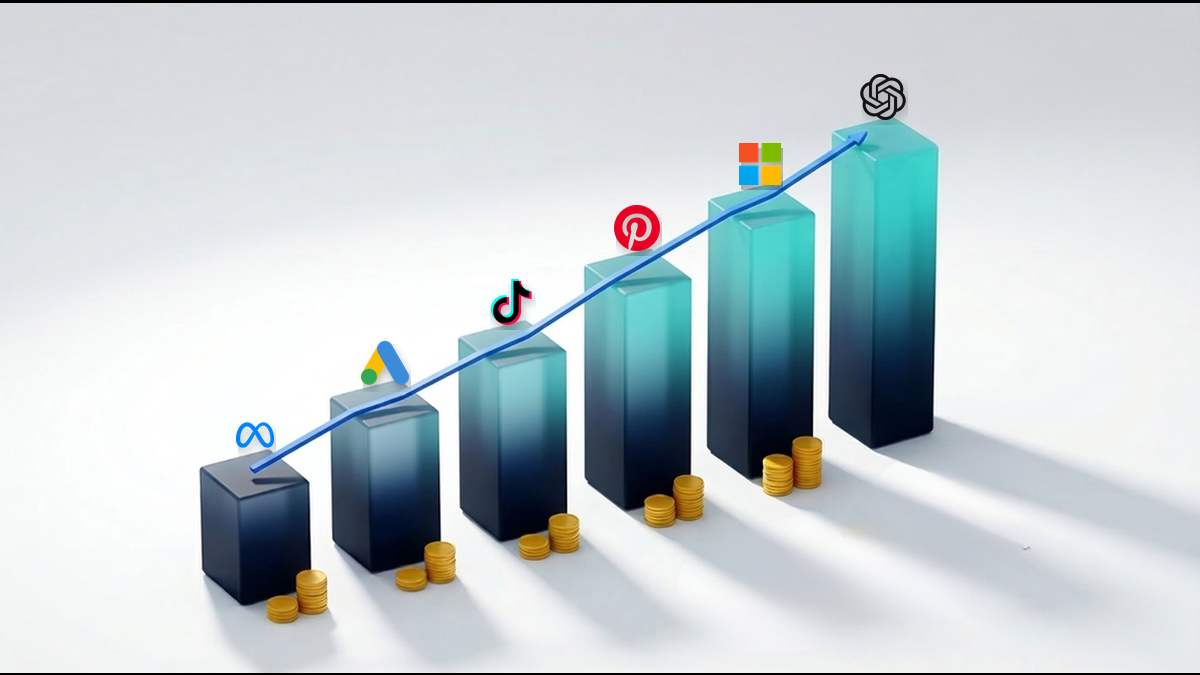

Across the major ad platforms in 2026, CPMs run from roughly €3 on the cheap end (Pinterest, Google Display, Microsoft) to over €20 on ChatGPT's new ad surface, and CPCs span €0.40 for EU ecommerce search to €4 or more on competitive Google and ChatGPT placements. There is no single "cheapest platform" answer, because cost only makes sense next to intent: a €10 TikTok impression and a €0.40 Google search click buy completely different things. This guide puts all six platforms side by side in one matrix, explains how to read the numbers, and shows why the tracking behind your campaigns now matters as much as the bid.
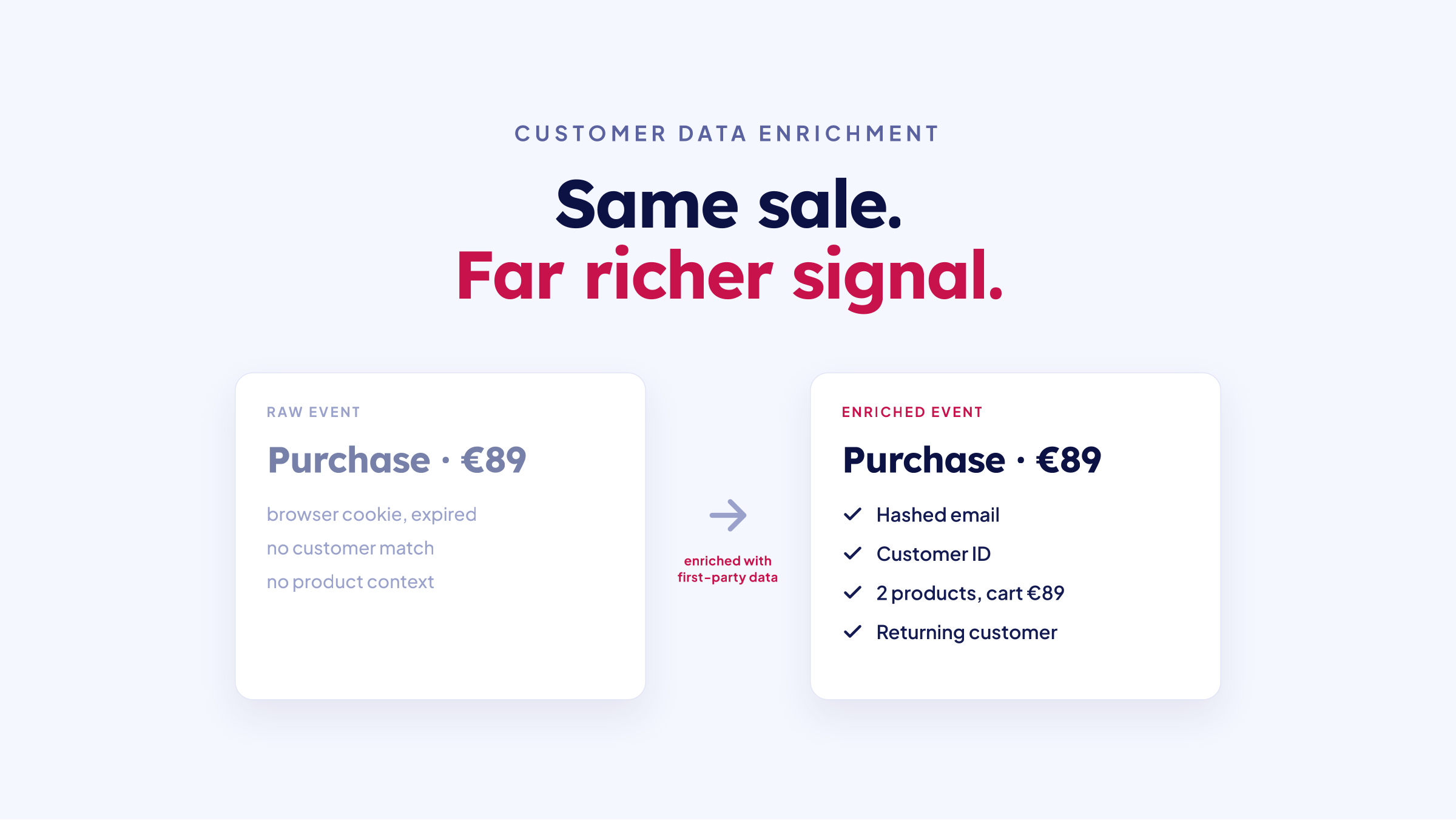
This is the gap TrackBee closes. It captures your conversions server-side and enriches them with first-party data, so every platform sees the sales the browser pixel misses and the cost per acquisition you compare here is the real one.
All figures below are EUR, converted from source data at roughly 1 USD to €0.87 (late-June 2026 spot). They are cross-industry ranges for Shopify DTC brands and the agencies that run them. Where reputable sources disagree, we show a range rather than invent an average.
The 2026 Ad Cost Matrix
Here is the side-by-side view most cost guides never give you: CPM, CPC, test budget, intent, creative demand, and the best-fit use for a Shopify DTC brand, across all six platforms in one table.
| Platform | CPM (€) | CPC (€) | Typical test budget | Audience intent | Creative requirement | Best-fit use for a Shopify DTC brand |
|---|---|---|---|---|---|---|
| Meta (FB + IG) | [€9.50–€12.50 (ecom ~€12)](https://sovran.ai/benchmarks/meta-ads-cpm-by-industry) | €0.65–€1.65 | €18–€45/day (~€450–€900/mo); €90+/day for a strong test | Discovery and social, low-to-mid intent | High volume of native UGC, video and static, frequent refresh | Prospecting and retargeting workhorse with the broadest reach |
| Display ~€2.70 (Search is CPC-led) | [EU ecom search €0.38–€0.44](https://smarter-ecommerce.com/en/smec-market-observer/metrics/cpc/); [US blended €2.60–€4.60](https://localiq.com/blog/search-advertising-benchmarks/) | €10–€45/day (~€920–€2,300/mo for SMB) | High intent on Search, discovery on Display and PMax | Search copy and feed; Shopping and PMax need a product feed | Capturing existing demand and product-led Shopping | |
| TikTok | [~€10 (ecom)](https://www.triplewhale.com/blog/tiktok-benchmarks) | [~€1.00](https://www.digitalapplied.com/blog/tiktok-ads-benchmarks-2026-cpc-cpm-cvr-industry) | ~€45/day campaign min (≥€500/mo to test well) | Entertainment and discovery, low intent, high scroll | Native sound-on short video, creator style, fast iteration | Top-of-funnel demand creation for demoable products |
| €3–€8 | [€0.45–€1.30 (avg ~€0.72)](https://adbacklog.com/blog/pinterest-ads-benchmarks-per-industry-2025) | €9–€45/day; ≥€18/day for conversion campaigns | Planning and discovery, mid intent and purchase-oriented | Vertical pins, lifestyle imagery, shoppable product pins | Cheap discovery for home, beauty, fashion and food brands | |
| Microsoft (Bing) | ~€3 (Audience Network) | [€1.20–€1.35 (~30–40% under Google)](https://searchlab.nl/en/statistics/microsoft-ads-statistics-2026) | €5–€10/day; ~€435/mo | High intent on Search, older and higher-income | Search copy and feed, importable from Google Ads | Cheap incremental search clicks for margin-sensitive brands |
| ChatGPT | ~€22–€52 (estimate, falling) | ~€2.60–€4.35 (estimate) | No minimum spend (self-serve) | Conversational, high intent inside the answer | Sponsored results and product-feed shopping ads | Early-mover bet on in-chat shopping demand |
Read this matrix as ranges, not gospel. The cheap-CPM story belongs to Pinterest, Google Display, and Microsoft, all clustering around €3. TikTok sits near €10, comparable to Meta, so it is not the bargain its reputation suggests. ChatGPT's numbers are early auction estimates and will move.
How to Read These Numbers
Three metrics carry most of the weight, and confusing them is the most common budgeting mistake.
CPM (cost per 1,000 impressions)
measures how expensive it is to be seen. It is the right lens for awareness and top-of-funnel work, and it is what makes Pinterest and Display look cheap. A low CPM only matters if those impressions reach people who might buy.
CPC (cost per click)
measures the price of an actual visit. Search platforms (Google, Microsoft, increasingly ChatGPT) sell primarily on CPC because a click there signals real interest. A €4 Google search click can be a better deal than a €0.50 social click if the searcher is ready to buy.
CPA (cost per acquisition)
is the only number that pays your bills, and none of the CPM or CPC figures above predict it on their own. CPA is CPC divided by conversion rate, so a platform with expensive clicks and high intent can deliver a lower CPA than a cheap-click, low-intent one.
The reason platforms are not directly comparable is intent. Meta, TikTok, and Pinterest interrupt people who are browsing. Google and Microsoft answer people who are actively searching. ChatGPT inserts sponsored answers into a conversation the shopper started. You are not buying impressions or clicks, you are buying a moment in someone's journey, and the price reflects how close that moment is to a purchase.
Why Ad Costs Keep Rising
Costs on most platforms have climbed around 12 percent year over year (higher in the prior year), and the drivers are structural rather than seasonal.
The biggest is signal loss. Apple's App Tracking Transparency and broader iOS privacy changes cut off a large share of cross-app tracking, with only about a third of users opting in. Ad blockers run for roughly 30 percent of users, stopping browser pixels from firing. Consent banners in the EU mean a meaningful slice of visitors are never tracked client-side at all. And third-party cookies, the connective tissue of legacy attribution, are finally deprecating.
Here is the compounding problem. When platforms lose visibility into conversions, their bidding algorithms optimize against an incomplete picture, so they bid less efficiently, waste budget on the wrong people, and need more impressions to find a buyer. That inefficiency shows up as higher CPMs and CPCs for everyone. On top of that, more advertisers are chasing the same shrinking pool of trackable users, and new AI-search surfaces are pulling spend into fresh, untested auctions.
In other words, a chunk of the rising cost you see is not real scarcity. It is platforms paying for their own blind spots, and passing the bill to you.
The Tracking Gap That Distorts Every Benchmark
Every benchmark in this guide assumes the conversions you report are the conversions that happened. For most Shopify stores running browser pixels alone, that assumption is wrong, and it quietly inflates the real cost of every platform above.
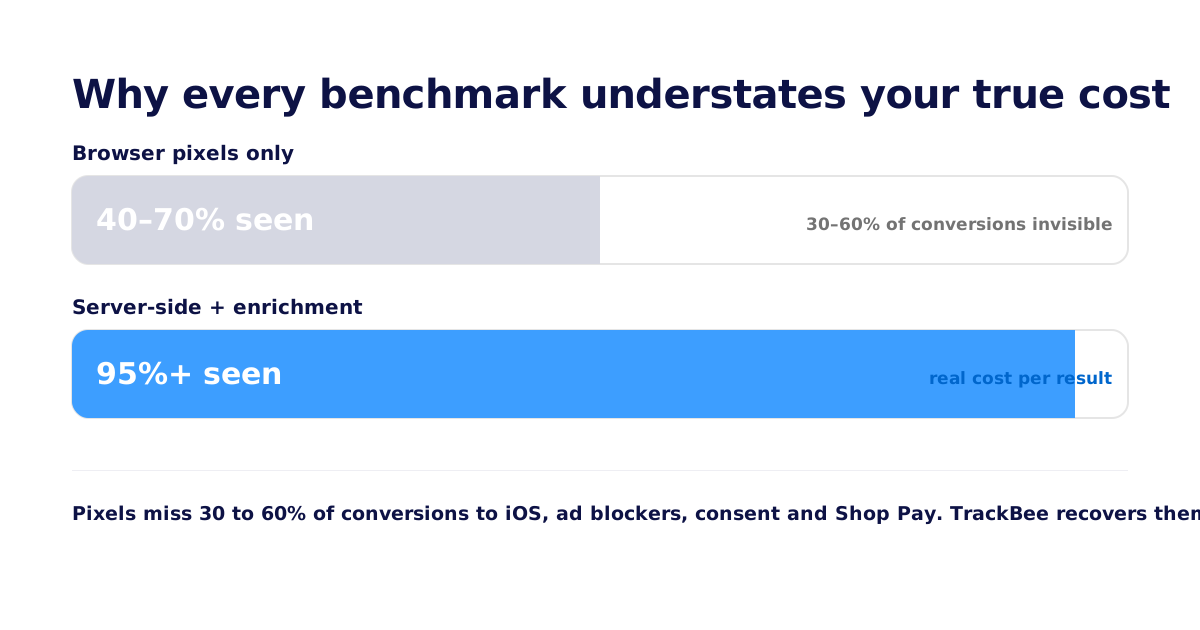
Browser-based pixels (the Meta Pixel, Google's gtag, the TikTok Pixel, the Pinterest Tag, Microsoft's UET) miss roughly 30 to 60 percent of conversions because of the exact signal loss described above: ad blockers, iOS restrictions, consent gating, and cookie expiry. When a platform's algorithm only sees half to two thirds of your buyers, it trains its targeting on an incomplete and biased sample of who actually converts. It then bids to find more people like that partial sample, not your full buyer population, so your CPA looks worse and your reported ROAS looks lower than reality.
This is the gap TrackBee closes. TrackBee captures conversion events server-side and enriches them with first-party data, then sends complete, accurate signals to Meta, Google, TikTok, Pinterest, Microsoft, and ChatGPT. Server-side delivery bypasses the browser, so the conversions pixels miss get recovered and deduplicated against existing pixel events. Each platform's algorithm then trains on real buyers rather than a tracking-limited subset, which improves match quality (such as Meta's EMQ and Google's Enhanced Conversion Coverage) and lowers effective CPA, so the benchmarks in this guide become achievable instead of aspirational. The cheapest platform on paper is whichever one your tracking lets the algorithm optimize honestly. See how TrackBee connects to each platform: Meta, Google Ads, TikTok, Pinterest, Microsoft Ads, and ChatGPT Ads.
Meta Ads Cost
Meta is the DTC workhorse, with ecommerce CPMs around €12 and CPCs from €0.65 to €1.65 depending on placement, since Facebook feeds run cheaper than Instagram. Costs swing hardest on industry and Q4 seasonality, where BFCM can push CPMs two to three times higher, and the Advantage+ Shopping algorithm rewards advertisers who feed it clean conversion data. It is the most accessible entry point of the six and pairs best with strong server-side signal for Event Match Quality.
Read the full Meta and Facebook ads cost guide for CPM and CPC by industry, budget tiers, and bidding strategy.
Google Ads Cost
Google is CPC-led, and for EU ecommerce the median search click sits around €0.38 to €0.44, far below the €2.60 to €4.60 US all-industry blended figure that headlines most benchmark reports. Display CPM runs near €2.70, and Shopping or Performance Max campaigns typically return 3 to 5 times ROAS for product-led brands. The cost ceiling is high on competitive keywords, but so is purchase intent, which is why Google captures demand the other platforms can only create.
Read the full Google ads cost guide for Search versus Shopping versus Display economics, smart-bidding, and ROAS.
TikTok Ads Cost
TikTok's CPM sits around €10 and CPC around €1.00, putting it in the same range as Meta rather than the bargain bin its reputation suggests. The platform minimum is modest, about €45 per day at campaign level and €18 per day at ad-group level, so the real cost is the practical test budget (plan on €500 or more per month) and the creative demand: native, sound-on, fast-iterating short video that the algorithm rewards with cheaper delivery when engagement is strong. It is best deployed as top-of-funnel demand creation for visually demoable products.
Read the full TikTok ads cost guide for formats, budget planning, and bidding strategy.
Pinterest Ads Cost
Pinterest is one of the genuine cheap-CPM stories, running roughly €3 to €8 CPM and €0.45 to €1.30 CPC, often 30 to 50 percent below Meta. Its audience skews female and arrives in planning mode, which makes it strong for home, beauty, fashion, and food brands, with Shopping ads as the DTC workhorse format. Treat it as a complementary discovery channel, not a Meta replacement.
Read the full Pinterest ads cost guide for formats, bidding, and budget rules.
Microsoft Ads Cost
Microsoft Advertising, formerly Bing Ads, leads on price: CPCs of €1.20 to €1.35 run roughly 30 to 40 percent cheaper than Google for search, with a CPA often roughly 20 to 30 percent lower, per industry benchmarks, thanks to lower competition rather than lower quality. The audience skews older, higher-income, and more desktop and B2B, and you can import campaigns straight from Google Ads. It is the obvious move for margin-sensitive brands wanting cheap incremental search reach.
Read the full Microsoft ads cost guide for the Google comparison, bidding, and budget setup.
ChatGPT Ads Cost
ChatGPT Ads launched on February 9, 2026 with no minimum spend, opening a self-serve auction with early CPC estimates around €2.60 to €4.35 and CPM estimates of roughly €22 to €52, both falling as inventory grows. These are auction estimates as of mid-2026, not settled benchmarks, so treat every number with caution. The notable detail for Shopify brands: server-side conversion measurement did not ship at launch. The Conversions API arrived later, around May 2026 (roughly three months after the February launch), because cookies and click IDs do not exist inside a chat.
Read the full ChatGPT ads cost guide for how the auction works, the Shopify shopping ads, and why pixel-only tracking misreads it.
Frequently Asked Questions
Which advertising platform has the cheapest ads in 2026? It depends on whether you mean impressions or clicks. For cheap impressions, the lowest CPMs belong to Pinterest, Google Display, and Microsoft's Audience Network, all clustering around €3. For cheap search clicks, Microsoft (Bing) wins, at roughly 30 to 40 percent below Google. TikTok is often assumed to be cheapest, but its CPM is around €10, comparable to Meta, so it is not the bargain its reputation suggests.
What is a good CPM in 2026? A good CPM depends entirely on the platform and the objective, so judge it against the right benchmark rather than chasing the lowest absolute number. Awareness placements on Pinterest, Display, or Microsoft can run around €3, social conversion CPMs on Meta and TikTok sit near €10 to €12, and ChatGPT's new surface can exceed €20. A low CPM on a low-intent placement is not automatically a good deal, because the only metric that matters is the cost of an actual buyer.
Meta vs TikTok vs Google, which is cheapest to advertise on? On CPC, Google's EU ecommerce search clicks (€0.38 to €0.44) are the cheapest of the three, while Meta runs €0.65 to €1.65 and TikTok around €1.00. On CPM, Meta and TikTok are close, both near €10 to €12, and Google Search is not CPM-led. But cheapest is the wrong question. Google buys high intent, Meta buys reach and retargeting, and TikTok buys cheap discovery, so the right platform is the one whose intent matches your campaign goal.
What is the minimum budget to test ads on each platform? Meta and Google start low at roughly €10 to €45 per day, though Google's higher search CPCs mean thin budgets buy few clicks. Pinterest and Microsoft are similarly cheap to test, from around €5 to €45 per day. TikTok's platform minimum is about €45 per day at campaign level and €18 per day at ad-group level, but realistically plan on €500 or more per month to test well and spend enough to exit the learning phase. ChatGPT has no minimum spend. Realistically, expect €2,700 to €4,500 per month to test several channels properly.
Why are ad costs rising in 2026? Most platforms are up around 12 percent year over year (higher in the prior year), driven mainly by signal loss: iOS privacy changes, ad blockers, consent banners, and the deprecation of third-party cookies. When platforms lose visibility into conversions, their algorithms bid less efficiently and need more impressions to find a buyer, which raises costs for everyone. More advertisers competing for a shrinking pool of trackable users and new AI-search auctions add further pressure.
Which ad platform is best for a Shopify store? There is no single answer, only a portfolio. Use Meta for broad prospecting and retargeting, Google for capturing existing search demand, TikTok for cheap top-of-funnel discovery, Pinterest for niche lifestyle categories, Microsoft for cheap incremental search, and ChatGPT as an early-mover bet. What actually determines results across all of them is whether your tracking lets each algorithm optimize on your real buyers.
The Cheapest Platform Is the One Your Tracking Lets You Win On
Every benchmark in this guide is achievable, but only if the platform running your campaign can see the conversions it is paying to generate. Browser pixels miss roughly 30 to 60 percent of those conversions, which inflates your real CPA and makes every platform look more expensive than it has to be. Server-side tracking with first-party enrichment closes that gap, so Meta, Google, TikTok, Pinterest, Microsoft, and ChatGPT all train on the buyers you actually have.
TrackBee delivers complete, enriched conversion signals to every platform in this matrix, so your ad spend competes on real data instead of a tracking-limited sample. That is the difference between hitting these benchmarks and chasing them.


.png)