

Pinterest advertising costs roughly €0.45 to €1.30 per click and €3 to €8 per thousand impressions in 2026, often 30 to 50% below Meta on a CPM basis. That makes it one of the cheaper places to reach a high-intent, planning-led audience, but cheap clicks only matter if you can measure what they turn into.
This guide covers what Pinterest ads actually cost in 2026, how to budget and bid for a Shopify store, and why your conversion tracking, not just your CPC, decides whether the channel is profitable. For a side-by-side view across every channel, see our ad cost benchmarks for 2026.
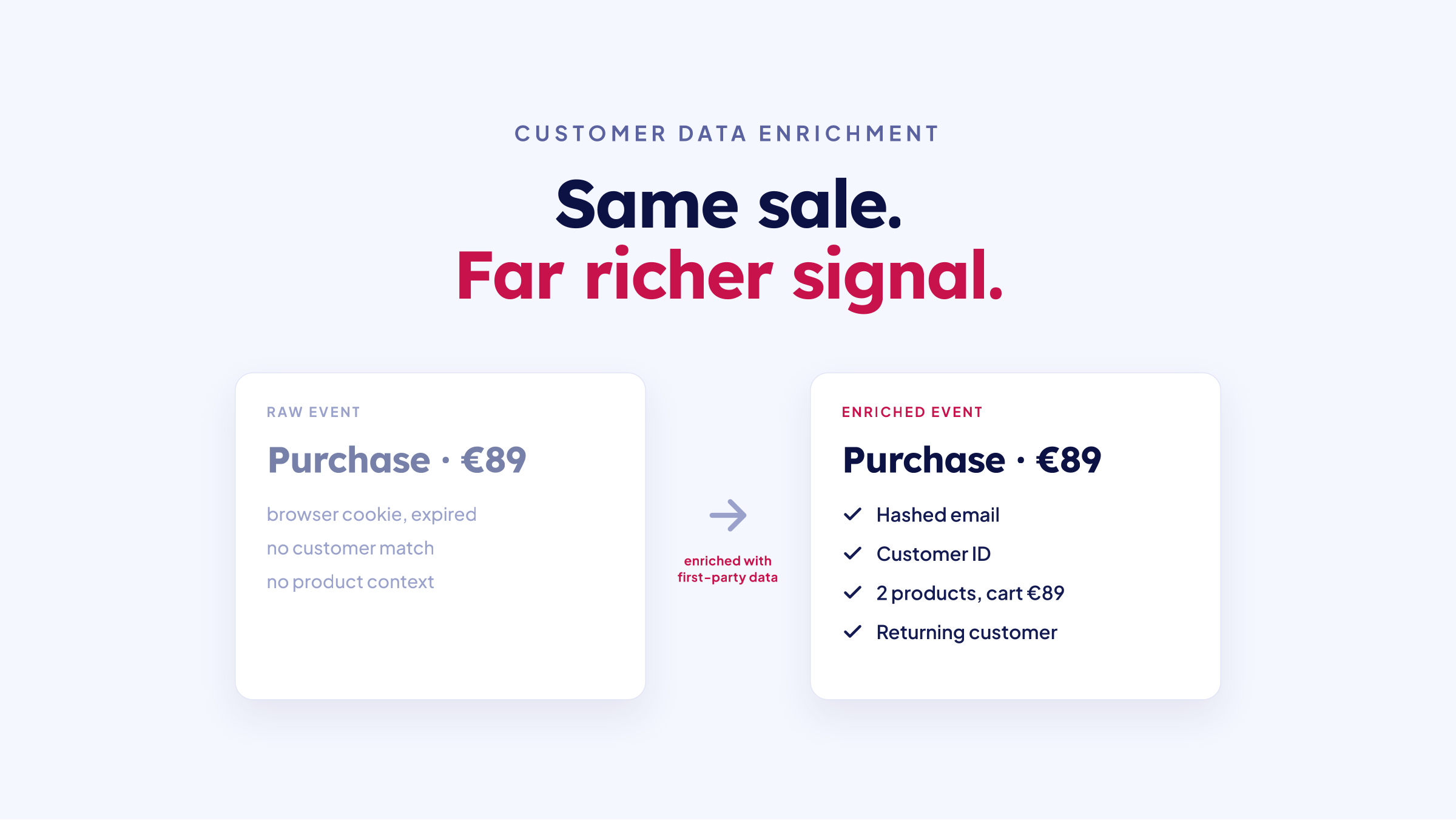
This is where TrackBee comes in. It captures your conversions server-side and enriches them with first-party data, so Pinterest sees the sales the browser pixel misses and you get an honest cost per acquisition.
Pinterest Ads Cost Overview
Average cost benchmarks for 2026:
| Metric | Typical Range |
|---|---|
| CPM (cost per 1,000 impressions) | €3–€8 |
| CPC (cost per click) | €0.45–€1.30 |
| CPV (cost per video view) | ~€0.13–€0.26 |
| Recommended test budget | €9–€45/day |
| Platform minimum | None (set your own) |
These are ranges, not fixed prices. CPC averages reported around €0.72 get quoted, though many advertisers pay far less, so lean on the range rather than any single point figure. Pinterest cost data is genuinely thinner than Meta or Google, so treat any single "average" you see elsewhere with suspicion. What actually moves your numbers:
-
Campaign objective: This is the biggest driver, because it decides whether you pay by impression, click, or view. Awareness campaigns bill on CPM, traffic and shopping campaigns bill on CPC, video bills on CPV.
-
Seasonality: Pinterest is unusually seasonal. Users plan weddings, holidays, and home projects months ahead, so Q4, back-to-school, and major holidays push auction prices up. Bids may need to rise 20 to 50% in peak periods to hold visibility.
-
Industry and category: Finance and high-AOV home decor sit at the top of the CPC range. Food, retail, and beauty sit at the cheaper end.
-
Audience targeting: Narrow, high-competition audiences cost more per click. Broad targeting paired with Pinterest's automation tends to find cheaper inventory.
The headline that matters for budgeting: Pinterest CPMs run roughly 30 to 50% below Meta for awareness, and CPCs are usually lower too. The catch is that Meta still tends to win on direct-response cost per acquisition. Pinterest's edge is high-intent discovery and a long organic tail after the campaign ends, which is why it works best as a complementary top and mid-funnel channel rather than a Meta replacement.
Pinterest Ad Formats and Their Cost Structures
Pinterest ads look like organic Pins with a small "Promoted" label, which is part of why they hold attention. What you pay depends almost entirely on the format and the objective behind it.
Standard ads (Promoted Pins) A single image Pin promoted into feeds and search results. Billed on CPC, typically in the €0.45 to €1.30 range depending on category and competition. The default starting point for most advertisers and the easiest format to test a product with. Best for: traffic, discovery, testing new creative.
Shopping ads Pulls products straight from your Shopify catalog and deep-links to the product page or checkout. Billed on CPC, with the rate varying by product competition. This is the workhorse format for DTC. Pinterest reports that Shopping ads deliver roughly 15% higher ROAS and 2.6x the conversion rate versus not running them, which is a first-party marketing claim but a directionally useful one. Best for: direct sales, catalog-driven stores.
Video ads Auto-playing video Pins, billed on CPV at roughly €0.13 to €0.26 per view. Good for demonstrating a product in motion or building consideration, though the per-view cost data here rests on a single credible source, so treat it as indicative. Best for: product demonstration, consideration.
Awareness ads Optimized for reach and impressions, billed on CPM in the €3 to €8 range. The objective to use when the goal is exposure to a planning audience rather than an immediate click. Best for: top-of-funnel reach, brand introduction.
Carousel and Collections Carousel ads are multi-image swipeable Pins. Collections pair a hero asset with a product grid below for an immersive shopping layout. Both bill on CPC like standard ads, with no separately published rate. Best for: showing product ranges, telling a fuller story.
For most Shopify DTC brands, Shopping ads are the workhorse.
They map your catalog onto a high-intent audience and carry the buyer straight to the product page. Start there, layer in standard Promoted Pins to test creative angles, and use awareness or video formats once you want to widen the top of the funnel. To turn those clicks into measurable revenue, set up your catalog and events properly first, which we cover in our Pinterest conversion tracking guide for Shopify.
Budget Requirements: Minimum and Recommended
There is no platform minimum.
Pinterest lets you set your own budget, and technically you can run €1 to €5 a day. In practice that starves the algorithm, so a tiny budget is a fast way to learn nothing.
Practical floor: A realistic test budget is €9 to €45 per day. For conversion campaigns specifically, keep daily spend at €18 or more so the algorithm has enough events to optimize against. A documented €5-a-day test burned out in about ten hours with poor click-through, which is exactly the failure mode to avoid.
The 4 to 5x rule: This is the budgeting guideline that matters most on Pinterest, and it comes from Pinterest's own guidance plus multiple practitioners. Set your daily budget to at least 4 to 5 times your target cost per acquisition. If your target CPA is €5, you want roughly €20 to €25 a day. Below that threshold the campaign starves and Pinterest cannot gather enough conversion signal to optimize.
A meaningful channel test: Plan for two to four weeks at a budget that clears the 4 to 5x rule before you judge the channel. For most Shopify stores that means roughly €500 to €1,500 across an initial test window, enough to exit the learning phase and reach stable performance.
Scaling: Once a campaign is profitable, raise budgets gradually rather than in large jumps. Big sudden increases can reset learning and destabilize delivery, the same pattern you see on Meta and Google.
Bidding Strategies Explained
Pinterest gives you two bidding modes plus an automation suite.
Automatic bidding Pinterest's algorithm adjusts your bid in real time to maximize your chosen result within budget. This is the recommended starting point. Agencies report that automatic bidding tends to deliver lower average CPC in the first 30 days while the system learns, though that is a single-source observation rather than a hard benchmark.
Manual bidding You set a maximum bid per result, which gives full per-placement control but needs experience to avoid overpaying. Switch to manual only once you have conversion data and a specific reason, such as defending a known CPA ceiling.
Performance+ Pinterest's AI bidding and automation suite, analogous to Meta's Advantage+ or Google's Performance Max. It auto-optimizes bids and, increasingly, targeting and creative. For most stores starting out, Performance+ with automatic bidding is the path of least resistance.
Recommendation for Shopify stores: Start with automatic bidding and let the campaign learn. Keep your daily budget above the 4 to 5x target-CPA threshold so the algorithm has room to work. Once you have a stable read on CPA, consider manual bidding only if you have a clear cost ceiling to enforce.
What Drives Pinterest Ad Performance
Pinterest behaves differently from feed-scroll platforms because it is search-led and planning-led. People come to Pinterest to plan a purchase, not just to be entertained, and that shapes both cost and performance.
Why Pinterest clicks carry high intent:
-
Roughly 70% of users are women, with the largest single segment being women aged 25 to 34
-
The platform reaches around 40% of US households earning over $150K
-
About 96% of searches are unbranded, so shoppers are open to discovering new brands
-
Around 85% of weekly Pinners report purchasing based on a Pin
That combination, an affluent, female-skewing, planning-oriented audience doing unbranded discovery, is why Pinterest clicks can carry higher commercial intent than equivalent-priced clicks on a pure entertainment feed. It is a discovery channel where people are actively looking for things to buy later.
What lifts performance and lowers effective cost:
-
Matching objective to billing model. Pay for the event you actually want. Optimizing an awareness objective when you need sales just buys cheap impressions that do not convert.
-
Strong, native-feeling creative. High engagement lowers your effective cost per action, the same dynamic as other platforms.
-
Broad targeting plus automation. Letting Pinterest's AI find inventory usually beats hand-narrowing an audience down to an expensive sliver.
-
Patience with the purchase window. Pinterest's planning behavior means conversions often arrive on a longer lag, with an organic tail after the paid campaign ends.
On ROAS and conversion rates, stay honest.
Agencies report ecommerce ROAS in the 3.2x to 4.8x range on conversion campaigns, and typical Promoted Pin conversion rates somewhere in the low single digits, but both figures are low confidence and trace back to thin, single-aggregator sources. Treat them as what agencies say they see, not as benchmarks you should bank a forecast on. Case studies citing 5x or 11x ROAS exist, but those are cherry-picked outliers, not what an average store should expect.
Pinterest Tracking: Why the Conversions API Matters
Pinterest, like Meta and Google, offers both client-side tracking through the Pinterest Tag, which runs in the browser, and server-side tracking through the Conversions API, which sends events directly from your server to Pinterest.
The Pinterest Tag faces the same browser limitations as every other pixel:
-
Ad blockers and tracking-prevention stop it loading on a large share of sessions
-
iOS privacy restrictions limit what it can capture
-
Cookie limits fragment attribution across sessions and devices, which is exactly where Pinterest's long planning-to-purchase window hurts you most
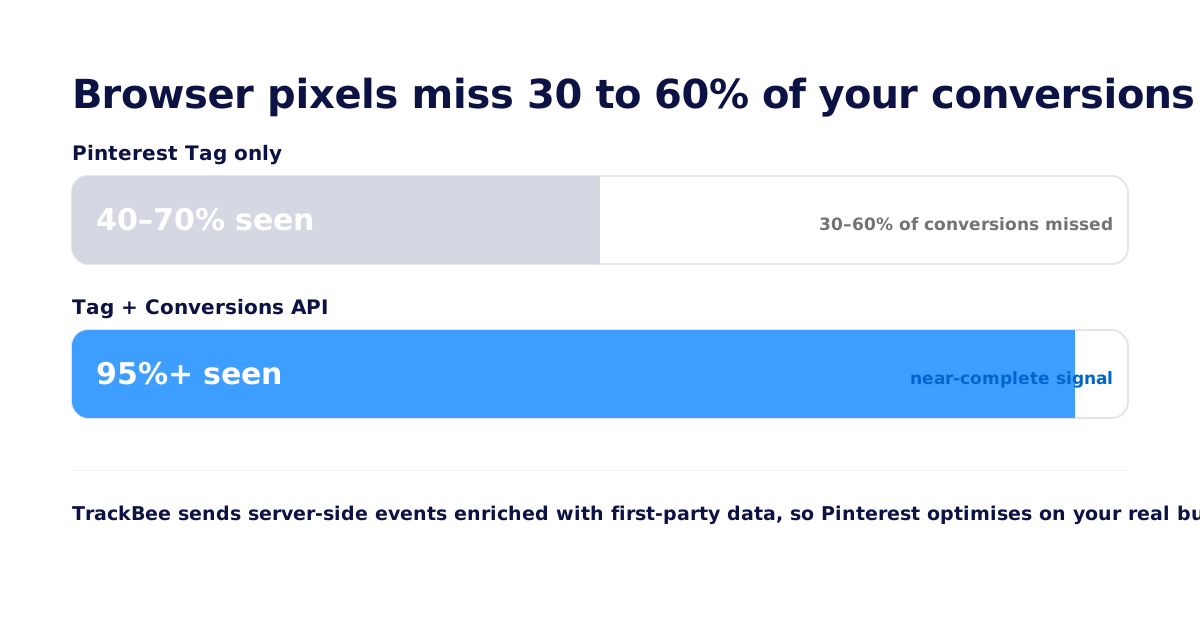
For Shopify stores, browser pixels typically miss 30 to 60% of conversions, depending on traffic mix and setup. On Pinterest that gap is especially costly, because the platform's value is discovery that pays off days or weeks later, precisely the window where cookies expire and tags silently fail.
Why this matters for your Pinterest ROAS: Pinterest's bidding algorithm learns from the conversion events it receives. If a third to more than half of your purchases never reach Pinterest, the algorithm is training on an incomplete, browser-trackable slice of your buyers and building its audience model on the wrong data. You also under-report ROAS, which makes a genuinely profitable channel look weaker than it is and pushes you to cut budget that was actually working.
TrackBee sends Pinterest server-side conversion events through the Conversions API and enriches each event with first party data, recovering the conversions the Pinterest Tag misses. Combined with the tag and deduplicated, you get complete conversion coverage, so Pinterest's algorithm optimizes against your real buyers and your reported ROAS reflects reality. The same server-side infrastructure that improves your Meta and Google performance extends to Pinterest. For the full setup, see our Pinterest conversion tracking guide for Shopify. See also the Pinterest integration.
Pinterest vs. Meta vs. Google: Cost Comparison
| Meta | Google Shopping | ||
|---|---|---|---|
| Average CPM | €9.50–€12.50 | N/A (CPC-based) | €3–€8 |
| Average CPC | €0.65–€1.65 | EU ecom median ~€0.40 | €0.45–€1.30 |
| Minimum budget | Low (€18/day typical) | No formal minimum | None (set your own) |
| Creative requirement | Moderate | Lower (product feed) | Moderate (visual Pin) |
| Audience intent | Discovery/intent mix | Active search intent | Planning/discovery |
| Best role | Discovery + retarget | Capture intent | Top/mid-funnel discovery |
Practical implications for Shopify advertisers:
-
Meta reaches users in browse mode and is your direct-response workhorse for discovery and retargeting. See our Meta and Facebook ads cost guide for the full breakdown.
-
Google Shopping captures users actively searching for products, the highest purchase intent but narrower reach.
-
Pinterest reaches users in planning mode at a lower CPM, ideal for introducing products to an affluent, high-intent discovery audience and feeding the rest of your funnel.
Pinterest is most effective as a complementary top and mid-funnel discovery channel for DTC brands, not a swap for Meta. Use Pinterest to put products in front of planning shoppers cheaply, retarget the engaged ones on Meta, and capture active intent on Google. If you are weighing it against another discovery channel, our TikTok ads cost guide covers the same trade-offs for short-form video.
Frequently Asked Questions
How much do Pinterest ads cost? Pinterest ads typically cost €0.45 to €1.30 per click and €3 to €8 per thousand impressions in 2026, with video billed at roughly €0.13 to €0.26 per view. The exact figure depends on your objective, industry, and season. Awareness campaigns bill on CPM, traffic and shopping campaigns bill on CPC, and video bills on CPV, so the format you choose sets your cost structure.
What is the minimum budget for Pinterest ads? There is no hard platform minimum, you set your own budget. In practice, keep daily spend at €9 to €45, and at least €18 for conversion campaigns. The key rule is to set your daily budget to at least 4 to 5 times your target cost per acquisition, otherwise the campaign starves and the algorithm cannot optimize.
Is Pinterest advertising worth it for ecommerce and Shopify stores? For many DTC brands, yes, as a complementary discovery channel rather than a primary one. Pinterest reaches an affluent, planning-led, female-skewing audience doing unbranded product discovery, with CPMs roughly 30 to 50% below Meta. Agencies report ecommerce ROAS in the 3.2x to 4.8x range, though that figure is low confidence, so test it against your own numbers with proper conversion tracking before scaling.
Are Pinterest ads cheaper than Meta ads? Usually on CPM, yes. Pinterest CPMs run roughly 30 to 50% below Meta for awareness, and CPCs tend to be lower too. But Meta typically wins on direct-response cost per acquisition thanks to its retargeting and lookalike strength. The smart play is to use both, Pinterest for cheap high-intent discovery and Meta for conversion and retargeting.
What is a good CTR, CPC, or ROAS on Pinterest? Directionally, a CPC in the €0.45 to €1.30 range is normal, a click-through rate above roughly 0.5% is considered solid, and agencies report ecommerce ROAS around 3.2x to 4.8x on conversion campaigns. Treat the ROAS figure as a loose reference rather than a guarantee, since the underlying data is thin, and rely on your own server-side measured numbers to judge the channel.
Pinterest Ads Work When the Tracking Does
Pinterest's cost structure is genuinely attractive: low CPMs and high-intent clicks from an affluent planning audience, at a moderate creative bar. What decides whether the channel looks profitable is the tracking, because Pinterest's long planning-to-purchase window is exactly where browser pixels lose the most signal.
Complete server-side tracking through TrackBee's Pinterest Conversions API integration, with events enriched by first party data, gives your campaigns the full conversion signal they need to optimize, and gives you the accurate ROAS you need to scale a channel that is working.


.png)