

Meta is still the default performance channel for DTC Shopify brands, and the cost structure is the main reason. In 2026, ecommerce advertisers on Facebook and Instagram pay roughly €9.50 to €12.50 CPM and €0.65 to €0.90 CPC (lead-generation verticals run higher), with most stores landing near €12 CPM and under €1 per click. Those are the headline numbers most advertisers want. What matters more is what those clicks and impressions return, and that depends on how accurately you measure conversions.
This guide covers what Meta advertising actually costs in 2026, how to budget and bid, what moves your costs up or down, and why your measured cost-per-result is often worse than your true cost when browser tracking misses conversions.
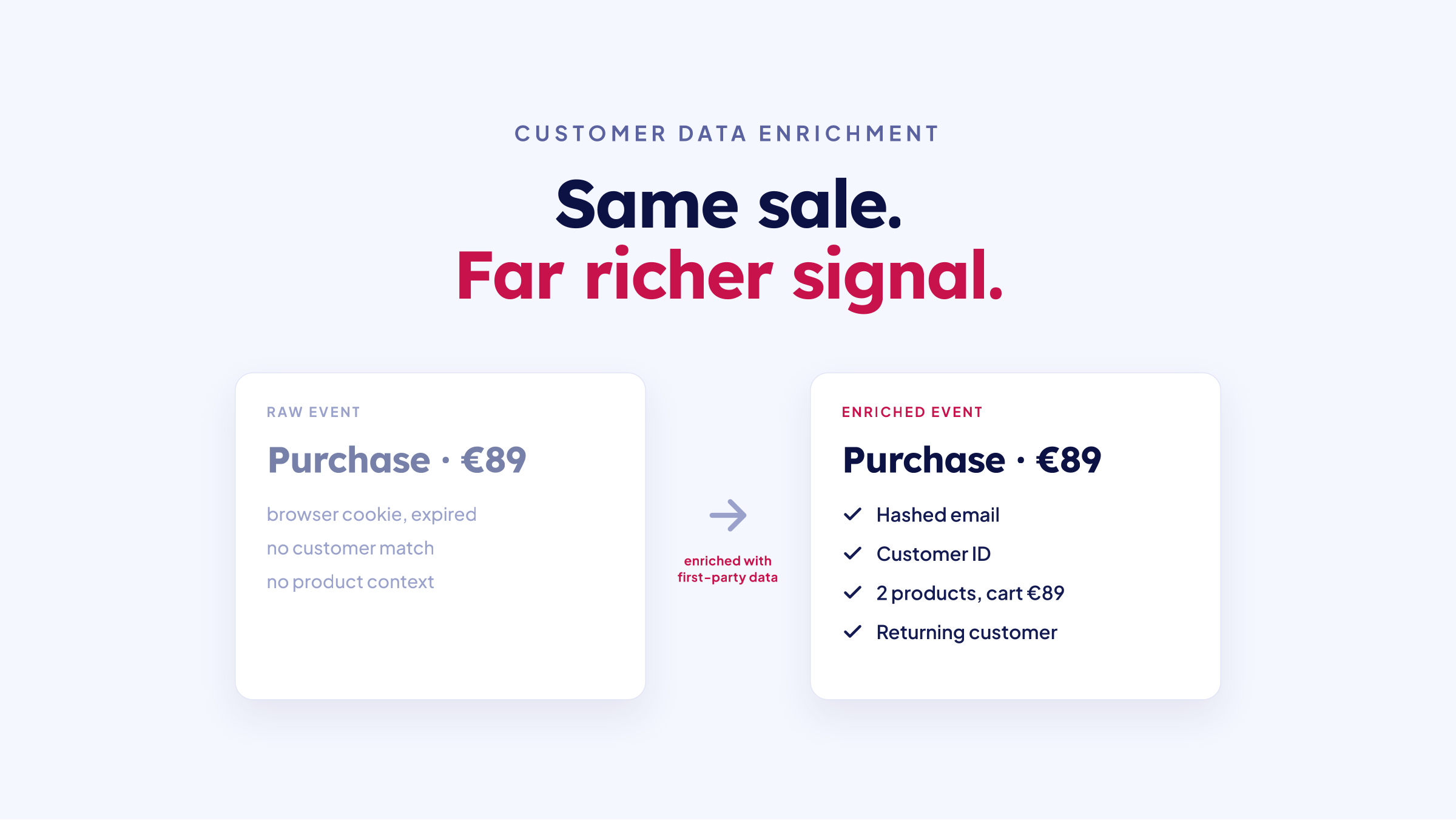
That gap is exactly what TrackBee closes. It captures your conversions server-side and enriches them with first-party data, so Meta sees the sales the browser pixel misses and your real cost per result is the one you act on.
Meta Ads Cost Overview
Average cost benchmarks for 2026:
| Metric | Typical Range (ecommerce) |
|---|---|
| CPM (Cost per 1,000 impressions) | €9.50–€12.50 (ecom often near €12) |
| CPC (Cost per click) | €0.65–€0.90 (lead-gen runs higher) |
| CPA (Cost per purchase) | ~€28–€46 by vertical |
| Minimum daily budget | €18–€45/day to test |
| Monthly to fund 1–2 ad sets | ~€1,400–€2,800/mo |
A note on these figures: there is no clean EU-only Meta benchmark. The reliable ecommerce datasets are global (Triple Whale, Superads), and EU CPMs typically sit at or modestly below the global figures, so treat these as directional for EU stores rather than exact local averages. We have converted source numbers at roughly 1 USD to €0.87.
Two benchmark families get blended online, and they should not be. Traffic and lead-generation campaign costs (the WordStream and LocaliQ tables, US-only) report the price of a click or a lead, not a sale. Ecommerce purchase economics (Triple Whale, Superads, global) report what it costs to drive an actual order. For a Shopify store the ecommerce numbers are the ones that matter, so that is what we lead with here.
Actual costs vary by:
-
Industry and product category: the single biggest swing. Ecommerce CPA runs roughly €28 in lifestyle and boutique categories up to €46 in electronics.
-
Seasonality: Q4 CPMs run well above Q1, and Black Friday and Cyber Monday push CPMs to 2–3x the annual baseline.
-
Auction competition: more advertisers chasing the same audience raises the clearing price. Meta costs rose roughly 20% year over year into 2025 on competition and inflation.
-
Signal loss: iOS privacy prompts, consent banners, and ad blockers degrade targeting and inflate your measured cost per result.
-
Creative and audience quality: strong creative and broad or Advantage+ audiences lower effective cost.
For benchmarks across every major channel, see our ad cost benchmarks for 2026.
Meta Ad Formats and Their Cost Structures
Meta serves the same ad across Facebook and Instagram placements, and the format you choose affects both creative cost and how efficiently the auction prices your impressions.
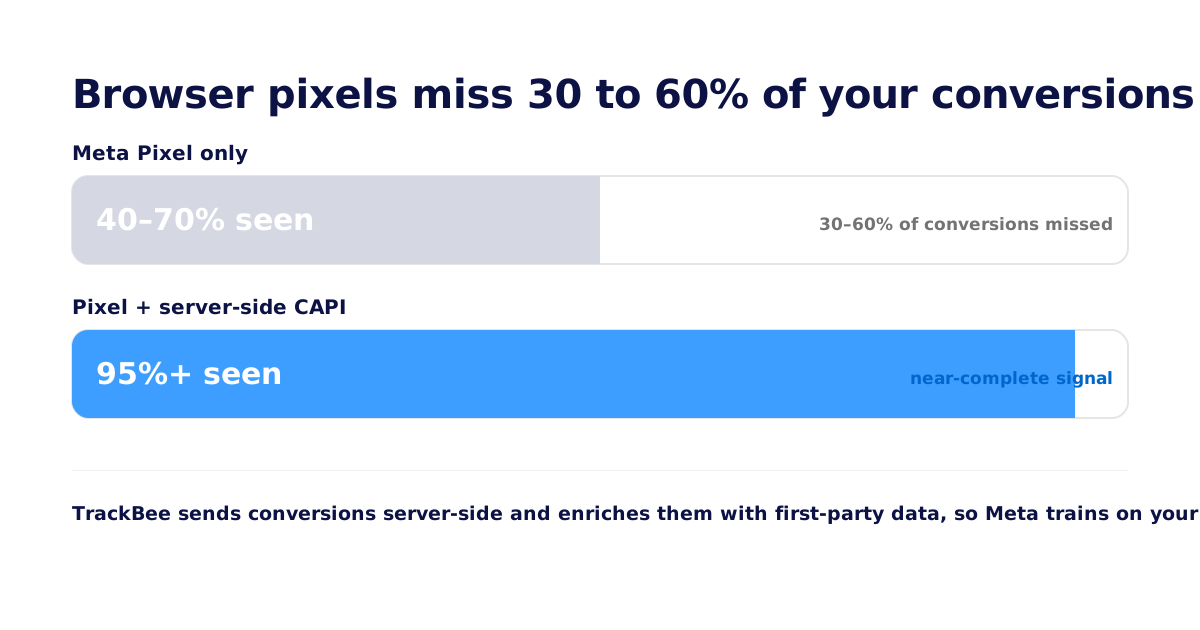
Image Ads A single static image with copy and a call to action. Cheap to produce and a fine starting point for testing a product or offer, but they fatigue faster than video. Best for: quick tests, retargeting, promotions
Video Ads Short video in feed, Stories, or Reels. Video typically earns more attention and lower CPMs when it is genuinely engaging, and Reels placements in particular reward native, vertical, sound-on content. Best for: product discovery, demonstration, top-of-funnel reach
Carousel Ads Up to ten images or videos in a single swipeable unit, each with its own link. Useful for showing a product range, a multi-step story, or several benefits in one placement. Best for: collections, multi-product stores, feature walkthroughs
Collection and Catalog Ads Pull directly from your Shopify product feed to show a shoppable grid. These power dynamic retargeting (showing shoppers the exact products they viewed) and are the workhorse format for ecommerce. Cost efficiency depends on feed quality and conversion signal. Best for: dynamic product ads, retargeting, catalog sales
Advantage+ Shopping Campaigns (ASC) Meta's automated ecommerce campaign type. It consolidates audiences and placements and leans on automated bidding to find buyers across the whole funnel. ASC reduces manual setup and often improves efficiency at scale, but it is only as good as the conversion data you feed it. Best for: stores with steady conversion volume that want a hands-off scaling engine
For most Shopify DTC brands:
start with video and catalog or collection ads, optimize for the Purchase event, and graduate proven products into Advantage+ Shopping once you have stable conversion volume. For a systematic approach to creative that performs across Meta and TikTok, see our UGC framework for profitable campaigns.
Budget Requirements: Minimum and Recommended
Minimum budgets:
-
Technical minimum: roughly €1/day for impression-optimized campaigns, and about €5/day for click or conversion-optimized campaigns.
-
Practical test budget: €18–€45/day for 7 to 14 days before you draw conclusions. A serious sales test runs €90/day or more.
-
Monthly: roughly €1,400–€2,800 to fund one or two ad sets properly through testing and into stable performance.
Why low daily budgets stall.
To exit Meta's learning phase an ad set needs roughly 50 optimization events in a rolling seven-day window. If you optimize for Purchase, that means about 50 purchases per week per ad set. A useful rule of thumb for budgeting toward that threshold is:
daily budget ≈ (target CPA × 50) ÷ 7
At a €25 target CPA that works out to roughly €180/day per ad set to clear learning inside a week. Lower budgets still work, they just take longer to stabilize and spend more time in the volatile learning phase.
Scaling budget.
Meta tolerates budget increases reasonably well, but large sudden jumps can re-trigger learning. Increase gradually (roughly 20% steps) and avoid editing the ad set, audience, or optimization event mid-flight, since significant edits reset learning.
The low-volume trap.
Stores that cannot generate 50 weekly purchases per ad set often get stuck in perpetual learning, where performance never stabilizes. Because Meta counts pixel, Conversions API, and modeled conversions toward that threshold, complete server-side tracking can be the difference between an ad set that exits learning and one that does not. More on that below.
Bidding Strategies Explained
Meta groups bid strategies into three families. Pick based on how much conversion data you already have and how tightly you need to control cost.
Highest Volume (spend-based, default) Maximizes conversions for your budget with no cost target. This is the right starting point for new campaigns: it lets the algorithm gather signal fast without artificial constraints. Most stores should launch here.
Highest Value (spend-based) Maximizes total conversion value rather than order count, favoring higher-AOV purchases. Useful when basket sizes vary widely and you care more about revenue than volume. Requires accurate purchase-value tracking to work.
Cost Per Result Goal (goal-based) You set a target CPA and Meta holds the average near it. Good once you know your economics. Set it too low and delivery starves, because Meta cannot find enough buyers under your cap.
ROAS Goal (goal-based) You set a target return, for example 3x, and Meta optimizes toward it. This fits margin-focused DTC, but it depends entirely on accurate value and conversion tracking. If your purchase values are under-reported, your ROAS goal is built on bad data and will misprice every auction.
Bid Cap (manual) A hard per-auction ceiling rather than an average. Maximum control and maximum risk: set it too low and you win no auctions at all. Reserve this for advertisers with deep auction data who know exactly what a conversion is worth.
Recommendation for Shopify stores:
launch on Highest Volume, let the ad set exit learning, then move to Cost Per Result Goal or ROAS Goal once you have a reliable target. Every goal-based and value-based strategy assumes your conversion data is complete, which is exactly where most Shopify setups quietly fall short.
What Drives Meta Ad Performance
Meta's auction prices each impression on a mix of your bid, your estimated action rates, and ad quality. The levers that move your real cost, roughly in order of impact:
Industry and vertical The biggest single swing. Ecommerce CPA ranges from around €28 in lifestyle and boutique to €46 in electronics, and CTR varies just as much (gift and shopping verticals can clear 4%+, while apparel and furniture sit closer to 1.3%). Your category sets the baseline before any optimization.
Seasonality Q4 is the second-biggest driver. CPMs climb steadily from October, peak in November, and spike hardest on Black Friday and Cyber Monday, when they commonly run 2–3x the annual baseline. Plan budgets and target CPAs around this rather than fighting it.
Auction competition More advertisers in your audience means a higher clearing price. This is structural and rising: Meta CPMs have grown roughly 20% year over year, so the channel gets modestly more expensive each year independent of anything you do.
Signal loss and tracking quality iOS App Tracking Transparency, consent banners, and ad blockers all reduce the conversion signal Meta receives. Less signal means worse optimization, weaker audiences, and a higher measured cost per result. This is the lever most advertisers ignore, and the one most under their control.
Creative and audience Strong, native creative earns better action rates and lower effective CPMs. Broad and Advantage+ audiences generally outperform tightly hand-built segments now that the algorithm has more modeling power. Creative fatigue is real, so refresh before performance decays.
The first three drivers are largely outside your control. The last two are not, and tracking quality is where the largest hidden cost usually lives.
Meta Tracking: Why the Conversions API and EMQ Matter
Here is the problem almost every Shopify store has and most never measure. Meta's browser pixel runs in the shopper's browser, and the browser is exactly where tracking breaks down. Between iOS App Tracking Transparency, ad blockers, cookie restrictions, consent banners, and Shop Pay checkouts that complete outside the standard flow, browser pixels miss roughly 30% to 60% of Shopify conversions, depending on your traffic mix and setup. Those purchases still happen. Meta just never hears about them.
That gap costs you twice. First, your reporting under-counts conversions, so your measured CPA looks worse than your true CPA and your ROAS looks worse than it really is. You end up pausing campaigns that are actually profitable. Second, and more damaging, Meta's bidding algorithm only learns from the conversions it receives. If it sees only half to two thirds of your buyers, it builds its audience model on an incomplete and biased sample, optimizes toward the wrong people, and prices your auctions on bad signal. Worse conversion data does not just misreport cost, it raises it.
The fix is server-side tracking through the Meta Conversions API (CAPI). Instead of relying on the browser, conversion events are sent directly from your server to Meta, bypassing the blocking that breaks the pixel. Run server-side and pixel together, deduplicated by a shared event ID, and you recover a large share of the conversions browser tracking misses.
This is where TrackBee comes in. As a Meta Business Partner, TrackBee sends server-side conversion events to Meta and enriches each event with first-party data: the shopper identifiers and session context Meta uses to match an event to a real account. That enrichment raises your Event Match Quality (EMQ), Meta's score for how well your events match to users. Higher EMQ means more conversions attributed, better audience modeling, and lower effective cost per result. It also helps low-volume stores hit that 50-events-per-week threshold and exit the learning phase, because server-side and modeled conversions count toward it.
For the full setup, see our Meta Conversions API guide for Shopify, and for the metric specifically, how to improve Meta's Event Match Quality score. See also the Meta integration.
Meta vs. Google vs. TikTok: Cost Comparison
| Meta | TikTok | ||
|---|---|---|---|
| Average CPM | €9.50–€12.50 | Display ~€2.70 (Search is CPC) | ~€10 |
| Average CPC | €0.65–€0.90 | EU ecom median €0.38–€0.44 | ~€1.00 |
| Minimum budget | Low (~€5/day possible) | No formal minimum | ~€45/day campaign |
| Creative requirement | Moderate | Lower (product feed) | High (native video) |
| Audience intent | Discovery and intent mix | Active search intent | Discovery and browsing |
| Learning phase | ~7 days, 50 events | ~7 days smart bidding | 7–14 days, 50+ events |
Practical implications for Shopify advertisers:
-
Meta reaches shoppers in browse and discovery mode, which makes it the engine for both prospecting and retargeting at scale.
-
Google captures active search intent, where the shopper is already looking. Its EU ecommerce CPC is far lower than Meta's CPC, but it reaches a narrower, lower-funnel audience. See our Google Ads cost guide for Search, Shopping, and PMax economics.
-
TikTok sits closest to Meta on raw cost but demands native video creative. See our TikTok ads cost guide for the full breakdown.
Most DTC brands run Meta as the core, layer Google to capture demand at the bottom of the funnel, and add TikTok once the first two are stable. The common thread across all three is that the bidding algorithm is only as good as the conversion data it receives.
Frequently Asked Questions
How much do Facebook ads cost per month? Most stores spend somewhere between a few hundred euros and €1,500/month, with a typical figure around €1,000/month. To test Meta as a channel properly, budget roughly €1,400–€2,800/month so you can fund one or two ad sets through the learning phase and out the other side. Spending less than that across too many ad sets is the most common reason a Meta test never stabilizes.
What is a good CPC on Facebook in 2026? For ecommerce, anything under roughly €0.80 is strong, and the typical range runs €0.65–€0.90 depending on vertical and audience. Lead-generation objectives cost more per click than traffic or purchase campaigns, so compare like with like. Bear in mind your measured CPC is only meaningful if the conversions behind it are tracked accurately.
What's the minimum budget to run Facebook ads? The technical minimum is about €1/day for impression-optimized ads and around €5/day for conversion-optimized ads. Realistically you need €18–€45/day to gather enough data to test, and roughly (target CPA × 50) ÷ 7 per ad set to exit the learning phase inside a week. At a €25 CPA that is about €180/day per ad set.
Why are my Facebook ads so expensive? Usually one of five things: a competitive or high-CPA vertical, a seasonal auction spike (Q4 and BFCM run 2–3x), targeting that is too narrow, weak or fatigued creative, or low ad quality and relevance. There is a sixth, less obvious cause: if your tracking is missing conversions, your CPA only looks expensive because Meta is not counting all the orders your ads actually drove.
How much is CPM on Facebook in 2026? Blended CPM sits in the high single digits to low teens, and ecommerce specifically runs roughly €9.50–€12.50, often near €12. Finance and insurance verticals run higher, and Q4 pushes everyone up, with Black Friday and Cyber Monday CPMs commonly 2–3x the annual average.
Meta Ads Work When the Tracking Does
Meta's cost structure is competitive and well understood: roughly €10–€12 CPM, under €1 CPC for ecommerce, and a learning phase that rewards stores with enough conversion volume to feed it. The variable most advertisers underestimate is not the auction price. It is whether Meta is seeing all of their conversions, because the same missing data that makes your CPA look worse also trains the algorithm on the wrong buyers and raises your true cost.
Complete server-side tracking through TrackBee's Meta Conversions API integration, with first-party enrichment that lifts your Event Match Quality, gives your campaigns the full conversion signal they need to optimize, attribute, and scale. If your Meta CPA looks high, check your tracking coverage before you cut budget.


.png)