Short answer: UGC outperforms polished brand creative for cold audiences on Meta and TikTok because skeptical viewers trust a real customer over a studio shoot. But UGC only converts with systematic development: the right research, angles, hooks and measurement to know what works. This 5-step framework covers building UGC that drives profitable results, not just engagement.
Brand creative looks polished. UGC looks real. On Meta and TikTok, real wins.
User-generated content - ads that look and feel like organic content from actual customers - consistently outperforms professional brand creative for cold audience acquisition. Not because production quality doesn't matter, but because cold audiences are skeptical of brands talking about themselves. A real customer talking about a product they bought is more credible than the same product in a studio photoshoot.
But not all UGC is created equal. The difference between UGC that converts and UGC that gets scrolled past comes down to systematic creative development: the right research, the right angles, the right hooks, and the right measurement infrastructure to know what's working.
This guide covers a 5-step framework for developing UGC campaigns that drive profitable results on Meta and TikTok.
Why UGC Outperforms Brand Creative for Cold Audiences
Cold audiences - people who have never encountered your brand - approach ads with a default skepticism that brand creative rarely overcomes. They recognize that ads are produced to make products look good. Professional photography and polished video confirm that bias rather than countering it.
UGC bypasses this defense mechanism. A video of a real customer demonstrating a product, speaking about their experience authentically, in their own environment - that's content that looks like something a friend would share. The production quality signal that says "this is an ad trying to sell you something" is absent.
The data supports this:
-
TikTok's own research shows that creator-style content (UGC-format) outperforms brand content on conversion rates on their platform
-
Meta has consistently found that authentic-looking creative in Reels format outperforms polished video for cold audiences
-
A customer saying "this product solved my problem" is more persuasive than a brand saying "our product solves this problem"
The mechanism isn't magic - it's trust. Potential buyers trust other buyers more than they trust brands. UGC operationalizes that trust at scale.
The 5-Step UGC Framework
Effective UGC isn't random user content. It's systematically developed creative that looks authentic while being strategically engineered to address your target audience's specific objections and desires. The 5-step framework:
-
Research - Find what your audience actually cares about
-
Analysis - Extract patterns from data and competitor behavior
-
Define - Create ICPs and measurable campaign goals
-
Content creation - Develop scripts, hooks, and briefs for creators
-
Launch and optimize - Test systematically and iterate on winners
Step 1: Research
Before writing a single script or briefing a creator, invest in understanding your audience's actual language, problems, and desires. The research sources that matter most:
Google search queries What questions are people asking about your product category? Google's autocomplete and "People also ask" sections reveal the specific language your audience uses - the exact words they type when they're looking for solutions. These words should appear in your UGC scripts.
Reddit Reddit communities are one of the richest sources of unfiltered customer feedback available. Search your product category on Reddit and read what real users say - their complaints, their successes, their comparisons to alternatives. This is the raw material that makes UGC feel authentic: it uses language that actual customers use, not marketing language.
Customer reviews Your own product reviews and your competitors' reviews on Amazon, your Shopify store, and Google contain the specific language customers use to describe their problems and their results. Mine these for recurring phrases, pain points, and specific outcomes that customers value.
PubMed (for health/wellness/supplement brands) If your product makes any health-adjacent claims, PubMed provides scientifically-backed research that can legitimize those claims in UGC scripts. Credible scientific backing combined with authentic customer delivery is a powerful combination.
Step 2: Analysis
Research gathers raw material. Analysis extracts the patterns that inform creative strategy.
Review mining with AI Collect 100+ customer reviews (yours and competitors') and analyze them with ChatGPT or similar tools. Ask: what pain points appear most frequently? What outcomes do customers mention most? What language do they consistently use? What comparisons do they make?
This systematic review analysis surfaces the specific angles that resonate with your target audience - not what you think they care about, but what they demonstrably say they care about.
Competitor ad analysis Study competitor ads in the Meta Ad Library and TikTok Creative Center. The most important signal: how long an ad has been running. Ads that have run for 30+ days are almost certainly profitable - if they weren't, they'd have been paused. These long-running ads tell you which creative angles are working in your category right now.
What angles are your competitors using? What hooks appear repeatedly? What problems are they addressing? Use this as directional intelligence - not to copy, but to understand the creative landscape you're competing in.
Your own performance data Analyze your historical ad performance: which creatives drove the lowest CPA? Which hooks had the highest CTR? Which ad formats (video, carousel, static) performed best by audience type? Past performance is the most reliable predictor of what will work in the future - assuming your tracking is accurate enough to trust these numbers.
Step 3: Define
Before creating content, define exactly who you're targeting and what success looks like.
Build an Ideal Customer Profile (ICP) Based on your research and analysis, build a specific ICP for this campaign:
-
Demographics (age range, gender, location)
-
Interests and behaviors
-
Core beliefs about your product category
-
Primary pain points your product addresses
-
Objections they have to purchasing
-
Language they use to describe their problem and desired outcome
The more specific your ICP, the more targeted your creative can be. Generic UGC for "anyone who might be interested" underperforms targeted UGC aimed at a specific buyer persona with a specific problem.
Set measurable campaign goals Define success in concrete terms before launching:
-
Target CPA for new customer acquisitions
-
Target ROAS
-
Minimum CTR threshold for hook testing
-
Volume of first-time purchases (not total conversions - see below)
Formulate creative hypotheses Based on your research and competitor analysis, formulate specific hypotheses to test:
-
"Angle A (pain-led hook: 'I was constantly exhausted until...') will outperform Angle B (benefit-led hook: 'After 30 days I noticed...') for our ICP"
-
"UGC testimonial format will outperform demonstration format for this product category"
Hypotheses make creative testing systematic rather than random.
Step 4: Content Creation
With research complete and strategy defined, create the content.
Write targeted scripts Scripts should directly address the ICP's specific pain points and use the language surfaced in your review mining. The best UGC scripts are:
-
Specific (not generic - name the exact problem)
-
Outcome-focused (lead with what happened, not what the product contains)
-
Authentic in tone (written to be spoken naturally, not read formally)
Develop multiple hooks The hook - the first 2–3 seconds of a video - determines approximately 70% of UGC campaign success. If a viewer doesn't stop scrolling in the first few seconds, the rest of the ad is irrelevant.
For each creative concept, develop at least three different hooks to test:
-
Pain-led: "I tried everything for [problem] and nothing worked until..."
-
Curiosity-led: "Most people don't realize that [product category] can also..."
-
Social proof-led: "I saw this on [TikTok/Instagram] and finally tried it after 6 months of seeing it..."
Test hooks systematically - same body, different hook - to identify which opening mechanism resonates most with your ICP.
Brief creators clearly When working with UGC creators:
-
Provide a specific script or talking points (not "just be natural about the product")
-
Specify the hook you want them to deliver
-
Include product specifics: what problem does it solve, what results did the customer experience, what's the specific call to action
-
Add subtitles - 85% of TikTok videos are watched without sound, and silent viewing is common on Meta Reels too
-
Set clear deadlines and provide all required product samples in advance
Step 5: Launch and Optimize
Test systematically Launch multiple creative variations with a structured testing approach:
-
Isolate one variable per test (hook vs. hook, format vs. format, angle vs. angle)
-
Run each variation long enough to gather statistically meaningful data - minimum 100 impressions, ideally 50+ link clicks
-
Evaluate on CPA and ROAS, not just CTR (high CTR with poor conversion often indicates clickbait)
Identify winners and iterate When a creative variation wins, don't just scale it - understand why it won:
-
Which specific hook element drove the response?
-
Which product benefit or pain point were you addressing?
-
What format or length worked best?
Use those insights to formulate your next creative hypothesis. Winning UGC campaigns aren't one-shot - they're iterations on a pattern that worked.
Visual optimization for long-running creatives When a winning creative starts to fatigue (rising CPM, declining CTR), refresh it visually before replacing it entirely. Changing the visual hook, adding a new opening frame, or modifying the b-roll while keeping the same script and narrative can extend a creative's useful life significantly.
AI voiceover optimization For creatives where the creator's on-camera delivery is strong but the audio quality or delivery pace could be improved, AI voiceover tools can refresh the audio layer while keeping the original visual content. This is particularly effective for extending the life of mid-performing creatives.
The Tracking Foundation UGC Campaigns Require
The 5-step framework produces better creative. But creative alone doesn't determine whether UGC campaigns are profitable - accurate attribution does.
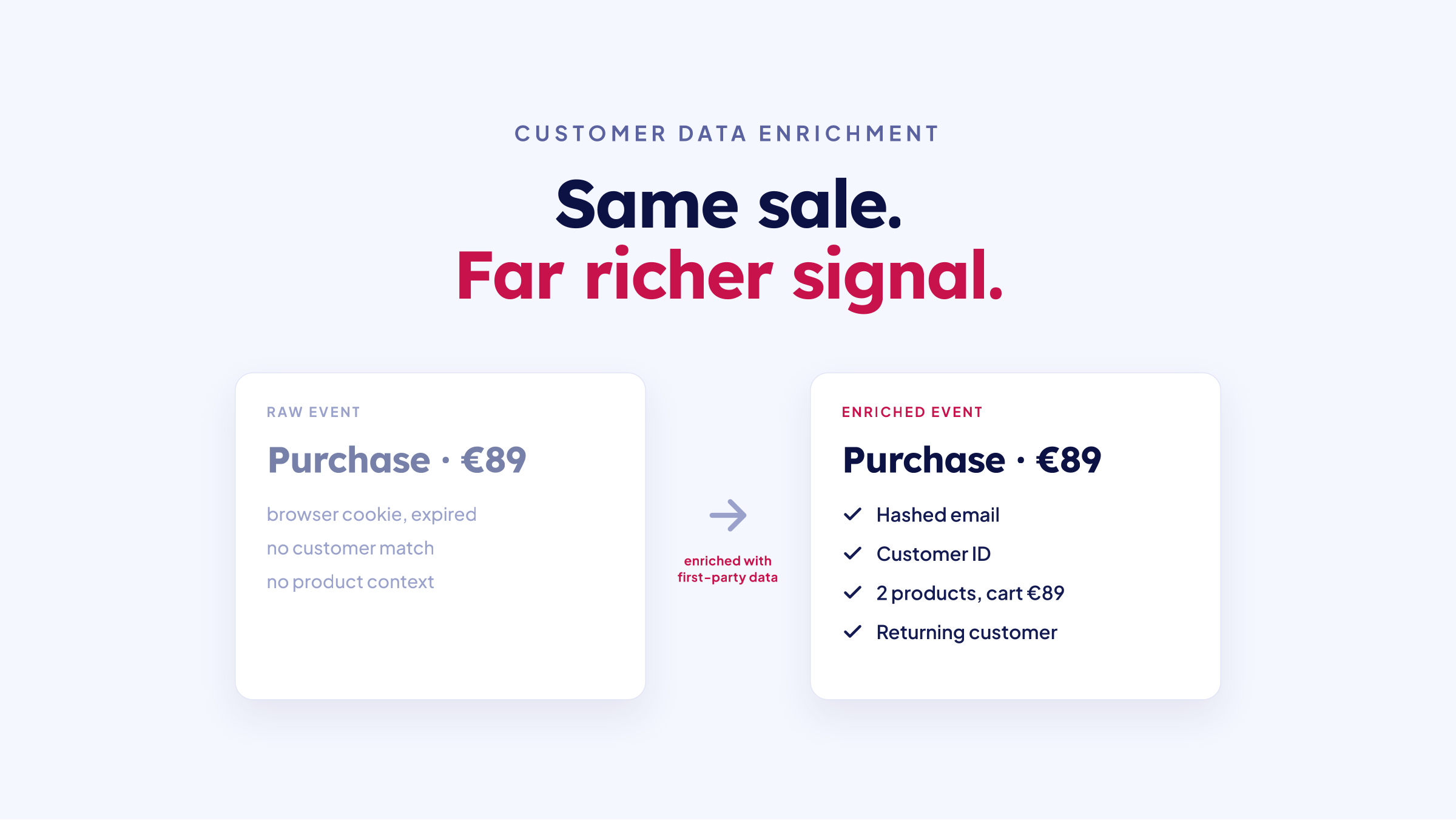
The specific tracking challenge with UGC: UGC ads on Meta and TikTok frequently reach new customers in the awareness phase - customers who see an ad, don't click immediately, do their own research, and convert later through a different channel or device. Standard browser-based pixel tracking attributes this conversion to "direct" and gives the UGC ad no credit. With iOS 26 stripping click IDs more aggressively from in-app browsers and Consent Mode V2 enforcement suppressing EU browser events, this attribution gap is growing wider in 2026.
When your optimization decisions are based on the conversions your ads directly received (instead of all conversions they influenced), you undervalue UGC - particularly awareness-phase UGC that initiates the customer journey without closing it.
What accurate tracking enables:
-
Correctly attribute new customer conversions that came from UGC ads, even when the conversion journey spanned multiple touchpoints
-
Identify which creative angles are actually driving purchases (not just clicks)
-
Calculate a real new customer CPA - including conversions that happened on a different device or after organic research
-
Feed accurate conversion data back to Meta and TikTok's algorithms for better delivery optimization
TrackBee's server-side tracking captures the conversions that browser-based pixel tracking misses - including cross-device conversions from UGC-initiated journeys. Shopper Profiles connect the TikTok or Meta click to the eventual purchase, even when they're separated by days and devices.
See: What is server-side tracking and how to install it for Shopify | How to optimize conversions for new customers.
Frequently Asked Questions
How many UGC creatives should I test at once? Test 3–5 variations at a time. More than this and you dilute the budget per variation, making it harder to reach statistical significance on any individual creative. Fewer than 3 and you're not getting enough diversity to identify patterns.
Should I use real customers or professional UGC creators? Both work. Real customers provide the most authentic content but are harder to produce at scale and harder to direct. Professional UGC creators can deliver authentic-looking content consistently and on brief. The best approach is to start with professional creators (controllable, consistent) and supplement with real customer content as you generate it through post-purchase requests.
How long should UGC videos be for Meta vs. TikTok? For Meta Reels: 15–30 seconds performs best for cold audiences. For TikTok: 15–45 seconds. Shorter is generally better for awareness-phase UGC - save detailed product explanation for customers already in the consideration phase. The hook needs to earn the remaining runtime.
How do I measure new customer conversions from UGC specifically? In Meta Ads Manager, add the "First-Time Purchase" column to your campaign view. This shows how many conversions were from users making their first purchase on your store - as tracked by Meta's Conversions API. For cross-device accuracy on this metric, server-side tracking (TrackBee) is required. See: How to optimize conversions for new customers.
When should I refresh UGC creative? When CPM is rising consistently over 7+ days and CTR is declining, the creative is fatiguing. For most Shopify brands, a strong UGC creative runs 4–8 weeks before needing refresh. Build a creative production pipeline that produces 8–10 new variations per month to stay ahead of fatigue.
Creative Strategy Plus Tracking Accuracy
The 5-step UGC framework - Research, Analysis, Define, Content Creation, Launch and Optimize - turns UGC production from guesswork into a systematic process. The output is creative that addresses your ICP's specific problems in language they recognize, with hooks engineered for their platform behavior.
But the framework only produces reliable results when the tracking infrastructure beneath it is accurate. Incomplete conversion data means you're optimizing creative based on a filtered sample of your actual buyers - which systematically undervalues the channels and angles that drive new customer acquisition.
Accurate tracking + systematic creative development is what makes UGC profitable at scale.


.png)