
TrackBee's Google Ads Integration for Shopify

Standard Google Ads tracking misses 30-40% of Shopify conversions. TrackBee's four-layer integration closes the gap with server-side enrichment.
March 18, 2026
Jitske
Latest
Google Ads

TrackBee's Google Ads Integration for Shopify

Google Ads is one of the most data-hungry advertising platforms. Its Smart Bidding algorithms - Target ROAS, Target CPA, Maximize Conversions - require accurate, complete conversion data to optimize effectively. When conversions are missing, those algorithms learn from an incomplete picture and make systematically worse decisions.

Standard Google Ads conversion tracking on Shopify misses a significant portion of conversions. The causes are familiar: third-party cookie deprecation, ad blockers, iOS privacy restrictions, and cross-device attribution failures. The result is a Google Ads account that appears less efficient than it actually is - and a bidding algorithm that's being trained on partial data.

TrackBee's Google Ads integration addresses this with a four-layer approach that captures conversions standard tracking misses and sends them back to Google to improve algorithm performance.

Five Challenges with Standard Google Ads Tracking on Shopify

1. Third-party cookie uncertainty and Privacy Sandbox abandoned Google's Privacy Sandbox - the proposed browser-level replacement for third-party cookies - has been effectively abandoned, leaving the future of cookie-based attribution unresolved. Meanwhile, third-party cookie restrictions in Safari and Firefox already affect the Google Ads tracking tag's ability to attribute conversions to clicks. Conversions from customers who visit multiple sites before purchasing - which is most customers - are increasingly unattributable via the standard gclid + cookie mechanism.

2. Privacy restrictions, iOS, and Consent Mode V2 Safari's Intelligent Tracking Prevention (ITP) limits cookie lifetimes to 7 days. iOS 17+'s Link Tracking Protection strips gclid parameters from URLs when shared, and iOS 26 tightens in-app browser restrictions further. Consent Mode V2 enforcement across the EU means consent-declined visitors generate zero browser-side events. This means Google Ad clicks that result in purchases more than 7 days later - common for considered purchases - often go unattributed.

3. Ad blocker interference The Google Ads tag (gtag.js) is a client-side script that ad blockers target. When the tag is blocked, the conversion event never fires. The customer purchased; Google Ads doesn't know.

4. Cross-device attribution failure A customer clicks a Google Shopping ad on their phone, then purchases on their laptop three days later. The gclid cookie was set on their phone. Their laptop has a different browser, no cookie. The purchase is attributed to "direct" - the Google Shopping ad gets no credit.

5. Complex customer journeys Multi-touchpoint journeys that span days, devices, and channels exceed what cookie-based tracking can handle. By the time a customer purchases after multiple research sessions, the original attribution signal has often been lost.


TrackBee's Four-Layer Tracking Approach

TrackBee addresses these challenges with four complementary tracking layers that work together:

Layer 1: Server-side tracking Conversion events are captured at Shopify's server level and sent to Google via the Google Ads Conversions API (Enhanced Conversions). This happens independently of browser conditions - no gclid cookie required for the conversion to register. Ad blockers, iOS restrictions, and browser limitations have no effect on server-side event capture.

Layer 2: Client-side tracking TrackBee maintains a browser-side tracking component that captures session and attribution data when available. This ensures that standard gclid-based attribution works for customers without privacy restrictions - and provides the first-party click data that feeds the server-side enrichment.

Layer 3: First-party data TrackBee builds persistent Shopper Profiles that store cross-session identity data - email addresses, device identifiers, and attribution signals - across a customer's history with your store. When a customer who clicked a Google Ad two weeks ago returns to purchase, their Shopper Profile connects the purchase to the original click, even if no cookie persists.

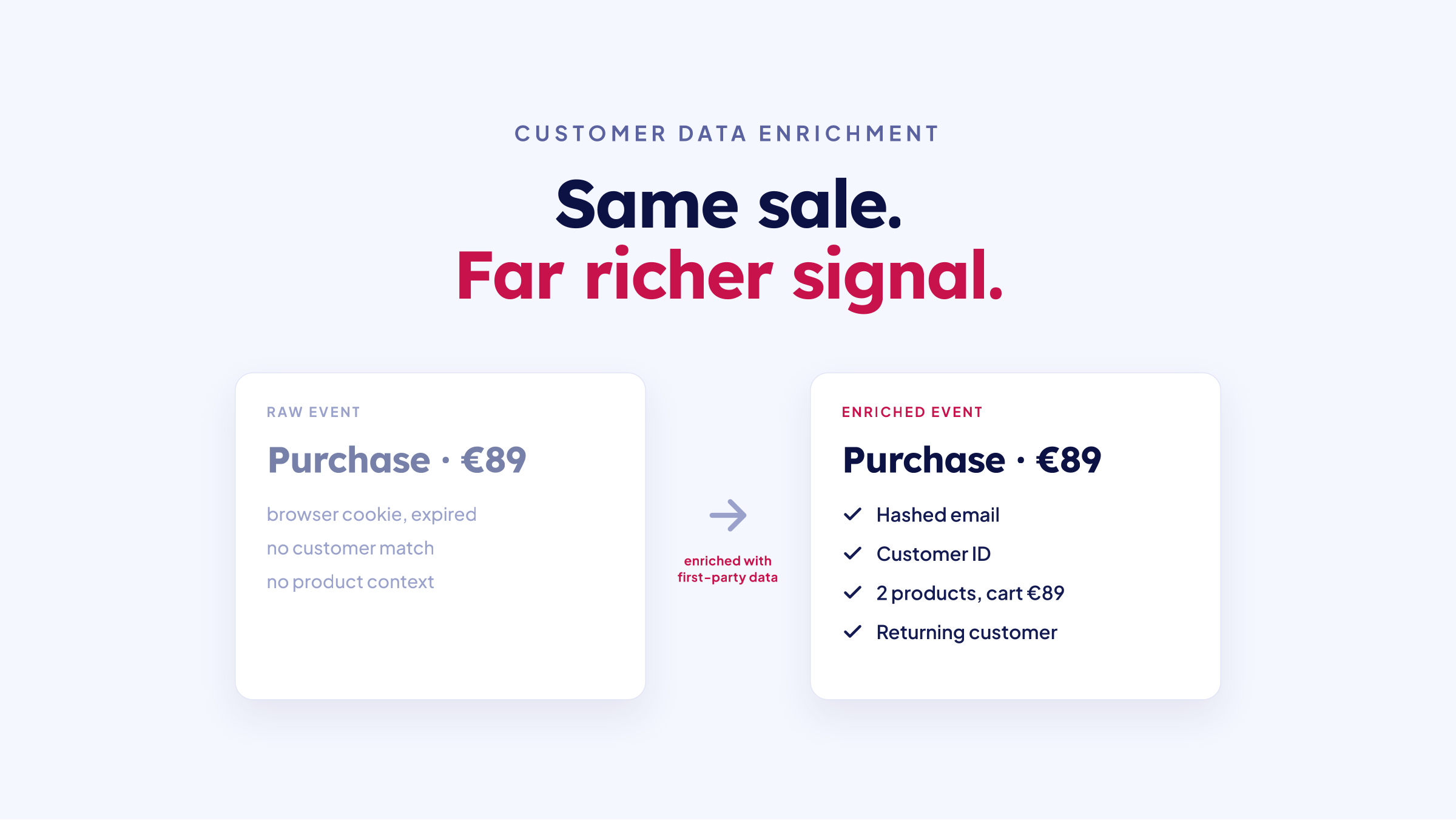
Layer 4: Data enrichment Conversion events sent to Google include enriched customer data - hashed email addresses, phone numbers, and device signals - that Google uses for Enhanced Conversions matching. This improves Google's ability to credit conversions to ad interactions, even when click-level tracking fails.


Google Enhanced Conversions via Server-Side

Google Enhanced Conversions is Google's mechanism for sending hashed first-party customer data (email, phone, name, address) alongside conversion events. Google uses this to match conversions to ad clicks via its own user graph - independent of third-party cookies or gclid parameters.

TrackBee sends Enhanced Conversions data server-side for every Shopify purchase event. The data is hashed (SHA-256) before transmission, as required by Google's customer data terms.

Why server-side Enhanced Conversions outperform client-side implementation:

  • Client-side Enhanced Conversions rely on the gtag.js script firing in the browser - subject to ad blockers, consent issues, and checkout page script restrictions

  • Server-side implementation captures conversion events directly from Shopify's backend - no browser dependency

  • The same conversion data that drives Shopify order processing is what gets sent to Google - accurate, complete, and consistent

See: The ultimate guide to Google Enhanced Conversions for Shopify.


Cross-Device Attribution and First-Party Data

The cross-device attribution problem is one of the most significant sources of conversion loss in Google Ads. A customer who clicks a Google Search ad on their phone and purchases on their laptop is effectively invisible to standard tracking.

TrackBee's Shopper Profiles solve this by building persistent cross-device identity profiles for your customers:

How Shopper Profiles enable cross-device attribution:

  1. Customer clicks a Google Shopping ad on their phone - TrackBee records the gclid and associates it with an anonymous session profile

  2. Customer uses the same email to sign up for your newsletter on their laptop - TrackBee links the laptop session to the phone session via the email identifier

  3. Customer purchases on their laptop - TrackBee sends the purchase event with the original phone gclid to Google

Google receives a purchase event attributed to the original ad click - even though the purchase happened on a different device, days later, with no shared cookies.

This cross-device matching works through email addresses, which are the most reliable cross-device identifier available without third-party cookies. See: Cross-device tracking for Shopify: how to get a complete customer view.


Impact on Smart Bidding Performance

The downstream effect of complete conversion data is better Smart Bidding performance. Google's Target ROAS and Target CPA strategies optimize based on the conversion signals they receive. More complete conversion data means:

More accurate target performance When 30–40% of conversions are missing, your Google Ads account shows lower conversion volume and higher CPA than reality. Smart Bidding responds by becoming more conservative - raising bids for only the highest-confidence clicks. With complete conversion data, the algorithm has an accurate picture of what's actually converting and can bid more aggressively for the right traffic.

Better conversion value modeling Smart Bidding uses historical conversion value data to predict the expected value of future conversions. Incomplete data creates biased models - the algorithm overweights easy-to-track conversions (direct traffic, returning customers with saved cookies) and underweights harder-to-track ones (new customers via ad clicks). TrackBee's complete conversion capture gives the algorithm a representative training dataset.

Faster algorithm learning Google's bidding algorithms require sufficient conversion volume to optimize effectively. When conversions are missing, it takes longer to exit the learning phase and longer to stabilize performance. Complete conversion data means hitting minimum conversion thresholds faster and achieving stable performance sooner.


Setup: No Technical Expertise Required

TrackBee's Google Ads integration doesn't require developer resources, GTM configuration, or custom code.

Setup process:

  1. Connect your Shopify store to TrackBee (one-click authentication)

  2. Connect your Google Ads account (one-click OAuth)

  3. Select the Google Ads conversion actions you want TrackBee to send data for

  4. TrackBee begins capturing and sending server-side conversion data automatically

No data layer setup. No GTM container configuration. No custom event mapping. After the initial connection, TrackBee handles updates automatically - when Google updates the Enhanced Conversions API, TrackBee updates its implementation. You don't need to maintain anything.

See: Setting up Google Enhanced Conversions for Shopify: step-by-step guide.


Frequently Asked Questions

Does TrackBee replace the standard Google Ads tag (gtag.js)? TrackBee complements rather than replaces your existing Google Ads tag. The combination of client-side tag (for click attribution when cookies are available) and TrackBee's server-side CAPI events (for cases where client-side tracking fails) provides the most complete coverage. Event deduplication ensures Google doesn't double-count conversions from both sources.

How does TrackBee handle conversion deduplication with Google? TrackBee sends unique transaction IDs with each server-side conversion event. Google uses these IDs to deduplicate against any matching client-side events from gtag.js. You won't see inflated conversion counts from running both tracking methods simultaneously.

Will I see more conversions in my Google Ads account after installing TrackBee? Typically yes - particularly for new customers, cross-device purchases, and customers with ad blockers or iOS privacy settings. The exact increase depends on your existing tracking coverage gaps, but stores consistently see 15–35% more attributed conversions after implementing complete server-side tracking.

Does this work with Performance Max campaigns? Yes. Performance Max uses the same conversion data as standard Google Ads campaigns. More complete conversion data benefits PMax's automated optimization - the algorithm has a more accurate signal for which products and audiences are driving real purchases.

Can I see the impact in Google Ads reporting? Yes. In Google Ads, navigate to Tools → Conversions → Diagnostics. This shows your conversion coverage rate and flags any data gaps. After TrackBee is running, your coverage rate should improve. You can also compare "all conversions" vs. "conversions" columns to see the impact of enhanced conversion matching.


The Algorithm Only Optimizes as Well as Its Data

Google's Smart Bidding is genuinely powerful at optimizing toward purchase intent - when it has accurate, complete conversion data to learn from. The gap between a Google Ads account training on 70% of its actual conversions vs. 100% of them isn't small. It's the difference between a bidding strategy that understands your real buyers and one that's extrapolating from a filtered sample.

TrackBee's four-layer tracking approach - server-side capture, client-side attribution, first-party Shopper Profiles, and data enrichment - closes the gap between conversions that happen and conversions that Google knows about.

In this article
Boost Your Revenue
Track Missing Conversion Data
Lorem Ipsum

Boost Your Revenue

Track & Enrich
Missing Conversion Data

Try for free
Share this:

Google Ads is one of the most data-hungry advertising platforms. Its Smart Bidding algorithms - Target ROAS, Target CPA, Maximize Conversions - require accurate, complete conversion data to optimize effectively. When conversions are missing, those algorithms learn from an incomplete picture and make systematically worse decisions.

Standard Google Ads conversion tracking on Shopify misses a significant portion of conversions. The causes are familiar: third-party cookie deprecation, ad blockers, iOS privacy restrictions, and cross-device attribution failures. The result is a Google Ads account that appears less efficient than it actually is - and a bidding algorithm that's being trained on partial data.

TrackBee's Google Ads integration addresses this with a four-layer approach that captures conversions standard tracking misses and sends them back to Google to improve algorithm performance.

Five Challenges with Standard Google Ads Tracking on Shopify

1. Third-party cookie uncertainty and Privacy Sandbox abandoned Google's Privacy Sandbox - the proposed browser-level replacement for third-party cookies - has been effectively abandoned, leaving the future of cookie-based attribution unresolved. Meanwhile, third-party cookie restrictions in Safari and Firefox already affect the Google Ads tracking tag's ability to attribute conversions to clicks. Conversions from customers who visit multiple sites before purchasing - which is most customers - are increasingly unattributable via the standard gclid + cookie mechanism.

2. Privacy restrictions, iOS, and Consent Mode V2 Safari's Intelligent Tracking Prevention (ITP) limits cookie lifetimes to 7 days. iOS 17+'s Link Tracking Protection strips gclid parameters from URLs when shared, and iOS 26 tightens in-app browser restrictions further. Consent Mode V2 enforcement across the EU means consent-declined visitors generate zero browser-side events. This means Google Ad clicks that result in purchases more than 7 days later - common for considered purchases - often go unattributed.

3. Ad blocker interference The Google Ads tag (gtag.js) is a client-side script that ad blockers target. When the tag is blocked, the conversion event never fires. The customer purchased; Google Ads doesn't know.

4. Cross-device attribution failure A customer clicks a Google Shopping ad on their phone, then purchases on their laptop three days later. The gclid cookie was set on their phone. Their laptop has a different browser, no cookie. The purchase is attributed to "direct" - the Google Shopping ad gets no credit.

5. Complex customer journeys Multi-touchpoint journeys that span days, devices, and channels exceed what cookie-based tracking can handle. By the time a customer purchases after multiple research sessions, the original attribution signal has often been lost.


TrackBee's Four-Layer Tracking Approach

TrackBee addresses these challenges with four complementary tracking layers that work together:

Layer 1: Server-side tracking Conversion events are captured at Shopify's server level and sent to Google via the Google Ads Conversions API (Enhanced Conversions). This happens independently of browser conditions - no gclid cookie required for the conversion to register. Ad blockers, iOS restrictions, and browser limitations have no effect on server-side event capture.

Layer 2: Client-side tracking TrackBee maintains a browser-side tracking component that captures session and attribution data when available. This ensures that standard gclid-based attribution works for customers without privacy restrictions - and provides the first-party click data that feeds the server-side enrichment.

Layer 3: First-party data TrackBee builds persistent Shopper Profiles that store cross-session identity data - email addresses, device identifiers, and attribution signals - across a customer's history with your store. When a customer who clicked a Google Ad two weeks ago returns to purchase, their Shopper Profile connects the purchase to the original click, even if no cookie persists.

Layer 4: Data enrichment Conversion events sent to Google include enriched customer data - hashed email addresses, phone numbers, and device signals - that Google uses for Enhanced Conversions matching. This improves Google's ability to credit conversions to ad interactions, even when click-level tracking fails.


Google Enhanced Conversions via Server-Side

Google Enhanced Conversions is Google's mechanism for sending hashed first-party customer data (email, phone, name, address) alongside conversion events. Google uses this to match conversions to ad clicks via its own user graph - independent of third-party cookies or gclid parameters.

TrackBee sends Enhanced Conversions data server-side for every Shopify purchase event. The data is hashed (SHA-256) before transmission, as required by Google's customer data terms.

Why server-side Enhanced Conversions outperform client-side implementation:

  • Client-side Enhanced Conversions rely on the gtag.js script firing in the browser - subject to ad blockers, consent issues, and checkout page script restrictions

  • Server-side implementation captures conversion events directly from Shopify's backend - no browser dependency

  • The same conversion data that drives Shopify order processing is what gets sent to Google - accurate, complete, and consistent

See: The ultimate guide to Google Enhanced Conversions for Shopify.


Cross-Device Attribution and First-Party Data

The cross-device attribution problem is one of the most significant sources of conversion loss in Google Ads. A customer who clicks a Google Search ad on their phone and purchases on their laptop is effectively invisible to standard tracking.

TrackBee's Shopper Profiles solve this by building persistent cross-device identity profiles for your customers:

How Shopper Profiles enable cross-device attribution:

  1. Customer clicks a Google Shopping ad on their phone - TrackBee records the gclid and associates it with an anonymous session profile

  2. Customer uses the same email to sign up for your newsletter on their laptop - TrackBee links the laptop session to the phone session via the email identifier

  3. Customer purchases on their laptop - TrackBee sends the purchase event with the original phone gclid to Google

Google receives a purchase event attributed to the original ad click - even though the purchase happened on a different device, days later, with no shared cookies.

This cross-device matching works through email addresses, which are the most reliable cross-device identifier available without third-party cookies. See: Cross-device tracking for Shopify: how to get a complete customer view.


Impact on Smart Bidding Performance

The downstream effect of complete conversion data is better Smart Bidding performance. Google's Target ROAS and Target CPA strategies optimize based on the conversion signals they receive. More complete conversion data means:

More accurate target performance When 30–40% of conversions are missing, your Google Ads account shows lower conversion volume and higher CPA than reality. Smart Bidding responds by becoming more conservative - raising bids for only the highest-confidence clicks. With complete conversion data, the algorithm has an accurate picture of what's actually converting and can bid more aggressively for the right traffic.

Better conversion value modeling Smart Bidding uses historical conversion value data to predict the expected value of future conversions. Incomplete data creates biased models - the algorithm overweights easy-to-track conversions (direct traffic, returning customers with saved cookies) and underweights harder-to-track ones (new customers via ad clicks). TrackBee's complete conversion capture gives the algorithm a representative training dataset.

Faster algorithm learning Google's bidding algorithms require sufficient conversion volume to optimize effectively. When conversions are missing, it takes longer to exit the learning phase and longer to stabilize performance. Complete conversion data means hitting minimum conversion thresholds faster and achieving stable performance sooner.


Setup: No Technical Expertise Required

TrackBee's Google Ads integration doesn't require developer resources, GTM configuration, or custom code.

Setup process:

  1. Connect your Shopify store to TrackBee (one-click authentication)

  2. Connect your Google Ads account (one-click OAuth)

  3. Select the Google Ads conversion actions you want TrackBee to send data for

  4. TrackBee begins capturing and sending server-side conversion data automatically

No data layer setup. No GTM container configuration. No custom event mapping. After the initial connection, TrackBee handles updates automatically - when Google updates the Enhanced Conversions API, TrackBee updates its implementation. You don't need to maintain anything.

See: Setting up Google Enhanced Conversions for Shopify: step-by-step guide.


Frequently Asked Questions

Does TrackBee replace the standard Google Ads tag (gtag.js)? TrackBee complements rather than replaces your existing Google Ads tag. The combination of client-side tag (for click attribution when cookies are available) and TrackBee's server-side CAPI events (for cases where client-side tracking fails) provides the most complete coverage. Event deduplication ensures Google doesn't double-count conversions from both sources.

How does TrackBee handle conversion deduplication with Google? TrackBee sends unique transaction IDs with each server-side conversion event. Google uses these IDs to deduplicate against any matching client-side events from gtag.js. You won't see inflated conversion counts from running both tracking methods simultaneously.

Will I see more conversions in my Google Ads account after installing TrackBee? Typically yes - particularly for new customers, cross-device purchases, and customers with ad blockers or iOS privacy settings. The exact increase depends on your existing tracking coverage gaps, but stores consistently see 15–35% more attributed conversions after implementing complete server-side tracking.

Does this work with Performance Max campaigns? Yes. Performance Max uses the same conversion data as standard Google Ads campaigns. More complete conversion data benefits PMax's automated optimization - the algorithm has a more accurate signal for which products and audiences are driving real purchases.

Can I see the impact in Google Ads reporting? Yes. In Google Ads, navigate to Tools → Conversions → Diagnostics. This shows your conversion coverage rate and flags any data gaps. After TrackBee is running, your coverage rate should improve. You can also compare "all conversions" vs. "conversions" columns to see the impact of enhanced conversion matching.


The Algorithm Only Optimizes as Well as Its Data

Google's Smart Bidding is genuinely powerful at optimizing toward purchase intent - when it has accurate, complete conversion data to learn from. The gap between a Google Ads account training on 70% of its actual conversions vs. 100% of them isn't small. It's the difference between a bidding strategy that understands your real buyers and one that's extrapolating from a filtered sample.

TrackBee's four-layer tracking approach - server-side capture, client-side attribution, first-party Shopper Profiles, and data enrichment - closes the gap between conversions that happen and conversions that Google knows about.

Latest

Discover other Blogs

Explore our collection of informative and engaging blog posts.

Why Your Shopify Sales Don't Match Meta and Google Ads
Frank
Frank
9
min read
Shopify Conversion Rate Drop? Check Your Tracking
Frank
Frank
10
min read
How to Fix Underreported Conversions on Shopify
Frank
Frank
10
min read