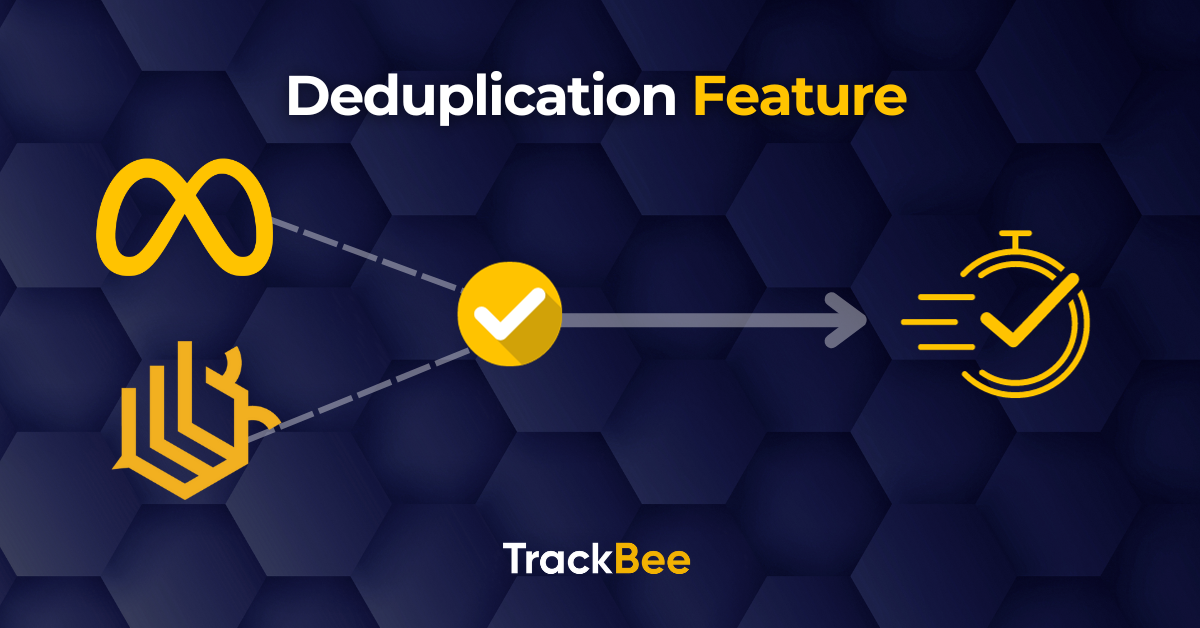


Short answer: Standard Meta Conversions API data can take hours to appear in Ads Manager, which blocks intraday decisions. TrackBee's deduplication feature intelligently routes and processes conversion data so 60 to 70 percent of your Meta data is visible almost immediately, while keeping the accuracy and completeness server-side tracking provides.
One of the persistent frustrations with server-side tracking for Meta is data delay. Standard server-side implementations send conversion data to Meta via the Conversions API - but that data often takes hours to appear in your Ads Manager dashboard, making real-time campaign optimization difficult.
TrackBee's deduplication feature addresses this directly. By intelligently routing and processing conversion data, 60–70% of your Meta conversion data becomes visible almost immediately in your dashboard - while maintaining the accuracy and completeness that server-side tracking provides.
The Problem: Data Delay in Meta Server-Side Tracking
Meta's Conversions API (CAPI) is the correct way to send server-side conversion data to Meta. But there's a timing gap between when events happen and when they appear in Ads Manager.
Standard CAPI data goes through Meta's processing pipeline before it's visible in your reporting and available for algorithm training. This delay can be several hours - which matters when you're making intraday optimization decisions, adjusting budgets based on today's performance, or evaluating whether a newly launched campaign is working.
The alternative - relying only on browser-based Meta Pixel data - shows up faster but is increasingly incomplete due to ad blockers, iOS privacy restrictions (with iOS 26 tightening these further), Consent Mode V2 enforcement in the EU, and consent banners. Google's Privacy Sandbox has been abandoned, so there's no browser-level fix coming. You can see data quickly, but you're seeing an incomplete picture.
The ideal solution captures the completeness of server-side data with the speed of browser-based pixel data. That's what TrackBee's deduplication feature achieves.
What Deduplication Is and Why It Matters
In a hybrid tracking setup, both the browser-based Meta Pixel and the server-side Conversions API send events to Meta for the same user actions. A customer who adds to cart and purchases triggers:

-
A browser-side Pixel event (fast, but potentially blocked or incomplete)
-
A server-side CAPI event (complete, but delayed)
Without deduplication, Meta counts both events as separate conversions - inflating your conversion numbers. Deduplication tells Meta that these two events represent the same action, so only one conversion is recorded.
The deduplication matching happens via an event ID: both the Pixel event and the CAPI event carry the same unique identifier. Meta matches them and deduplicates correctly.
Why deduplication is non-negotiable for hybrid tracking: Without it, your reported conversions are inflated, your ROAS appears higher than reality, and your algorithm is being trained on duplicate signals that distort its optimization. See: Why profitable ad campaigns need event deduplication.
How TrackBee's Deduplication Works
TrackBee's deduplication feature is built on a machine learning model that processes events differently from standard CAPI implementations.
Standard CAPI flow: Browser Pixel fires → CAPI event sent → Meta processing pipeline → Data visible in Ads Manager (several hours later)
TrackBee's deduplication flow: Browser Pixel fires immediately → TrackBee's deduplication model processes the event → 60–70% of events are immediately matched and visible in Ads Manager → Remaining events follow through standard CAPI processing
The key insight: not all conversion events require the same processing path. TrackBee's model identifies which events can be routed for immediate visibility without sacrificing accuracy, and which events need the full server-side processing pipeline for complete enrichment.
The result is a hybrid that gives you the speed benefit of pixel data and the accuracy and completeness benefit of CAPI data - simultaneously.
60–70% of Data Visible Immediately: What This Means
"60–70% of your data visible almost immediately" isn't a rounding of conversion counts - it refers to the event data that becomes available for:
Ads Manager reporting You can see the majority of your conversions in near-real-time, not hours later. Campaign and ad set performance is visible while your campaigns are still running that day.
Algorithm training input Meta's algorithm learns from conversion signals as they arrive. Faster signal delivery means faster learning cycles - your algorithm is being updated with today's performance data, not yesterday's.
Budget decision-making If you're monitoring performance intraday and making budget adjustments, you need data that reflects what's actually happened today. 60–70% immediate visibility means your optimization decisions are based on near-current data rather than yesterday's numbers.
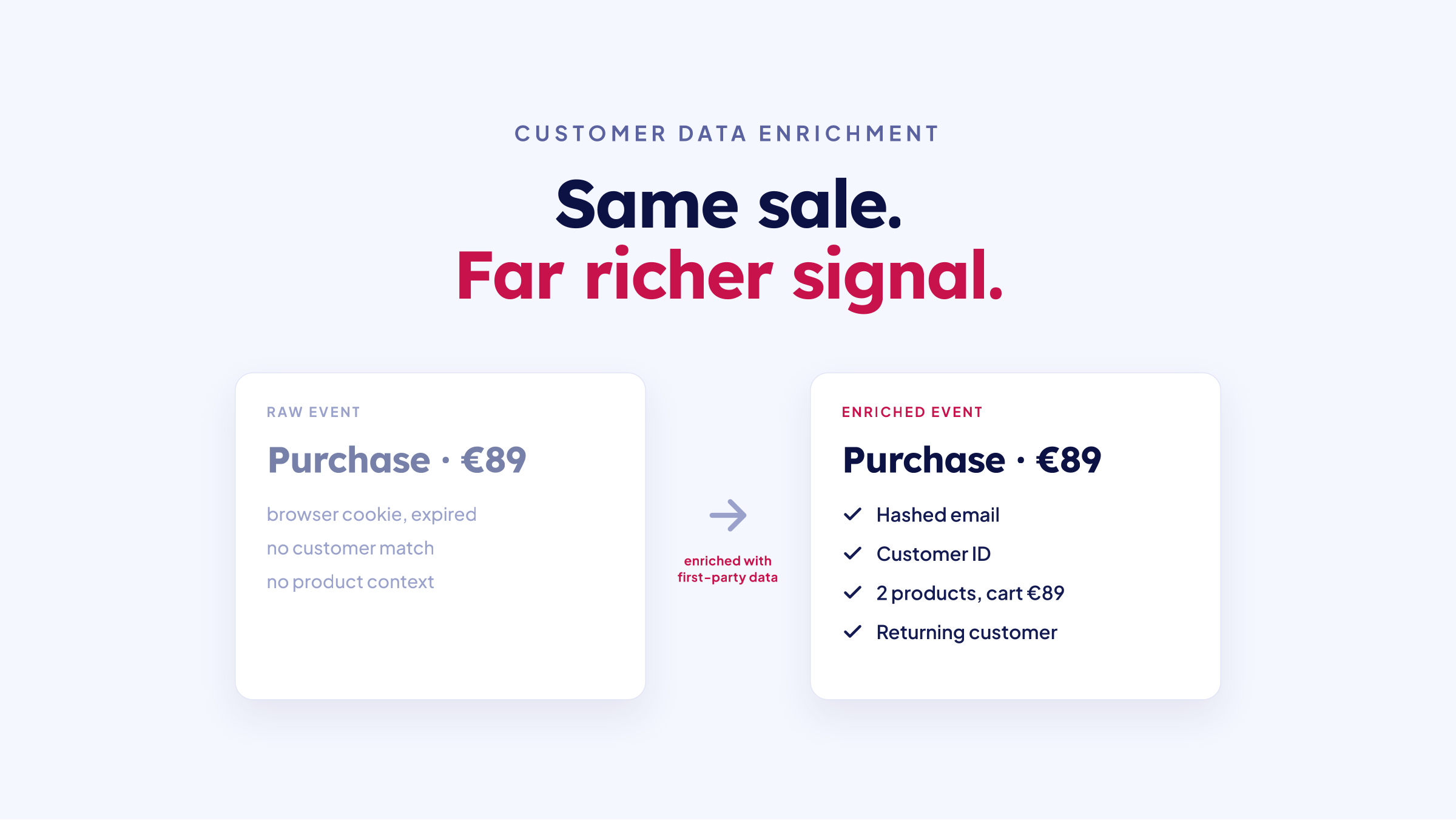
The remaining 30–40% of events follow through standard CAPI processing - arriving with complete enrichment including cross-device matching, enriched customer attributes, and Shopper Profile identity data. You get both speed (for the majority of events) and completeness (for all events).
How to Set Up TrackBee's Deduplication
Setting up TrackBee's deduplication requires three steps:
Step 1: Install or update the Facebook Sales Channel in Shopify If you don't have the Facebook & Instagram (Meta) app installed in Shopify, install it from the Shopify App Store. If you already have it installed, ensure it's updated to the latest version.
Step 2: Connect your Facebook account Within the Facebook & Instagram app in Shopify Admin, connect your Facebook Business account and select the ad account and pixel you want to use.
Step 3: Configure data sharing to Conservative mode In the Meta app settings, set data sharing to Conservative mode. This setting ensures that only browser-side Pixel events come through this channel - TrackBee handles the server-side CAPI data separately. This is what enables correct deduplication: two distinct event streams (browser Pixel via Conservative mode, server-side CAPI via TrackBee) that Meta can match and deduplicate via event IDs.
Once this is configured, TrackBee's deduplication runs automatically. No ongoing configuration is required.
Impact on Campaign Performance
Faster, more complete data has downstream effects beyond just seeing numbers sooner:
More accurate Event Match Quality scores Meta's Event Match Quality (EMQ) score measures how well your conversion events can be matched to Meta users. Higher EMQ means better audience building and more efficient delivery. TrackBee's enriched CAPI events - including hashed email, phone, and device identifiers - improve EMQ scores. See: How to improve Meta's Event Match Quality score.
Better lookalike audience building Lookalike audiences are built from purchase conversion data. More complete purchase data (from CAPI filling in what Pixel misses) creates lookalikes that more accurately represent your actual buyers rather than the buyers whose conversions happened to be tracked by the browser.
Algorithm learning from complete signals Meta's algorithm trains on the conversion signals it receives. When 30–40% of conversions are missing from Pixel data alone, the algorithm is learning from an incomplete picture. CAPI + deduplication gives the algorithm your complete buyer picture, which improves targeting efficiency over time.
Real-time optimization capability For performance marketers who make intraday adjustments - scaling budgets for campaigns that are performing well, pausing those that aren't - near-real-time data visibility is operationally significant. You're responding to what's actually happening today, not extrapolating from yesterday.
Frequently Asked Questions
Does deduplication work with Meta's Conversions API gateway? TrackBee uses event IDs for deduplication - the same mechanism Meta recommends for all CAPI implementations. This approach works regardless of whether you're using Meta's native CAPI gateway or TrackBee's server-side infrastructure.
Will this cause any double-counting in Ads Manager? No - that's the point of deduplication. When both the browser Pixel and TrackBee's CAPI send an event for the same action, Meta matches them via event ID and counts only one conversion. You get faster visibility without inflated conversion counts.
What happens if the browser Pixel is blocked? If the browser Pixel is blocked by an ad blocker or iOS restrictions, only the server-side CAPI event from TrackBee is received by Meta. In this case, the event isn't deduplicated (there's nothing to deduplicate against) - it's simply counted once from the CAPI. You lose the speed benefit but retain the accuracy benefit.
Does TrackBee's deduplication work with Meta's Advantage+ campaigns? Yes. The deduplication mechanism is at the event level - it's how data reaches Meta, not how Meta uses it. Advantage+ campaigns, standard campaigns, and Advantage Shopping Campaigns all benefit from the same accurate, complete, deduplicated event data.
How is this different from just using standard CAPI without deduplication? Standard CAPI without a browser Pixel sends all events through the server-side pipeline - complete but slow. Standard CAPI with Pixel but without proper deduplication sends duplicate events and inflates conversion counts. TrackBee's approach combines both correctly: Pixel for speed, CAPI for completeness, deduplication for accuracy.
The Right Data, Faster
Meta campaign optimization depends on two things: complete data and timely data. Standard browser Pixel tracking has timely data but incomplete coverage. Standard CAPI has complete coverage but delayed visibility.
TrackBee's deduplication feature delivers both. 60–70% of your Meta conversion data is visible immediately for intraday optimization. 100% of your data arrives with complete enrichment for algorithm training and attribution accuracy.


.png)