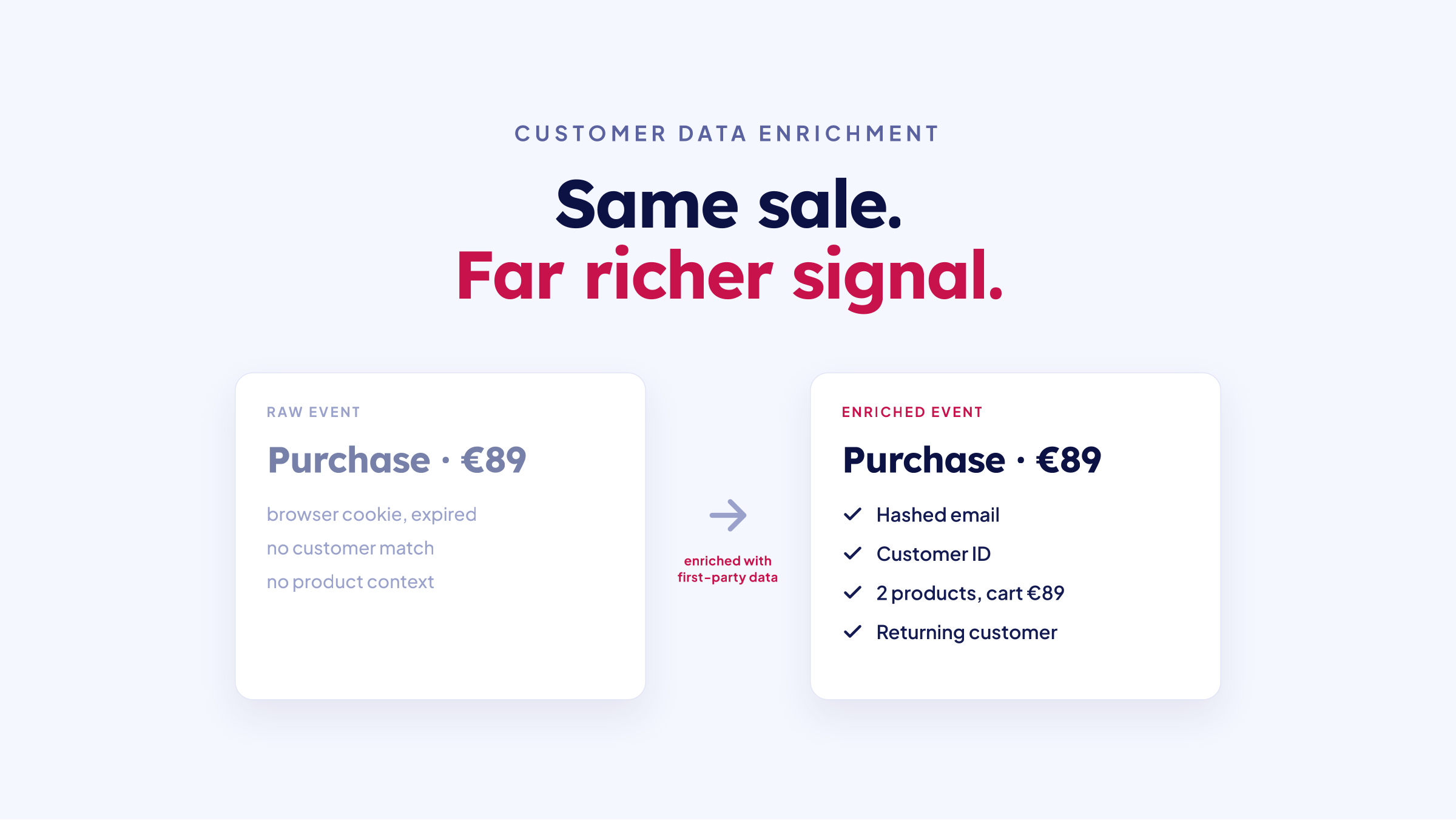


Short answer: TrackBee's Conversion Booster sends Google Ads up to 20 percent more conversion data by combining client-side and server-side tracking with persistent shopper profile enrichment. Standard tags miss conversions to ad blockers, cross-device journeys and iOS limits, so Smart Bidding learns from partial data. Feeding it more complete signals improves optimisation and ROAS.
Most Shopify stores running Google Ads are sending Google an incomplete picture of their conversions. Ad blockers prevent tracking tags from firing. Cross-device journeys break cookie-based attribution. iOS restrictions reduce what gets measured. The result: Google's Smart Bidding algorithms learn from partial data - and partial data produces worse bidding decisions.
TrackBee's Conversion Booster addresses this at the source. By combining client-side and server-side conversion tracking with persistent shopper profile enrichment, it sends Google more of the conversion data your store is generating - enabling more accurate optimization.
The Problem: Conversion Data Gaps in Google Ads
Google Ads tracks conversions through a client-side tag - either via Google Tag Manager or the gtag.js snippet running in a visitor's browser. When everything works, the tag fires at checkout completion, sends purchase data to Google, and the conversion is recorded.
When everything doesn't work - which is increasingly common - the conversion disappears.
What causes conversion data gaps:
-
Ad blockers: 30–40% of internet users have ad blockers installed that prevent Google's tracking tag from loading. When the tag doesn't load, the conversion event never reaches Google - even if the purchase completes successfully.
-
iOS privacy restrictions: Apple's App Tracking Transparency has significantly reduced cross-app tracking on iOS devices. Google's ability to attribute conversions from users who've opted out of tracking is limited on iOS.
-
Safari's Intelligent Tracking Prevention (ITP): Safari caps cookie lifetimes at 7 days. A customer who clicked your Google ad nine days ago and returns to purchase may not be attributed to that ad click.
-
Cross-device journeys: A customer clicks your Google Shopping ad on their iPhone, browses product pages, and completes the purchase three days later on their laptop. The gclid (Google Click ID) from the original ad click isn't present on the laptop. Without cross-session identity resolution, this conversion appears unattributed.
-
Shopify checkout restrictions: Shopify's checkout pages have limitations on what custom JavaScript can execute, which can affect tracking tag reliability at the purchase confirmation step.
These aren't edge cases. For stores with meaningful iOS traffic, Safari users, and customers who switch devices - which describes most DTC Shopify brands - conversion data gaps are systematic and measurable. Google's own interface changes, such as the ability for users to hide sponsored results, add further pressure on advertisers to maximize the ROI of every click that does come through.
How the Conversion Booster Works
The Conversion Booster uses a dual-layer tracking architecture: client-side tracking and server-side tracking running simultaneously, with automatic deduplication.
Layer 1: Client-Side Tracking
TrackBee's client-side component runs in the visitor's browser, capturing conversion events as they happen. This layer handles the majority of conversions - those from users without ad blockers, running standard browser configurations, on non-iOS devices or iOS devices where tracking is permitted.
Client-side tracking captures the conversion at the moment of the transaction, including session context and behavioral data that's only available in the browser.
Layer 2: Server-Side Tracking
TrackBee's server-side layer captures conversion events directly from Shopify's order data - independent of what happens in the visitor's browser. When an order is placed in Shopify, TrackBee's servers receive that order event and send it to the Google Ads Conversions API.
This layer captures the conversions that the client-side layer misses:
-
Conversions from users with ad blockers
-
Conversions on iOS devices with ATT restrictions
-
Conversions where the browser tag failed for any reason
Because server-to-server communication bypasses the browser entirely, ad blockers and browser restrictions have no effect.
Deduplication
When both layers capture the same conversion - which happens for the users whose browser tags work correctly - deduplication prevents the event from being counted twice. TrackBee uses unique order IDs to identify duplicate events and ensures Google receives each conversion exactly once.
The outcome: maximum event coverage (from both layers), accurate conversion counts (from deduplication), and enriched attribution data (from session profiles).
What "Up to 20% More Data" Actually Means
The "up to 20% more conversion data" figure represents the additional conversions captured by the server-side layer that would have been missed by client-side-only tracking.
The actual improvement varies by store based on:
-
Ad blocker prevalence in your audience: Technology-savvy audiences (who skew toward ad blocker adoption) will see larger improvements. Consumer goods brands may see smaller improvements.
-
iOS traffic share: Stores with higher iOS traffic percentages benefit more from server-side tracking.
-
Cross-device purchase behavior: The more your customers browse on mobile and purchase on desktop, the more the server-side layer and session identity resolution contribute.
For most Shopify stores, the improvement is meaningful. For stores with high iOS traffic or technically sophisticated audiences, it can be substantially larger.
More importantly: even a 10% improvement in conversion data represents 10% more training data for Google's Smart Bidding algorithm. The downstream campaign performance impact is amplified beyond the raw data improvement.
The Downstream Impact on Smart Bidding
Google's Smart Bidding strategies - Target ROAS, Target CPA, Maximize Conversions - are machine learning systems. They optimize bid prices by learning which users, keywords, audiences, and contexts produce conversions.
The quality of that learning depends entirely on the quality of the conversion data they receive.
When conversion data is incomplete:
-
The algorithm builds audience models from a sample of your actual buyers
-
It bids based on patterns in a subset of your real conversion behavior
-
It misidentifies "low-performing" keywords or audiences that actually drive conversions - they just weren't tracked
-
Target ROAS and Target CPA calculations are distorted by artificially low conversion volumes
When conversion data is complete:
-
The algorithm builds audience models from your full buyer population
-
It identifies the actual patterns that predict conversion in your store
-
It bids more accurately on genuinely high-intent signals
-
Target ROAS and Target CPA targets are achievable against a complete denominator
The Conversion Booster's impact on ROAS isn't just about counting more conversions in your reports. It's about giving Google's algorithm better training data - which produces more accurate bidding, better audience targeting, and lower effective CPMs over time.
How to Enable the Conversion Booster
The Conversion Booster is part of TrackBee's Google Ads integration. Setup takes under five minutes and requires no developer.
Prerequisites:
-
A TrackBee account with your Shopify store connected
-
Admin access to your Google Ads account
-
Enhanced Conversions for Web enabled in Google Ads (set to Google Ads API mode)
Setup:
-
In your TrackBee dashboard, navigate to the Google Ads integration
-
Connect your Google Ads account by authenticating and selecting your ad account
-
Enable the Conversion Booster toggle
-
Follow the in-product setup guide - it walks through the Google Ads configuration steps (accepting customer data terms, confirming Enhanced Conversions API mode)
-
In Shopify, add the TrackBee Google Tag as a Custom Pixel in Settings > Customer Events
Once enabled, TrackBee begins capturing server-side conversion events and sending them to Google alongside the enriched customer data (hashed email, name, and gclid) that powers Enhanced Conversions matching.
For a full walkthrough of the Google-side configuration: Setting up Google Enhanced Conversions for Shopify.
Real Results: HoneyBalm
HoneyBalm is a Shopify DTC brand that had been running on standard Google Ads pixel tracking. Their ad costs were rising and ROAS was declining despite no major changes in creative or targeting.
After implementing TrackBee with the Conversion Booster:
-
ROAS increased by 100% - return on ad spend doubled
-
Revenue grew by 123% over three months, from $103,000 (≈$95,000) to $229,000 (≈$212,000)
-
CPM decreased by 60% - from $10 to $4 per thousand impressions
The lower CPM is the key signal here: Google's algorithm was identifying HoneyBalm's target audience more accurately, which meant fewer wasted impressions and lower costs to reach the right users. That's the downstream effect of more complete, enriched conversion data reaching Google's bidding system.
Frequently Asked Questions
Does the Conversion Booster replace my existing Google Tag or GTM setup? No. The Conversion Booster adds server-side tracking alongside your existing client-side setup. Your existing Google Tag continues to run. The server-side layer captures additional conversions that the client-side tag misses. Deduplication ensures no event is counted twice.
Do I need to remove my existing Google Ads conversion action when using TrackBee? No. Keep your existing conversion action. TrackBee creates a parallel server-side conversion stream that Google deduplicates against your existing conversions. Running both ensures maximum coverage.
Will the Conversion Booster affect my conversion data retroactively? No. It captures new conversions going forward. Historical data isn't changed.
How does the Conversion Booster handle Consent Mode? TrackBee's setup includes full Google Consent Mode V2 support - which has been mandatory for all advertisers serving EEA users since July 2025. Default consent values are set in TrackBee's Google Tag settings, and are overridden by your cookie banner when users make consent choices. For users who decline consent, Google uses conversion modeling based on consenting users to estimate the missing conversions. Enhanced Conversions only fire for users who've consented (or where consent isn't required by applicable law).
Is the Conversion Booster included in my TrackBee subscription? Yes. The Google Ads Conversion Booster is part of the standard TrackBee integration - no separate add-on is required.
How do I know if it's working? After setup, monitor your Google Ads conversion data. Within 24–48 hours you should see conversion events appearing via the Google Ads API source in your Conversions report. The Enhanced Conversions diagnostics tab in Google Ads will show match rates for enhanced conversion data. Significant drops in the gap between your Shopify order count and Google Ads reported conversions is the clearest signal that the server-side coverage is working.
Complete Google Ads Conversion Data, Automatically
Every conversion Google doesn't see is a conversion your Smart Bidding algorithm can't learn from. Over thousands of conversions, that gap compounds - producing worse targeting, higher CPMs, and lower ROAS than your store should be generating.
The Conversion Booster closes that gap: server-side capture for what client-side misses, persistent profile enrichment for richer matching, and automatic deduplication for clean data.


.png)