
For EU ecommerce stores, the typical Google Ads cost per click sits around €0.38 to €0.44, far below the €2.60 to €4.60 blended figure you see quoted for US search campaigns. The reason the numbers look so different is that "Google Ads" is not one product. Search, Shopping and Performance Max, and Display each have their own cost structure, and a healthy Shopping or Performance Max campaign typically returns 3 to 5 times its spend.
This guide breaks down what Google Ads actually costs in 2026 across each campaign type, how much to budget as a Shopify store, which bidding strategy to use, and why your conversion tracking quietly determines the real number Google charges you to hit a target. If you are comparing channels, this guide is part of our wider ad cost benchmarks breakdown.
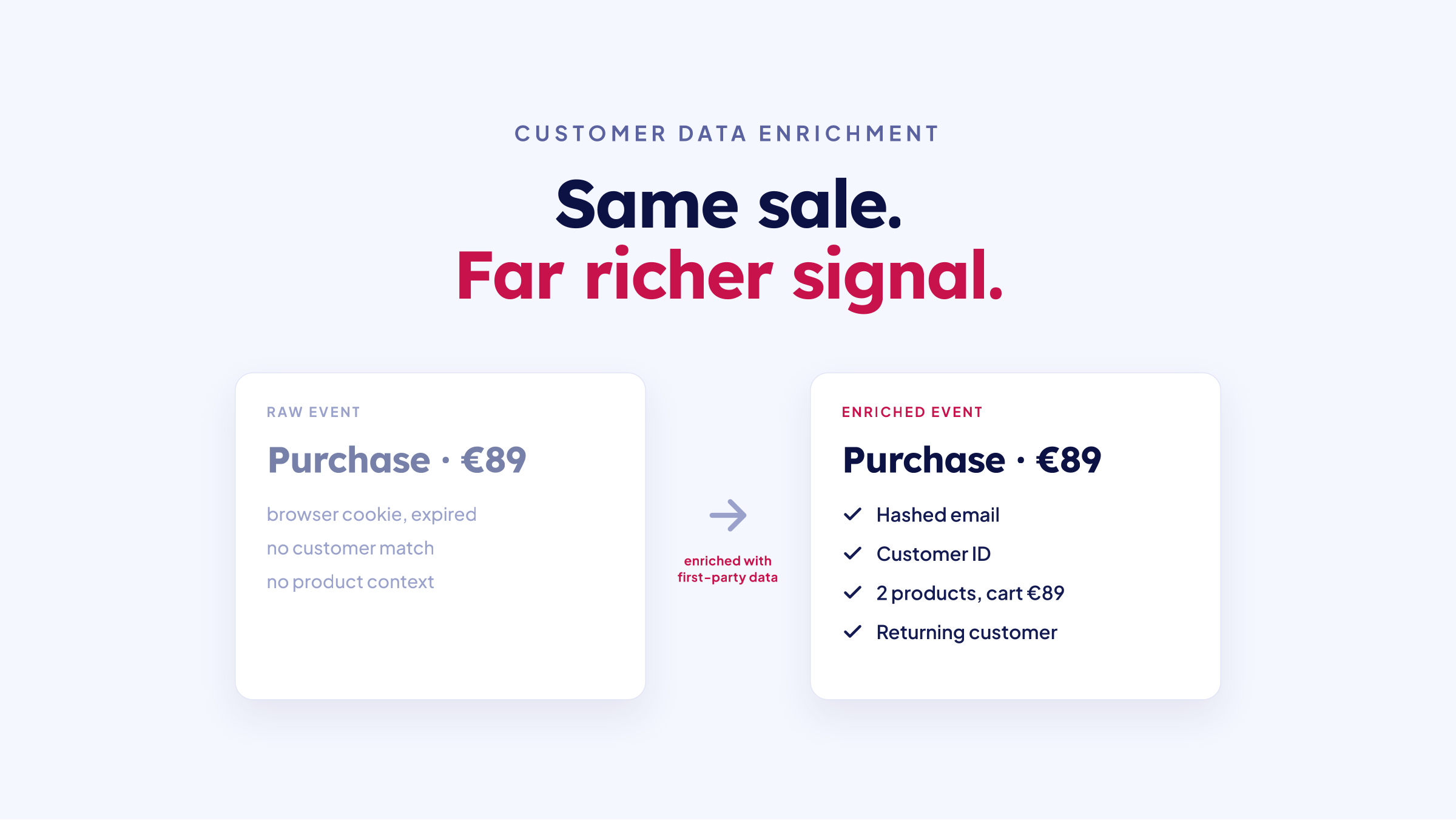
This is where TrackBee comes in. It captures your conversions server-side and enriches them with first-party data, so Google sees the sales the browser pixel misses and Smart Bidding optimizes on the full picture.
Google Ads Cost Overview
There is no single Google Ads cost, because the platform spans three different campaign families. The clearest way to read it is per campaign type, with a separation between what EU ecommerce stores actually pay and the wider US benchmarks that dominate most published guides.
Benchmark costs for 2026 by campaign type:
| Campaign type | CPC (EU ecommerce median) | CPC (US / wider range) | Typical ROAS |
|---|---|---|---|
| Search | €0.38–€0.44 | €2.60–€4.60 (blended) | ~5x (Search) |
| Shopping | ~€0.38 | €0.34–€1.09 (global) | 3–5x |
| Performance Max | ~€0.40 | varies by feed | 3–5x |
| Display | ~€0.40 | under €0.50 | brand/assist |
For a Shopify store advertising in Europe, the EU ecommerce medians are the figures that matter: roughly €0.38 to €0.44 per click on Search, around €0.38 on Shopping, and about €0.40 on Performance Max. The much-quoted US numbers (a blended Search CPC anywhere from €2.60 to €4.60 depending on whose account database you read) are pulled up by high-value verticals like legal and insurance, which bid clicks to several euros. Ecommerce is one of the cheapest categories on the platform.
Costs vary within those bands based on:
-
Industry and keyword competition: the single largest cost differentiator. High-lifetime-value verticals bid CPCs 5 to 6 times higher than ecommerce, because they can afford to.
-
Quality Score: Google's rating of your ad relevance, expected click-through rate, and landing page experience. A higher score lowers your CPC for the same position.
-
Seasonality: Q4 and peak retail periods inflate CPCs as more advertisers compete for the same inventory.
-
Geography and device: EU ecommerce medians run far below US blended figures, and country-level CPCs vary widely.
One genuinely useful trend for 2026: EU ecommerce cost growth is decelerating. Search CPCs are roughly flat year on year, while Shopping and Performance Max have cooled to around 6 to 10 percent growth, down from the mid-teens in late 2025.
Google Ad Formats and Their Cost Structures
Search Ads Text ads on the results page, triggered by keywords. This is the highest-intent format on the platform: you reach people actively searching for what you sell. Priced per click. EU ecommerce CPCs sit in the €0.38 to €0.44 range, but competitive head terms and broad cold-prospecting keywords cost more. Branded terms are the cheapest clicks you will buy. Best for: Capturing demand, high-intent bottom-funnel queries
Shopping Ads Product listings with image, price, and store name, served from your Google Merchant Center feed. The DTC workhorse. There are no keywords to manage; Google matches your products to relevant searches based on the feed. EU ecommerce Shopping CPCs run around €0.38, with a global range of roughly €0.34 to €1.09. Feed quality (titles, images, attributes) does most of the heavy lifting on cost and relevance. Best for: Most Shopify stores, product discovery on search intent
Performance Max Google's automated campaign type that spans Search, Shopping, Display, YouTube, Gmail, and Discover from a single asset group and product feed. EU ecommerce PMax CPCs sit around €0.40. PMax trades manual control for reach, and it leans heavily on your conversion data to decide where to spend, which is why tracking quality matters so much here. Best for: Stores with clean conversion tracking that want scale across Google's full inventory
Display Ads Banner and image ads across the Google Display Network of partner sites and apps. CPC-led, typically under €0.40 to €0.50, with CPMs in a wide €2 to €10 band depending on placement and targeting. Display rarely converts cold traffic at Search rates; its value is reach, retargeting, and assisting conversions further up the funnel. Best for: Retargeting, awareness, and assisting other campaigns
For most Shopify DTC brands:
Shopping or Performance Max is the primary spend, with Search capturing branded and high-intent non-brand queries, and Display reserved for retargeting. The common starting point is a Shopping or PMax campaign fed by a well-optimized product feed, because that is where search intent and product imagery meet.
Budget Requirements: Minimum and Recommended
Minimum budgets:
-
Daily test budget: €18 to €46 per day for a Shopify store, higher for high-average-order-value catalogs
-
Google sets no formal minimum spend, but Smart Bidding needs enough volume to learn
-
Budgets under roughly €18 to €28 per day usually starve the algorithm of conversion signal
Practical budget for testing: A meaningful test of Google Ads as a channel needs enough spend to clear around 30 conversions per month, which is the threshold Smart Bidding needs to optimize. For most SMB Shopify stores that works out to €920 to €2,300 per month. Below that, the algorithm cannot gather enough data to stabilize, and early performance will not be representative.
Scaling budget: Once a campaign is profitable and out of the learning phase, increase budgets gradually rather than in large jumps. Big sudden increases can push a campaign back into learning and destabilize performance while the algorithm recalibrates.
A note on where the budget goes: Unlike Meta, where creative is the main lever, Google rewards feed quality and account structure. A well-built Shopping feed and a clean conversion setup will stretch the same budget considerably further than a poorly structured account, because both feed into the Quality Score and Smart Bidding signals that determine what you actually pay per click.
Bidding Strategies Explained
Google's bidding strategies form a ladder. You start broad to gather data, then graduate to tighter optimization once you have enough conversions to support it.
Maximize Clicks Gets the most clicks for your budget with no conversion optimization. Use it only for early traffic gathering or when conversion tracking is not ready yet.
Maximize Conversions Spends the entire daily budget chasing the most conversions, with no cost ceiling. This is the right starting point for new campaigns in the 0 to 30 conversion range while they build data. The risk: with limited good conversions, it can spend the rest of the budget on low-quality traffic.
Target CPA Adds a cost-per-acquisition ceiling on top of conversion optimization. Graduate to this once you have a CPA target tied to your unit economics and roughly 30 or more conversions per month to support it.
Target ROAS Optimizes for conversion value rather than count, which is the right objective for ecommerce where order values vary. It needs more data than Target CPA. Google's threshold for Search and Shopping is around 15 conversions in the last 30 days, though many advertisers wait for 50 or more before relying on value optimization.
Manual CPC Full bid control, no automation. Largely legacy in 2026 and rarely recommended over Smart Bidding for ecommerce.
The graduation path for Shopify stores:
start a new campaign on Maximize Conversions (or Maximize Conversion Value), let it build through the 30 to 100 conversion window, then move to Target CPA once you have 30 or more conversions, or Target ROAS once you clear roughly 50. Do not skip straight to a tight target with too little data; you will throttle delivery before the algorithm has learned anything.
Naming change to know about:
from June 2026, Google relabels "Maximize conversions with a Target CPA" as a standalone Target CPA strategy, and "Maximize conversion value with a Target ROAS" as a standalone Target ROAS strategy. The underlying behavior is unchanged, only the labels in the interface. Separately, from mid-August 2026 Google adjusts bidding for budget-limited campaigns, so expect some temporary fluctuation in target-based campaigns around that change.
The learning period: After launch or any major change, Smart Bidding enters a learning phase that typically lasts around 7 days, or until it has gathered enough conversion data (Google frames this as roughly 50 conversion events). Do not judge results or make edits during it. The practical implication is budget: to feed the algorithm you need enough monthly spend to clear about 30 conversions, which loops straight back to that €920 to €2,300 per month figure for most SMB stores.
What Drives Google Ad Performance
Four levers determine what Google Ads cost you and how well they perform. Two you control directly, two you manage around.
Quality Score (1 to 10) Google's rating of your expected click-through rate, ad relevance, and landing page experience. A higher Quality Score lowers your CPC for the same ad position. This is the single biggest lever the advertiser controls, and the cheapest way to bring your costs down without touching your bids.
Ad Rank and the auction Ad Rank equals Quality Score multiplied by your maximum bid, plus the context and extensions of the ad. It decides whether you show and what you pay, and because the auction works like a second-price model, you only pay what is needed to beat the next advertiser. More advertisers bidding on a keyword pushes the clearing price up.
Keyword competition and industry The dominant cost differentiator. CPCs are driven by what a customer is worth, not by Google. Ecommerce sits at the low end (around €1 and below in the EU); high-lifetime-value verticals like legal and insurance bid clicks up several times higher because their margins justify it.
Seasonality Q4 and peak retail windows inflate CPCs across the board as more advertisers compete for the same inventory. Plan budgets and targets to flex with the calendar rather than holding a fixed CPA target through Black Friday.
There is a fifth driver that most guides skip, and it quietly distorts every number above: the quality of your conversion tracking. If Google cannot see your conversions, it bids blind, and your reported CPA and ROAS look worse than they really are. That is the next section.
Google Tracking: Why Enhanced Conversions Matter
Every cost figure in this guide assumes Google can actually see your conversions. For a lot of Shopify stores, it cannot.
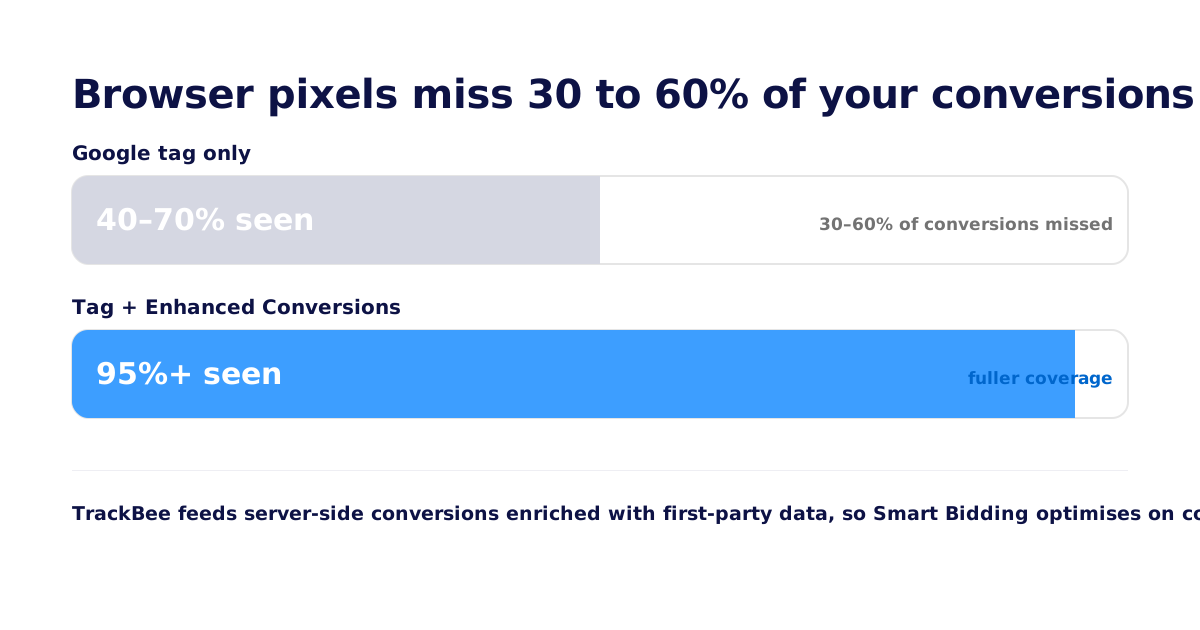
Browser-based conversion tracking, the Google tag running client-side, misses a meaningful share of real purchases. Between ad blockers, iOS privacy changes, consent banners, and the steady decline of third-party cookies, Shopify stores commonly lose 30 to 60 percent of their conversions before they ever reach Google, depending on traffic mix and setup. Post-purchase upsells and one-page checkout edge cases lose even more.
This is not just a reporting nuisance. It actively inflates your costs in two ways:
-
Your CPA and ROAS look worse than reality. If Google sees only half to two thirds of your purchases, your cost per conversion appears 30 to 60 percent higher than it actually is. Targets you set against those inflated numbers are wrong from the start.
-
Smart Bidding trains on an incomplete sample. Google's algorithm learns from the conversions it receives. Feed it half to two thirds of your buyers and it builds a model of who converts based on a partial, possibly skewed slice of your real customers. It then spends your budget chasing that distorted picture.
are designed to close this gap. They send hashed first-party customer data (email, phone, name, address) server-to-server so Google can match conversions it would otherwise miss, recovering signal lost to cookie and browser limitations. Done well, this is what TrackBee calls Enhanced Conversion Coverage: a server-side conversion stream that recovers the purchases your client-side tag drops, deduplicated against it so nothing is double-counted.
TrackBee captures conversion events server-side and enriches them with first-party data before sending them to Google, which improves match rates and recovers the conversions browser tracking misses. It also handles Consent Mode v2 correctly, modeling conversions for users who decline consent so you stay compliant without going blind on measurement. The result is a cleaner conversion signal: Smart Bidding optimizes against your actual buyers, and the CPA and ROAS numbers you budget against reflect reality.
For the full setup, see our guide to Google Enhanced Conversions and how to implement Google Consent Mode v2 on Shopify. See also the Google Ads integration.
Google vs. Meta vs. TikTok: Cost Comparison
Google, Meta, and TikTok solve different parts of the funnel, and their cost structures reflect that. Google captures existing demand, Meta and TikTok create it.
| Meta | TikTok | ||
|---|---|---|---|
| Average CPM | Display ~€2.70 (Search is CPC) | €9.50–€12.50 | ~€10 |
| Average CPC | €0.38–€0.44 (EU ecom) / €2.60+ (US blended) | €0.65–€1.65 | ~€1.00 |
| Minimum budget | No formal minimum | Low (€5/day possible) | €500 campaign |
| Creative requirement | Low (text + product feed) | Moderate | High (native video) |
| Audience intent | Active search intent | Discovery / intent mix | Discovery / browsing |
| Learning phase | ~7 days, ~30 conversions | ~7 days, ~50 events | 7–14 days, 50+ events |
Practical implications for Shopify advertisers:
-
Google reaches users who are actively searching for products, which is the highest purchase intent of the three but a narrower reach. Shopping and Performance Max are the natural fit.
-
Meta reaches users in browse mode and is strong for discovery and retargeting. See our Facebook ads cost guide for the full Meta breakdown.
-
TikTok reaches users in entertainment mode, with the highest creative barrier but unique discovery potential.
If you sell on search demand, Google is usually the highest-ROAS channel in the mix. The catch is that this only holds when its conversion signal is complete. A Search campaign with broken tracking will report a worse CPA than a Meta campaign with clean tracking, even when the Search campaign is genuinely more profitable. Worth noting too: if you are already running search ads, Microsoft Ads typically runs 30 to 40 percent cheaper per click than Google for the same intent.
Frequently Asked Questions
How much do Google Ads cost for a small business in 2026? Most SMB Shopify stores should plan for €920 to €2,300 per month to run Google Ads effectively, with a daily test budget of €18 to €46 to start. The cost per click depends heavily on your campaign type and market: EU ecommerce stores pay around €0.38 to €0.44 per Search click and roughly €0.38 on Shopping, while the much higher US blended figures (€2.60 and up) are skewed by expensive verticals like legal and insurance that ecommerce stores do not compete in.
What is the average cost per click on Google Ads in 2026? For EU ecommerce, the median Search CPC is €0.38 to €0.44, Shopping is around €0.38, and Performance Max is about €0.40. US blended Search CPCs are quoted anywhere from €2.60 to €4.60 depending on the source, because different account databases include different industry mixes. There is no single average; ecommerce sits at the low end of the platform, high-value lead-gen verticals at the high end.
Google Shopping vs Search ads, which is cheaper and which converts better? Shopping clicks are usually cheaper than non-brand Search clicks (around €0.38 versus €0.38 to €0.44 and up in the EU), and Shopping is the more natural fit for product-based DTC stores because it matches products to searches from your feed with no keyword management. Search converts well on high-intent and branded queries. Most Shopify stores run both: Shopping or Performance Max as the volume driver, Search for branded and specific high-intent terms.
What is a good ROAS for Google Shopping or Performance Max in 2026? A typical Shopping or Performance Max campaign returns 3 to 5 times its spend, with Search often higher and Performance Max varying more by feed and vertical. What counts as "good" depends on your margins and customer lifetime value. Just as important: your reported ROAS is only as accurate as your conversion tracking, so a campaign that looks like it returns 3x with broken tracking may actually be returning 4x or more once you recover the missing conversions.
Why is my Google Ads CPA higher than the benchmark? The most common hidden cause is conversion under-reporting. Shopify stores routinely lose 30 to 60 percent of their conversions to ad blockers, iOS privacy, consent banners, and cookie limitations before the data reaches Google. If Google sees only half to two thirds of your purchases, your cost per conversion can look 30 to 60 percent higher than it really is, and Smart Bidding optimizes against an incomplete sample. Server-side tracking with Enhanced Conversions recovers that signal and usually brings your reported CPA back in line with reality.
Google Ads Work When the Tracking Does
Google Ads remain one of the most profitable channels for Shopify stores selling on search demand, with EU ecommerce CPCs around €0.38 to €0.44 and Shopping or Performance Max campaigns returning 3 to 5 times their spend. But every one of those numbers depends on Google being able to see your conversions. When 30 to 60 percent of purchases never reach the platform, your costs look inflated, your targets are set against wrong data, and Smart Bidding trains on an incomplete picture of your buyers.
Server-side tracking with Enhanced Conversions, enriched with first-party data through TrackBee, closes that gap. It recovers the conversions browser tracking misses, keeps you compliant with Consent Mode v2, and gives Smart Bidding the complete signal it needs to hit the targets you set.


.png)