ChatGPT Ads went from rumor to a self-serve ad channel in a matter of months. As of mid-2026, there is no minimum spend, CPC bids start around €2.60–€4.35 (from a $3–$5 starting bid), and CPMs that opened high are already falling. For Shopify brands, the harder question is not what ChatGPT Ads cost to buy, but what they cost you per acquisition, because pixel-only tracking will misread that number badly.
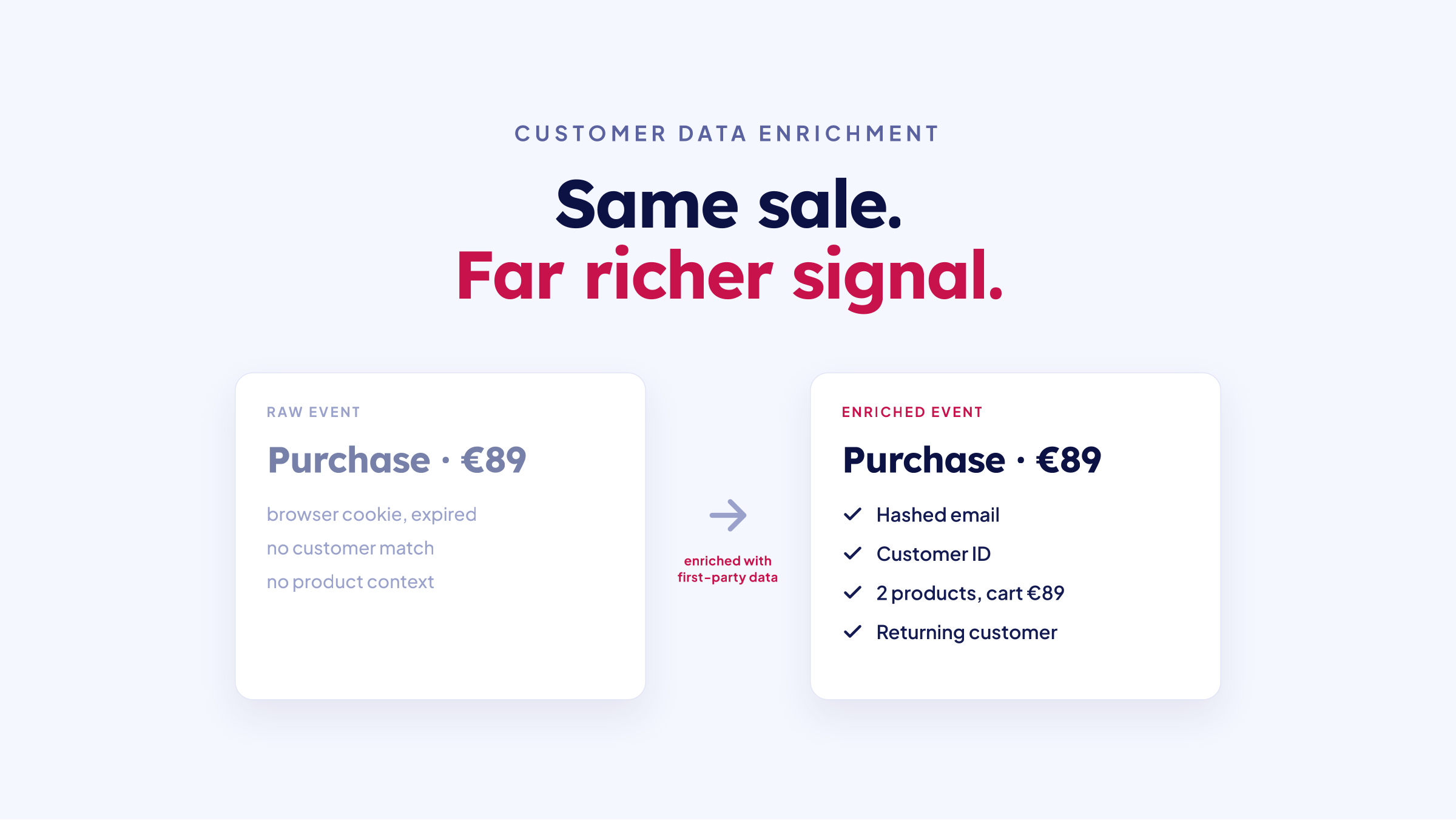
This guide covers what ChatGPT Ads cost so far in 2026, how the formats and bidding work, and why server-side conversion tracking decides whether a channel looks unprofitable on paper or stays measurable. That last part is where TrackBee comes in: it captures your conversions server-side and enriches them with first-party data, so ChatGPT Ads sees the sales the pixel misses and you get an honest cost per acquisition. For how these numbers compare across every paid channel, see our ad cost benchmarks by platform.
ChatGPT Ads Cost Overview
A few facts are confirmed. ChatGPT Ads launched in the US, Canada, Australia, and New Zealand on February 9, 2026, shown as clearly labeled "Sponsored" results on the Free and Go tiers only. A self-serve Ads Manager opened to all US businesses on May 5, 2026, with no minimum spend. Conversion-optimized campaigns with cost-per-action (CPA) bidding arrived on June 5, 2026, and Shopify product-feed shopping ads launched in beta on June 11, 2026 (with a SKU cap reported around one million). ChatGPT reached roughly 900 million weekly active users in early 2026, and the ad-supported free tier is the large majority of them.
The cost picture is an estimate. OpenAI does not publish a fixed rate card, because ChatGPT Ads is an auction. Any number you read is a snapshot of a market that is moving fast, and downward on CPM.
Estimated cost benchmarks (as of mid-2026):
| Metric | Estimated range |
|---|---|
| CPM (cost per 1,000 impressions) | ~€22–€52 (from $25–$60) |
| CPC (cost per click) | ~€2.60–€4.35 (from $3–$5) |
| CPA (cost per action) | Newly available, no public benchmark |
| Minimum spend | None (self-serve) |
These figures are third-party and analyst estimates, converted from USD at roughly 0.87, not OpenAI-published rates. The launch CPM opened with a default max bid near $60 and has been reported clearing as low as ~$25 in some categories, with the trend pointing down. The $3–$5 CPC is a recommended starting max bid, and agency reports suggest it runs higher in competitive categories like software and finance. Treat every number here as directional and verify before you commit budget. A CPM quoted today can be stale within weeks.
ChatGPT Ad Formats and Their Cost Structures
ChatGPT Ads currently come in three shapes, and they share one trait that matters for measurement: they live inside a conversation, not on a web page with cookies and click IDs.
Sponsored results The original format. A clearly labeled "Sponsored" placement appears below the end of a ChatGPT response, visually separated from the answer. Ads are matched to the current conversation topic, plus chat history and prior ad interactions. OpenAI states that ads do not influence the answers and that conversations are kept private from advertisers. Best for: Reaching users actively researching a problem your product solves.
In-conversation placements Because ads are tied to the live topic of the conversation, the targeting signal is intent expressed in natural language rather than a keyword or an interest list. A shopper asking ChatGPT how to fix a specific problem is a different, often warmer, signal than a cold interest audience. This is the closest thing ChatGPT Ads has to search intent, but it is conversational rather than transactional. Best for: Mid-funnel research and consideration, where a shopper is comparing options.
Shopify product-feed shopping ads Launched in Ads Manager beta on June 11, 2026. You upload your catalog and ChatGPT auto-generates sponsored product placements, supporting up to roughly one million SKUs. Eligible Shopify stores were already discoverable inside ChatGPT by default after March 2026 (via the OpenAI sales channel), so the paid product feed builds on an integration many stores already have. Best for: DTC Shopify brands that want their actual products, not just a brand message, surfaced in shopping-intent conversations.
For most Shopify DTC brands, the product-feed shopping format is the obvious entry point, because it maps directly onto a catalog you already maintain. Sponsored results suit brands with a clear problem-solution story that comes up naturally in conversation.
Budget and Access: No Minimum Spend
No minimum spend is what makes ChatGPT Ads accessible to growth-stage Shopify stores rather than only enterprise buyers.
Minimum spend:
none. Since the self-serve Ads Manager opened on May 5, 2026, there is no floor to start. Earlier managed pilots reportedly carried a high minimum, but that was removed at self-serve launch.
How to get in:
the Ads Manager is open to US businesses, and Shopify catalogs integrate through the OpenAI sales channel without a separate app install for discovery. If you already enabled discovery in ChatGPT, the step up to running paid product-feed ads is small.
Practical budget for testing:
with no minimum, the constraint is statistical, not financial. ChatGPT Ads is early and the auction is volatile, so a meaningful test needs enough spend to clear the noise and generate a usable number of conversion events. Treat ChatGPT as one line in a diversified test budget rather than a channel you bet the quarter on. Start small, measure server-side from day one (more on why below), and scale only once the real cost per acquisition holds up.
A note on geography:
as of mid-2026, ads run in the US, Canada, Australia, and New Zealand. EU brands should watch for the rollout but plan around availability before budgeting.
Bidding Strategies Explained
ChatGPT Ads supports the standard auction objectives. The right one depends on how mature your measurement is.
CPM (Reach objective) You pay per 1,000 impressions. This is how the channel launched, with a high default max bid that has been eroding. CPM buying makes sense for awareness, but it puts all the burden of judging value on you, because you are paying for exposure regardless of outcome.
CPC (Clicks objective) You pay per click, with a recommended starting max bid around $3–$5 (roughly €2.60–€4.35). Early advertiser reports suggest very low bids struggle to win impressions, so this may not be a channel where you can sneak in at a token price. CPC is the sensible default for performance-minded advertisers who want to pay for engagement rather than exposure.
CPA (cost per action) Available since June 5, 2026. You optimize toward an action such as a sign-up or purchase, and the algorithm bids to hit it. This objective aligns ChatGPT Ads with your business goal, but it only works as well as the conversion data you feed back to it. If your conversion signal is incomplete, CPA bidding optimizes toward a distorted target. That dependency is the reason the next section exists.
Recommendation for Shopify stores:
start on CPC to control cost per engagement while you learn the channel, and graduate to CPA once you have clean, server-side conversion data flowing back to ChatGPT. CPA without reliable conversion signal is optimization toward the wrong number.
What Drives ChatGPT Ad Cost and Performance
Three forces move your ChatGPT Ads cost, and none of them behave like a fixed rate card.
The auction.
Price is set by competition for the conversation topics you want to appear in. Agency reports suggest categories with deeper-pocketed advertisers, like software and finance, clear at higher CPCs than ecommerce. As more advertisers enter, expect competitive topics to cost more even as the platform-wide CPM falls.
Demand and supply maturity.
ChatGPT Ads is young. Impression supply is growing as OpenAI expands placements, which has pushed CPMs down from their launch highs. That is good for early buyers, but it also means today's economics are not a stable baseline. Budget for a moving target.
Intent quality.
This variable decides whether a click is worth €3 or worthless. A conversational placement can reach someone genuinely mid-decision, which is high-value, or someone idly asking, which is not. Unlike Google Search, where a query like "buy X" is unambiguous, conversation intent is fuzzier. To know which placements deliver real buyers, you have to measure conversions accurately, all the way through to purchase, and most of those conversions do not happen in the click session.
That last point breaks the assumptions most Shopify stores carry over from other channels.
ChatGPT Ads Tracking: Why Server-Side Conversions Matter
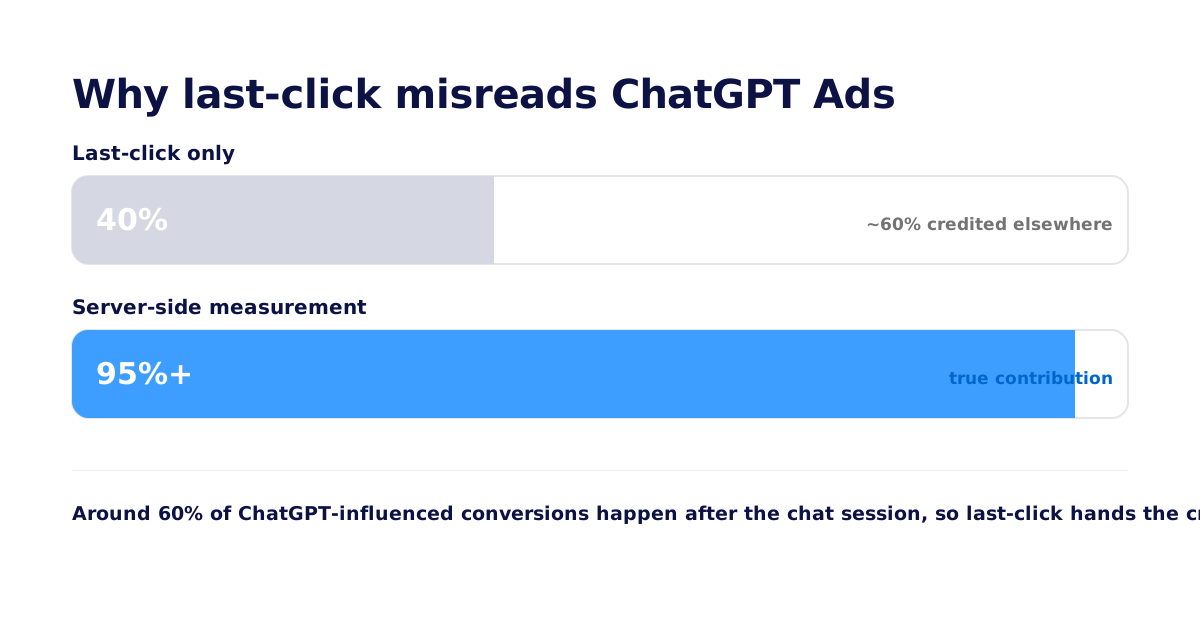
The problem in one sentence: a shopper researches your product inside a ChatGPT conversation, clicks an ad, leaves, and then converts days later through branded search or by typing your URL directly. Last-click attribution hands that sale to Google or to "direct," and ChatGPT Ads looks unprofitable on paper. A third-party measurement estimate from Lapis puts roughly 60% of ChatGPT-influenced conversions outside the original click session. If that estimate is even directionally right, pixel-only tracking will undercount ChatGPT Ads severely, and brands will cut a working channel before it proves itself.
ChatGPT Ads anticipates this. It ships with both a JavaScript pixel and a server-side Conversions API, and OpenAI's documentation describes the server-side API as more reliable than the pixel alone. That is the thesis behind server-side tracking, validated by the platform itself.
The pixel suffers the losses TrackBee already fixes for Meta and Google: ad blockers stop it loading on a large share of sessions, browser privacy controls limit cross-session tracking, and cookie restrictions fragment the multi-day journeys that ChatGPT Ads depend on. In-chat placements make this worse, because there are no cookies or click IDs to fall back on inside a conversation. First-party, server-side signal is the only reliable way to connect a ChatGPT-influenced shopper to the purchase they eventually make.
This is the gap TrackBee was built to close. We capture every conversion server-side and enrich it with first-party data, then send that complete, high-match signal to ChatGPT's Conversions API instead of the thin one a pixel leaves behind. It is the same setup that already improves results for Meta, Google, TikTok, Pinterest, GA4 and Klaviyo, so it carries straight over to ChatGPT Ads. See how the ChatGPT Ads integration works, or try TrackBee for free.
There is a strategic upside for early adopters. ChatGPT's bidding and CPA optimization train on the conversion data you feed back. Brands that send clean, server-side, enriched conversions from day one give the algorithm accurate training data while competitors are still feeding it a leaky pixel signal. For the full picture of how server-side tracking captures conversions across every channel, see full-funnel tracking for Shopify, and for the fundamentals of the approach, read what server-side tracking is and how to install it for Shopify.
ChatGPT Ads vs. Google vs. Meta: Intent and Cost
ChatGPT Ads is not a replacement for Google or Meta. It sits at a different point on the funnel, and its cost data is far less mature.
| ChatGPT Ads | Google Search | Meta | |
|---|---|---|---|
| Estimated CPM | ~€22–€52 (falling, estimate) | Display ~€2.70 (Search is CPC-led) | €9.50–€12.50 (ecom ~€12) |
| Estimated CPC | ~€2.60–€4.35 (estimate) | €2.60–€4.60 US; €0.38–€0.44 EU ecom median | €0.65–€1.65 |
| Minimum spend | None | No formal minimum | Low (€5/day possible) |
| Intent type | Conversational research | Active transactional search | Discovery and intent mix |
| Cost confidence | Low (auction, early estimates) | High (CPC) | High (CPM/CPC) |
Practical implications for Shopify advertisers:
-
Google Search captures shoppers who already know what they want and are ready to transact. It is the most mature data and the clearest intent, but the most competitive auction.
-
Meta reaches shoppers in browse mode and is the workhorse for discovery and retargeting at a low, well-understood cost.
-
ChatGPT Ads sits between them, reaching shoppers mid-research inside a conversation. The intent can be strong, but the cost data is early, the prices are moving, and the attribution is harder.
For more on the mature side of this comparison, see our Google Ads cost guide and Meta and Facebook ads cost guide. Treat ChatGPT as a research-stage placement that you measure server-side, not a like-for-like swap for either.
Frequently Asked Questions
Does ChatGPT have ads? Yes. ChatGPT Ads launched on February 9, 2026, shown as clearly labeled "Sponsored" results below responses. They appear only on the Free and Go tiers, not on Plus, Pro, Business, Enterprise, or Edu, and not for users known or predicted to be under 18. OpenAI states that ads do not influence the answers and that conversations are kept private from advertisers.
How much do ChatGPT Ads cost? There is no fixed rate card, because ChatGPT Ads is an auction. As of mid-2026, estimates put CPC around €2.60–€4.35 (from a $3–$5 starting bid) and CPM around €22–€52 (from $25–$60 and falling). These are third-party estimates, not OpenAI-published rates, and they move fast. There is no minimum spend since the self-serve Ads Manager opened in May 2026.
Can Shopify stores advertise on ChatGPT? Yes. The Ads Manager is self-serve with no minimum spend, and Shopify catalogs integrate through the OpenAI sales channel. Product-feed shopping ads launched in beta on June 11, 2026, letting stores surface actual products (up to roughly one million SKUs) in shopping-intent conversations. As of mid-2026 ads run in the US, Canada, Australia, and New Zealand, so check availability for your market first.
How do you track ChatGPT ad conversions? ChatGPT Ads ships a JavaScript pixel plus a server-side Conversions API, and the server-side API is the more reliable of the two. The pixel alone misses conversions to ad blockers, browser privacy controls, and the multi-day journeys typical of ChatGPT. The fix is server-side tracking with enriched first-party data, which is how you capture the conversions that happen after the click session, a share that a third-party measurement estimate (Lapis) puts at roughly 60% of ChatGPT-influenced conversions.
Are ChatGPT Ads worth it for DTC brands? They can be, but only if you measure them correctly. ChatGPT Ads is early and the cost data is immature, so treat it as a research-stage placement and measure server-side from the start. With last-click attribution alone, the channel will look worse than it is and risk being cut before it proves out. Send clean, enriched conversions back to ChatGPT and you can judge the real cost per acquisition.
ChatGPT Ads Work When the Tracking Does
ChatGPT Ads gave Shopify brands a high-reach channel with no minimum spend and conversational intent that no other platform offers. But its cost data is early, its prices are moving, and most of the conversions it influences happen after the click. The brands that win here measure server-side from day one, feed ChatGPT's Conversions API clean, enriched first-party signal, and judge the channel on real cost per acquisition rather than a leaky last-click number.
TrackBee enriches your conversion events with first-party data and sends them server-side, the same infrastructure that already improves Meta and Google performance, so ChatGPT Ads gets the complete conversion signal it needs to optimize and you get an honest read on what the channel actually costs.


.png)