

Short answer: Last-touch attribution gives all credit to the final click, overpaying for brand search and retargeting while underfunding the campaigns that create demand. Since most ecommerce customers touch several channels before buying, it misattributes credit and skews budgets. Data-driven attribution uses your real conversion data to distribute credit by actual contribution.
Last-touch attribution is the default for most marketers who haven't explicitly chosen an attribution model. It's simple: whatever the customer clicked last before converting gets all the credit. Brand search gets the sale. Retargeting gets the sale. The Meta prospecting campaign that introduced the brand to the customer three weeks ago gets nothing.
The problem: last-touch attribution doesn't reflect how customers actually convert. Most e-commerce customers touch multiple channels before purchasing. Last-touch systematically misattributes conversion credit - and the budget decisions that follow are systematically wrong.
Data-driven attribution (DDA) is the alternative. It uses machine learning and your actual conversion data to distribute credit across touchpoints based on their real contribution to conversion - not an arbitrary rule about which click came last.
The Problem with Last-Touch Attribution
Last-touch attribution gives 100% of conversion credit to the final interaction before a conversion occurs. Everything that happened before - the awareness campaign that introduced the brand, the consideration-stage content that explained the product, the email that kept the brand top-of-mind - receives zero credit.
The concrete distortion this creates:
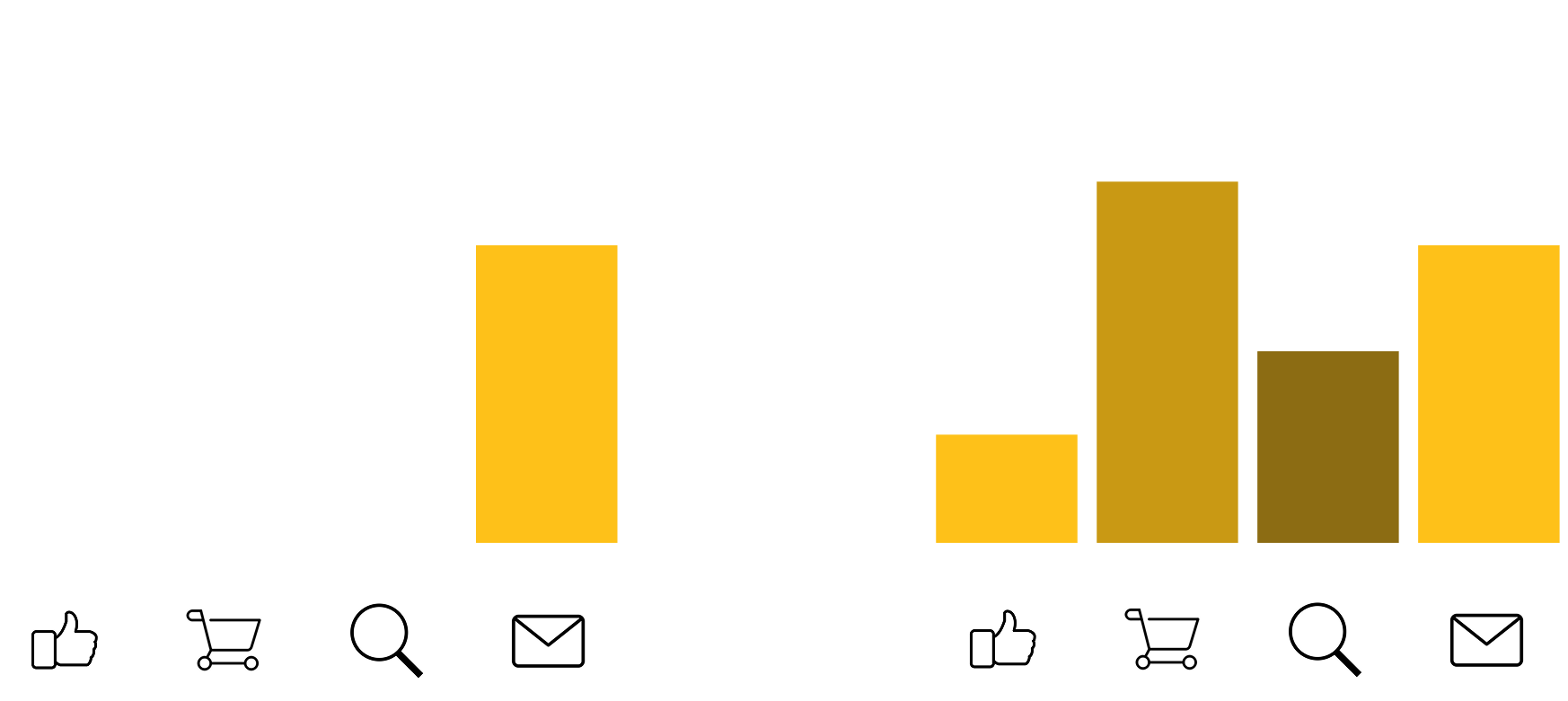
A customer sees a Meta prospecting ad, visits your site, reads your blog post, gets added to your Klaviyo list, receives two emails, searches your brand on Google, clicks a branded search ad, and purchases.
Under last-touch attribution:
-
Google Ads branded search: 100% of credit
-
Meta prospecting: 0%
-
Email sequence: 0%
-
Organic content: 0%
Your reporting shows Google Ads branded search driving high ROAS. Meta prospecting shows poor ROAS. You shift budget from Meta to Google. Demand generation drops. Fewer people search your brand. Google's branded search volume falls. ROAS on branded search drops.
This is the self-defeating cycle that last-touch attribution creates: it starves top-of-funnel channels that generate demand, which eventually destroys the bottom-funnel performance it was over-crediting.
The budget allocation problem: Last-touch attribution systematically directs budget toward the channels that sit at the bottom of the funnel - retargeting campaigns, branded search, email. These channels convert well because they're reaching people who are already convinced. They rarely create that conviction. The channels that create it - prospecting campaigns, awareness content, organic search - get underreported ROAS and face budget cuts.
What Data-Driven Attribution Does Differently
Data-driven attribution uses machine learning to analyze your actual conversion data - all the touchpoints across all the paths - and assigns credit based on how much each touchpoint statistically contributed to conversions.

Instead of a rule ("last click gets everything"), it uses statistical analysis:
-
What's the conversion rate for customers who saw Channel A?
-
What's the conversion rate for customers who saw Channel A and then Channel B?
-
How much does adding Channel B to the Channel A path increase the conversion probability?
-
The incremental probability increase is the "contribution" - and it determines credit allocation
This approach captures the genuine influence of each channel, including channels that contribute early in the customer journey without being the final click.
What changes with DDA:
-
Prospecting and awareness campaigns show higher attributed revenue (because their contribution to later conversions is measured)
-
Retargeting and branded search show lower attributed revenue (because their current over-attribution is corrected)
-
Budget decisions based on DDA reflect actual channel influence rather than final-click proximity
How DDA Works in Google Ads and Meta
Google Ads and GA4
Google Ads now defaults to data-driven attribution for all conversion actions (for accounts with sufficient data). GA4's default attribution model is also data-driven.

Google's DDA analyzes interaction data across Search, Shopping, YouTube, Display, and Discovery campaigns. It uses a counterfactual analysis: comparing the conversion paths of customers who converted to those who didn't, identifying which touchpoints made the statistical difference.
Minimum data requirements: Google's DDA requires a minimum number of conversions and interactions to build a statistically meaningful model. Accounts with fewer than ~150 conversions over the last 30 days may not qualify for DDA and will fall back to a rules-based model.
Meta
Meta's attribution window defaults to 7-day click and 1-day view. Meta uses machine learning for its attribution but the approach differs from Google's - Meta's system is inherently single-platform. It analyzes touchpoints within Meta's ecosystem (ads across Facebook, Instagram, Messenger, WhatsApp) and attributes based on patterns within that ecosystem.
The Meta-specific limitation: Meta attributes conversions based on what it can observe - interactions with Meta ads. It has no visibility into your Google Ads, email, or organic traffic. This means Meta will attribute conversions that were multi-touch across platforms as entirely Meta-driven if a Meta touchpoint was present.
The Cross-Platform Attribution Conflict
Here's the practical reality of running campaigns across Google and Meta simultaneously: both platforms will claim the same conversion.
A customer clicks a Meta ad on Tuesday, clicks a Google Shopping ad on Thursday, and purchases. Meta counts a conversion (7-day click window covers Tuesday's click). Google counts a conversion (30-day click window covers Thursday's click). Your Shopify analytics shows one order.
Neither platform's attribution is wrong given its own model. But together, they report 2 conversions from 1 actual order. Your combined platform ROAS looks better than your actual business ROAS.
This is why reported ROAS across platforms almost always exceeds actual business ROAS. And it's why budget decisions made entirely on platform-reported data are systematically distorted.
What data-driven attribution does and doesn't solve for this: DDA within each platform produces better attribution than last-touch within that platform. But DDA doesn't resolve the cross-platform attribution conflict - Google's DDA doesn't see Meta touchpoints, and Meta's DDA doesn't see Google touchpoints.
A cross-platform view requires a unified attribution layer - either a measurement tool that receives data from all platforms, or a triangulation methodology (comparing platform-reported conversions to Shopify actuals and modeling the difference). If you're evaluating dedicated attribution tools, our comparison of TripleWhale alternatives breaks down the difference between attribution dashboarding and upstream data quality.
What DDA Needs to Work Correctly
Data-driven attribution is more accurate than last-touch - but only when it has access to complete, high-quality data.
The data quality dependency:
Google's DDA model is built from your conversion data. If 30–40% of your purchase events are missing - blocked by ad blockers, lost to iOS restrictions, or not firing due to checkout tracking failures - DDA is building attribution models from incomplete training data.
Incomplete data doesn't just produce lower conversion counts. It introduces systematic bias:
-
Users who convert with ad blockers (who don't send events) are underrepresented in the training data
-
Attribution patterns from the users whose events do reach Google may not represent your full buyer population
-
Google's model "learns" from a biased sample
Server-side tracking closes this gap. When all purchase events reach Google - not just the ones from users whose browsers allow tracking - DDA has complete data to build accurate attribution models from. Note: while Google abandoned its Privacy Sandbox plans to deprecate third-party cookies, the DDA data quality problem remains - ad blockers, iOS Link Tracking Protection (expanding in iOS 26), and Consent Mode V2 enforcement (since July 2025) all reduce the conversion events reaching Google. Server-side tracking addresses all three. See: What is server-side tracking and how to install it for Shopify.
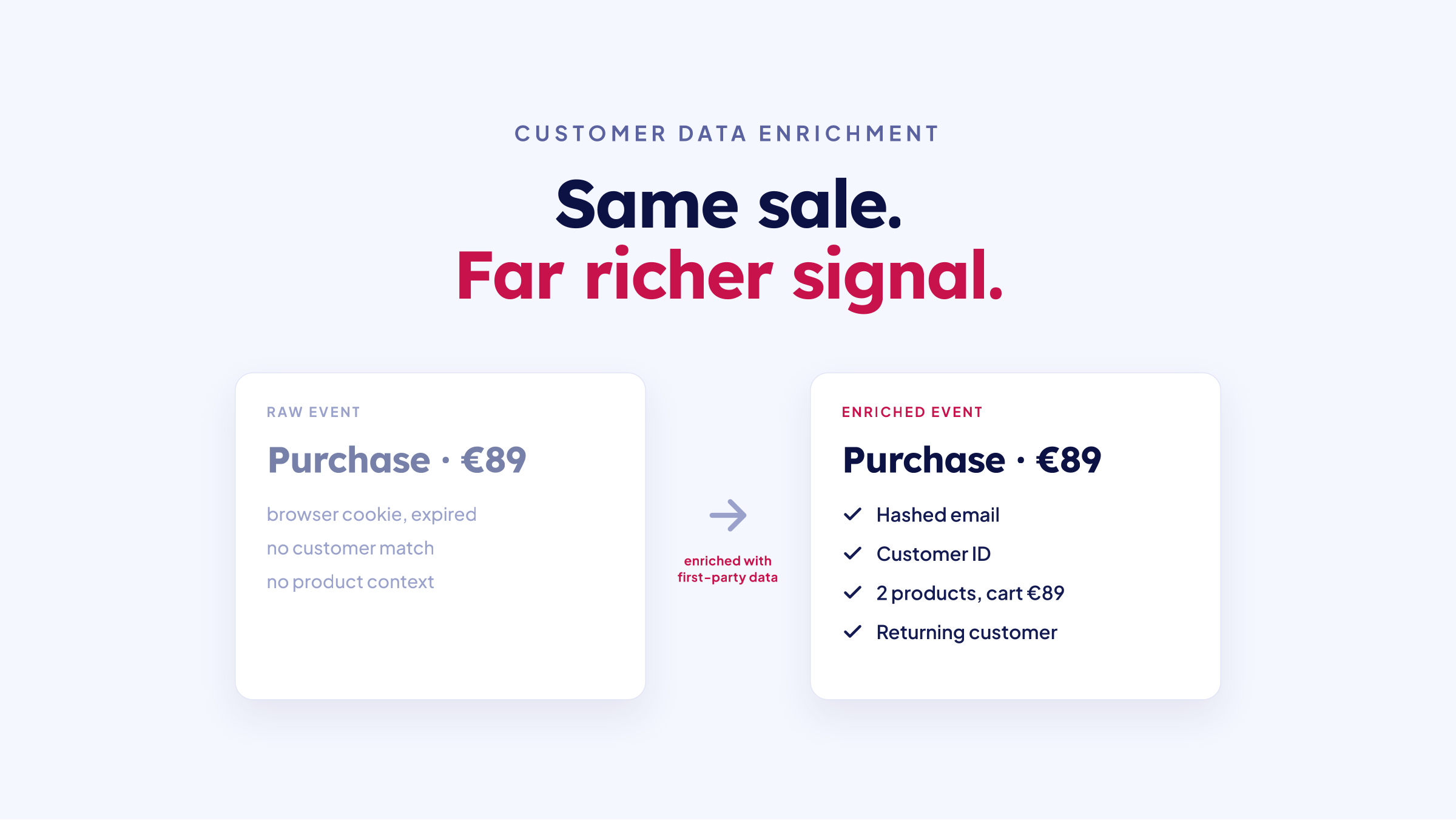
Shopper profile enrichment: DDA also benefits from richer event data. When each conversion event arrives with hashed email, name, and click IDs - rather than just an IP address - the matching quality improves. Better matching means more accurate attribution, particularly for cross-device conversion paths.
TrackBee builds persistent Shopper Profiles that are sent with every event to Google and Meta - enriching the data that powers both platforms' attribution models. See: Full-funnel tracking for Shopify: how does it work?.
When to Switch to Data-Driven Attribution
DDA requires sufficient conversion volume to build a reliable statistical model. If you're generating fewer than 150 conversions per month on a given platform, the model has limited data to work from.
Switch to DDA when:
-
You're generating 150+ conversions per month in Google Ads (Google's minimum for DDA)
-
You're running multi-channel campaigns (if you're only on one platform, cross-channel misattribution is less of an issue)
-
You want budget allocation to reflect actual channel contribution rather than final-click proximity
-
Your current model is producing budget decisions you suspect are wrong (overinvesting in retargeting/branded search, underinvesting in prospecting)
Before switching: Fix your tracking completeness first. Switching to DDA on incomplete conversion data produces a more sophisticated version of the wrong answer. Ensure server-side tracking is running and your conversion data is as complete as possible before transitioning attribution models.
Frequently Asked Questions
Does switching to data-driven attribution require any code changes? In Google Ads and GA4, attribution model changes are made in the platform settings - no code changes required. The conversion tracking code stays the same; only the model that assigns credit to those conversions changes.
Will my ROAS numbers change when I switch to DDA? Yes. Channels that were over-credited under last-touch (retargeting, branded search) will show lower ROAS. Channels that were under-credited (prospecting, awareness) will show higher ROAS. Total attributed revenue may also change slightly as the model distributes credit differently. This is the model working correctly - your actual revenue hasn't changed.
How do I handle the attribution conflict between Meta and Google? Accept that platform-reported attribution will always double-count some conversions. The more useful metric is comparing your total platform-reported conversions to Shopify's actual order count - the ratio tells you how much overlap exists. Focus budget decisions on incrementality testing and business-level ROAS rather than platform-reported ROAS alone.
Does data-driven attribution work for small Shopify stores? For stores below ~150 monthly conversions, Google's DDA may not activate (it requires minimum data to build a reliable model). In this case, "position-based" or "time-decay" attribution models are better alternatives to last-touch while you build toward DDA-qualifying conversion volume.
Can I see DDA data in my GA4 reports? Yes. GA4's Attribution reports (under Advertising > Attribution) show conversion credit distribution across touchpoints under different attribution models, allowing you to compare how DDA distributes credit compared to other models for the same conversion data.


.png)