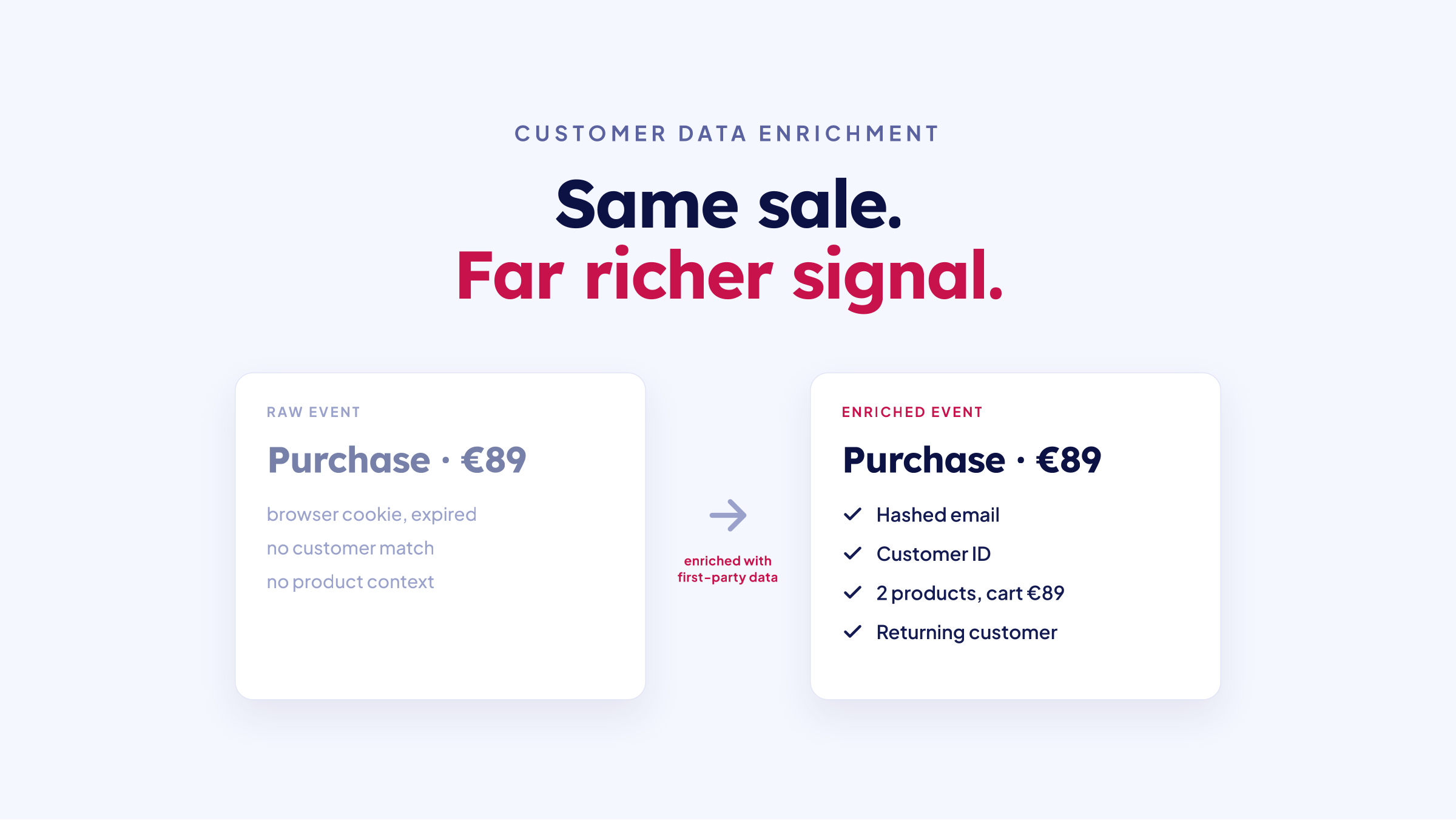
Short answer: Ad platforms underreport because ad blockers, iOS privacy restrictions and browser limits strip 25 to 40 percent of conversion events before they arrive. The fix is server-side tracking, which captures purchases at the server level and sends them to your platforms. Better signal means smarter algorithms, lower CPAs and ad spend that reflects real performance.
For the full picture of how conversion tracking should be set up, see Shopify conversion tracking, done right.
You spent $15,000 on Meta ads last month. Meta reported 120 purchases. Shopify recorded 198. That is 78 conversions your ad platform never saw.
Those missing conversions are not a harmless reporting quirk. They directly damage your ad performance. When Meta, Google, or TikTok cannot see a conversion, their algorithms cannot learn from it. Every underreported purchase degrades the signal your campaigns rely on. The result: worse targeting, higher CPAs, and budget wasted on audiences that would not have converted.
This guide walks you through why underreporting happens, how to diagnose it on your store, and what fixing it does to your performance across every major ad platform.
Why Ad Platforms Underreport Your Conversions
Underreporting is not caused by a single technical failure. It is the combined result of multiple privacy changes, browser restrictions, and device limitations that each strip away a portion of your conversion data.
When Apple introduced ATT in iOS 14.5, users gained the ability to opt out of cross-app tracking. Over 80% of users decline. For Shopify brands where 50-70% of traffic comes from iOS devices, this means the majority of mobile ad interactions lose their attribution link. The customer clicked your ad, visited your store, and purchased. The platform just cannot connect those events.
iOS 17+ made this worse by introducing Link Tracking Protection, which strips click IDs (fbclid, gclid, ttclid, epik) from URLs. The purchase event arrives at the ad platform without the click context that enables attribution. For a complete breakdown of every iOS privacy change and how to mitigate them, see our guide to iOS-proofing your ads.
Browser extensions like uBlock Origin, AdBlock Plus, and Brave's built-in shields block tracking pixels at the browser level. Every visitor running an ad blocker is invisible to your client-side tracking. Depending on your audience demographics, this affects 10-25% of visitors.
Cookie consent rejection
GDPR and CCPA compliance requires cookie consent in the EU and California. Users who decline generate zero client-side tracking events. In EU markets, rejection rates of 30-50% are common. Google's Consent Mode V2 enforcement means advertisers without a compliant consent setup lose remarketing and audience signals entirely for EEA users.
Cookie expiration
Safari limits first-party cookies to 7 days. Firefox and Chrome are following with similar restrictions. Any customer who clicks an ad and converts more than 7 days later is unattributed in browser-based tracking. For brands selling products above $50-100, where purchase consideration often exceeds a week, this creates a persistent attribution gap.
Multi-device journeys
A customer discovers your product on Instagram via phone, researches on a tablet, and purchases on a desktop. Browser-based pixels treat these as three unrelated sessions. The purchase is never connected to the original ad interaction.
Cumulative impact
These mechanisms partially overlap, but the combined tracking loss typically lands between 25-40% of conversions for most Shopify brands. For stores with high European traffic, iOS-heavy audiences, or privacy-conscious demographics, the gap can approach 45-50%.
How to Diagnose Underreporting on Your Store
Before you fix underreporting, you need to measure it. Here is a straightforward diagnostic process.

Step 1: Pull your baseline numbers
Open two dashboards side by side:
-
Shopify Admin > Analytics: note your total order count and revenue for the last 30 days.
-
Each ad platform's conversion dashboard: note the Purchase event volume and attributed revenue for the same period.
Step 2: Calculate the gap per platform
For each ad platform, run this calculation:
Example:
-
Shopify orders from Meta campaigns (last 30 days): 198
-
Meta Purchase events (same period): 120
-
Underreporting gap: 1 - (120 / 198) = 39.4%
Repeat for Google Ads, TikTok, and Pinterest. Each platform will have a different gap size based on its reliance on client-side signals and the traffic mix it sends you.
Step 3: Check for click ID coverage
Click IDs are the identifiers ad platforms attach to URLs when a user clicks an ad. Meta uses fbc, Google uses gclid/gbraid/wbraid, TikTok uses ttclid, and Pinterest uses epik.
If you have access to your order data, check what percentage of orders carry a click ID. Orders without click IDs happen because of:
-
View-through conversions: the customer saw your ad but did not click it
-
Direct or organic visits after ad view: the customer remembered your brand and typed the URL
-
iOS stripping click IDs: Apple removes tracking parameters from URLs
-
Multi-touchpoint journeys: the converting session does not carry the original click context
A healthy click ID coverage rate is 40-60% of ad-attributed orders. If yours is lower, iOS traffic and multi-device journeys are likely eroding your attribution data.
Step 4: Check your Event Match Quality (Meta-specific)
In Meta Events Manager, navigate to your pixel and check the EMQ score. This number (1-10) measures how well Meta can match your server events to user profiles. A score below 7 means Meta is struggling to attribute conversions. Most brands running only client-side tracking see EMQ scores between 5 and 7.
For a deeper guide on diagnosing your tracking health, see How Much Revenue Are You Losing to Bad Tracking.
The Compounding Effect: Why Underreporting Gets Worse Over Time
Here is what most Shopify brands miss: underreporting is not a static problem. It creates a negative feedback loop that degrades performance over time.

Stage 1: Data loss Privacy changes cause 25-40% of conversions to go unreported. Your campaigns look less effective than they actually are.
Stage 2: Algorithmic mistraining Meta, Google, and TikTok optimize campaigns based on conversion data. When they see fewer conversions, their algorithms conclude that your targeting or creative is underperforming. The machine learning models that determine who sees your ads are trained on incomplete data.
Stage 3: Worse targeting decisions With incomplete training data, platform algorithms make suboptimal bidding decisions. They underbid on high-value audiences (because they never saw the conversions) and overbid on low-value ones. Your CPA rises. Your ROAS drops.
Stage 4: Budget reallocation You see worse reported performance and respond logically: you reduce budget on "underperforming" campaigns or shift spend to platforms with better reported numbers. But the campaigns were not actually underperforming. They were underreported.
Stage 5: Compounded decline Less budget means fewer conversions means even less training data. The algorithm has less signal to work with. Targeting gets worse. Reported performance drops further. The cycle continues.
This is why brands with identical creative, similar audiences, and comparable budgets can see dramatically different results. The difference is often not strategy. It is data quality. The brand with better tracking feeds better signal to the same algorithms and gets better output.
For more on how bidding algorithms depend on data quality, read AI Bidding Needs Better Data.
Platform-Specific Underreporting: Meta, Google, TikTok, Pinterest
Each ad platform has different vulnerabilities to underreporting. Here is where the gaps are largest and why.

Meta (Facebook and Instagram)
Meta is the platform most affected by iOS ATT because its core ad product depends on cross-app tracking. The Meta Pixel fires client-side, making it vulnerable to ad blockers, cookie consent, and Safari cookie restrictions simultaneously.
Where conversions go missing:
-
iOS users who opted out of ATT (80%+ of iOS users)
-
Users who declined cookie consent
-
Users with ad blockers installed
-
Purchase journeys longer than Safari's 7-day cookie window
-
Cross-device conversions from mobile ad view to desktop purchase
The fix:
Server-side Conversions API (CAPI) sends events directly from the server, bypassing browser restrictions entirely. When paired with data enrichment that attaches hashed customer identifiers (email, phone, address) to every event, Meta can match server events to user profiles even without a click ID.
Measured impact:
TrackBee captures 30-40% more conversion data than client-side tracking alone. Brands improving their EMQ from 8.6 to 9.3 saw CPA drop 18%, match rate increase 24%, and ROAS lift 22%.
For the full technical setup, see Meta Conversions API for Shopify: Complete Guide.
Google Ads
Google is less affected by iOS ATT than Meta because much of its ad inventory runs through its own browser (Chrome) and search engine. But Google is still vulnerable to consent rejection, ad blockers, and cross-device gaps.
Where conversions go missing:
-
Safari and Firefox users (cookie restrictions)
-
Users who declined cookie consent in EU/EEA markets
-
Cross-device journeys (especially mobile search click to desktop purchase)
-
Smart Shopping and Performance Max campaigns with incomplete conversion data
The fix:
Server-side Enhanced Conversions send hashed first-party customer data (email, phone, name, address) with every conversion event. Google matches this data against signed-in Google accounts to recover attribution.
Measured impact:
Brands running server-side Enhanced Conversions see an average 17.1% increase in measured conversions. This directly improves Smart Bidding performance because the algorithm has more signal to optimize against. For a complete walkthrough of TrackBee's four-layer approach to Google tracking, see TrackBee's Google Ads Integration.
Learn more in The Ultimate Guide to Google Enhanced Conversions.
TikTok
TikTok faces similar challenges to Meta: heavy iOS traffic (TikTok's audience skews mobile), reliance on client-side pixel, and vulnerability to ad blockers.
Where conversions go missing:
-
iOS users (TikTok is predominantly a mobile platform)
-
Users with in-app browser restrictions
-
Purchase journeys that start in TikTok but convert on desktop
-
Consent rejection in EU markets
The fix:
TikTok's Events API allows server-side event delivery with enriched identifiers. Server events include hashed email, phone, and external ID for better user matching.
Measured impact:
Server-side tracking captures 19% more events and delivers a 15% CPA improvement. For a platform where most users interact via mobile and many conversions happen across devices, recovering these events has an outsized impact on campaign optimization.
Pinterest has a unique underreporting problem. Its users frequently save pins and return days or weeks later to purchase. This long consideration cycle means cookie expiration affects Pinterest more than any other platform.
Where conversions go missing:
-
Long consideration cycles (pin saved today, purchased in 14 days)
-
Safari cookie expiration before conversion
-
Cross-device journeys from mobile browse to desktop purchase
-
Consent rejection
The fix:
Pinterest's server-side Conversions API, paired with persistent shopper profiles that maintain attribution context beyond browser cookie windows.
Measured impact:
Brands running server-side tracking see a 14% reduction in CPA and 28% more attributed conversion volume. For Pinterest specifically, where the attribution window problem is most acute, server-side tracking recovers conversions that are structurally invisible to client-side pixels.
How Server-Side Tracking and Data Enrichment Close the Gap
Understanding why server-side tracking works requires understanding what it does differently from browser-based pixels.
Client-side tracking (the default)
A JavaScript pixel loads in the visitor's browser. It fires events (PageView, AddToCart, Purchase) to the ad platform. Every event passes through the browser, which means:
-
Ad blockers can intercept it
-
Cookie consent can prevent it
-
Safari can expire the cookie before conversion
-
iOS can strip the click ID from the URL
The pixel is only as reliable as the browser environment allows. And that environment is increasingly hostile to tracking.
Server-side tracking (the solution)
Events are captured at the server level and sent directly to ad platforms via API. The browser is not involved in the data transmission. This means:
-
Ad blockers cannot intercept server-to-server communication
-
Events fire regardless of cookie consent status (with appropriate consent handling)
-
Cookie expiration does not affect server-stored session data
-
Click IDs can be captured and stored before iOS strips them
But server-side tracking alone is not enough. Raw server events without enrichment are only marginally better than client-side events. The real performance improvement comes from data enrichment.
What data enrichment adds
Data enrichment means attaching additional context and identifiers to every event before sending it to ad platforms:
-
Hashed customer identifiers: email, phone number, and address (SHA-256 hashed for privacy) attached to events so platforms can match them to user profiles
-
Session context: traffic source, click ID, landing page, and referrer data preserved across the entire session
-
Product and cart context: product categories, cart value, variant data that help platform algorithms understand purchase intent signals
-
Persistent shopper profiles: cross-session, cross-device identity resolution that connects the same customer across multiple visits
-
GA4 completeness: server-side GA4 data via the Measurement Protocol fills the gaps that client-side GA4 tracking misses - see TrackBee's GA4 Integration for how this works
This enrichment is what transforms server-side tracking from a marginal improvement into a significant competitive advantage. When Meta receives a Purchase event with a hashed email, phone number, and the original click ID from three sessions ago, it can do things that a raw pixel event never allowed.
For a deeper explanation of how enrichment works, read How to Improve Meta's Event Match Quality Score.
What to Expect in the First 30 Days After Fixing
Fixing underreported conversions does not produce instant results. Here is a realistic timeline of what happens when you implement server-side tracking with data enrichment.
Days 1-3: Verification
After connecting server-side tracking, your first task is verification. Place a test order and confirm it appears in both your tracking dashboard and in the ad platform's event manager. Server events in Meta can take up to 48 hours to appear. Google and Pinterest may take up to 72 hours.
Check your browser console (right-click > Inspect > Console) to confirm client-side components are loading correctly alongside the server-side stream.
Days 3-7: Data volume increase
Within the first week, you will see a noticeable increase in reported conversion events across all connected platforms. This is the underreported gap closing. More Purchase events, more AddToCart events, more complete funnel data.
Your EMQ score in Meta should begin rising. Most brands see an improvement of 2-4 points within the first two weeks.
Days 7-14: Algorithm recalibration
This is the critical phase. Ad platform algorithms are now receiving more conversion data than before. They begin recalibrating their models. During this period, you may see some fluctuation in CPA and ROAS as the algorithms adjust to the new, more complete signal.
Do not make aggressive budget changes during this window. Let the algorithms retrain on the improved data.
Days 14-30: Performance improvement
By the end of the second week, most brands begin seeing measurable improvements in campaign metrics. The platforms have had enough new data to retrain their bidding models. You should see:
-
Lower CPAs as algorithms target more precisely based on complete conversion data
-
Higher ROAS as spend is allocated more effectively
-
Better audience matching as enriched identifiers improve user profile resolution
-
More stable performance with less day-to-day volatility in reported metrics
The brands that see the fastest improvement are typically those with the largest pre-existing underreporting gaps. If you were missing 35-40% of conversions, recovering that data gives the algorithm a substantial amount of new signal to work with.
Beyond 30 days: Compounding gains
The positive feedback loop is now working in your favor. Better data means better targeting means more conversions means more training data. Over 60-90 days, the compound effect of consistently complete conversion data produces performance gains that exceed the initial improvement.
This is also when you can start making more informed budget allocation decisions. With accurate cross-platform conversion data, you can see which platforms are truly driving results and allocate spend accordingly, rather than over-indexing on the platform with the best reported numbers.
FAQ
Will fixing underreporting increase my total number of Shopify orders?
No. Server-side tracking does not create new orders. It reports existing orders that were previously invisible to your ad platforms. Your actual sales volume stays the same. What changes is the ad platforms' ability to see and learn from those sales, which improves their targeting and bidding over time.
Does server-side tracking replace my existing pixels?
No. The most effective setup combines browser-side pixels with server-side tracking. The browser pixel handles real-time user interactions. The server-side stream provides a complete, deduplicated event feed. Both work together, with deduplication ensuring no double-counting.
How does this work with cookie consent?
Server-side tracking respects consent signals. When a user declines consent, conversion events can still be sent to platforms without personal identifiers. Platforms like Google can then model conversions using data from consenting users. This is fully compliant with Google Consent Mode V2.
My Meta conversions are higher than my Shopify orders for Meta. Is that a problem?
Not necessarily. Meta attributes conversions using both click-through and view-through models. A customer who saw your ad but did not click, then later purchased, is counted by Meta but may not appear as a Meta-attributed order in Shopify. Both numbers can be correct because they measure different things.
How long does setup take?
With a Shopify-native solution like TrackBee, setup takes less than 5 minutes. Install the app, connect your store, link your ad platform accounts, and enable the app embed in your Shopify theme. No developer required, no GTM configuration, no ongoing maintenance.
Will this affect my existing campaign performance negatively during the transition?
There is typically a brief recalibration period (7-14 days) where algorithms adjust to the increased data volume. During this time, you may see minor fluctuations. After recalibration, performance consistently improves because the algorithms are working with more complete data.


.png)