.png)


Short answer: Acquisition campaigns waste budget on people who already bought because exclusion audiences are only as current as your data, and a manual CSV export lags behind real purchases. The fix is keeping exclusion audiences updated from live conversion data across Meta, Google and TikTok, so spend reaches new prospects. It works without Shopify Plus.
You just bought a new pair of sneakers. You're happy with them - until those same sneakers follow you across the internet for the next two weeks. It's annoying. It might even make you like the brand less.
Now think about this from the advertiser's side: they're paying for every one of those impressions. They're paying to advertise to someone who already bought. Those ad dollars could have been reaching new potential customers - instead, they're burning impressions on an existing one.
This is unintended retargeting of returning customers. It's a quiet, persistent drain on most ad budgets. And it happens because platforms don't know your customer already converted.
The good news: this is completely fixable without Shopify Plus.
Why This Keeps Happening
Meta, Google, TikTok, and every other ad platform determine who to show your ads to based on the audience data you provide - and their own modeling of user behavior.
Your acquisition campaigns are designed to reach non-customers. You might have an exclusion audience of existing customers set up. But that exclusion is only as current as your data.
The timing gap:
A customer purchases on your Shopify store at 2pm. Your Meta customer exclusion audience was last updated from a manual CSV export two weeks ago. She isn't in the exclusion list. Your Meta acquisition campaign serves her ads at 3pm. You pay for those impressions. She sees ads for something she already bought.
This is the default state without automated, real-time audience synchronization.
Tracking gaps compound the problem:
Even with automated audience sync, tracking gaps create exclusion delays. If a purchase event doesn't reach Meta because the browser pixel didn't fire - blocked by ad blockers or iOS restrictions - Meta never learns about the conversion. The customer remains in acquisition targeting indefinitely.
Cross-device purchases create another failure mode: a customer who purchased on a different device than the one where they clicked the ad may not be matched to their existing profile. From the platform's perspective, the purchase didn't happen.
When your conversion tracking is incomplete, your exclusion audience is incomplete - even with real-time sync in place.
The Four-Way Damage to Your Campaigns
1. Direct budget waste
Every impression served to an existing customer is an impression that didn't reach a potential new customer. The unit economics are unfavorable: you're spending acquisition-priced CPMs on a user who has zero probability of being a new customer.
At scale, this isn't trivial. If 5-10% of your acquisition audience is existing customers - a conservative estimate for stores without automatic exclusion - that's 5-10% of your acquisition budget generating no possible new customer value.
2. Algorithm confusion
Your acquisition campaign is optimizing to find users who will make a first purchase. The algorithm serves impressions to existing customers. They don't complete a "new purchase" - they already have what they need. The algorithm receives a negative signal: this user didn't convert.
This teaches the algorithm that users who behave like your existing customers are unlikely to convert. Your campaign learns to avoid your best prospects. The damage compounds with every impression served to an existing customer who "doesn't convert" to acquisition.
3. Inflated and misleading ROAS
Existing customers who see acquisition ads and happen to make a repeat purchase appear as acquisition conversions in your reporting. This inflates your reported new customer ROAS - it looks like the campaign is performing well, but some of those "new customers" are existing ones who would have repurchased anyway.
This makes it harder to assess the true performance of new customer acquisition and can lead to over-investment in campaigns that aren't generating the new customers they appear to be. See also: Why consistent data across all your ad channels is essential for performance.
4. Brand experience degradation
Customers who are consistently retargeted after purchasing form a negative impression. "Why is this brand still advertising the thing I already bought?" is a sentiment that erodes post-purchase satisfaction and reduces the likelihood of organic word-of-mouth.
Why the Problem Is Bigger Than It Looks
Most performance marketers underestimate unintended retargeting for two reasons.
Reporting doesn't surface it.
Platform reporting doesn't separate "existing customer who saw acquisition ad and didn't convert" from "genuine new prospect who didn't convert." Both look the same. The budget waste is invisible unless you specifically look for it.
Manual exclusion lists fall behind immediately.
The standard fix - exporting a customer list from Shopify and uploading it as a custom audience exclusion - works for the moment of upload. But your customer list grows every day. A customer who purchased yesterday isn't in last week's export. The exclusion list is out of date the moment you finish uploading.
For stores with regular purchase volume, a monthly or even weekly manual export means your exclusion audience is perpetually behind. The only customers actually excluded are those who purchased before the last export.
The only solution that keeps the customer audience automatically current without manual exports has historically been Shopify Plus Audiences. But Shopify Plus has a significant monthly cost that many brands aren't paying just for audience management.
The Fix: Automatic Audience Syncing with Real-Time Data
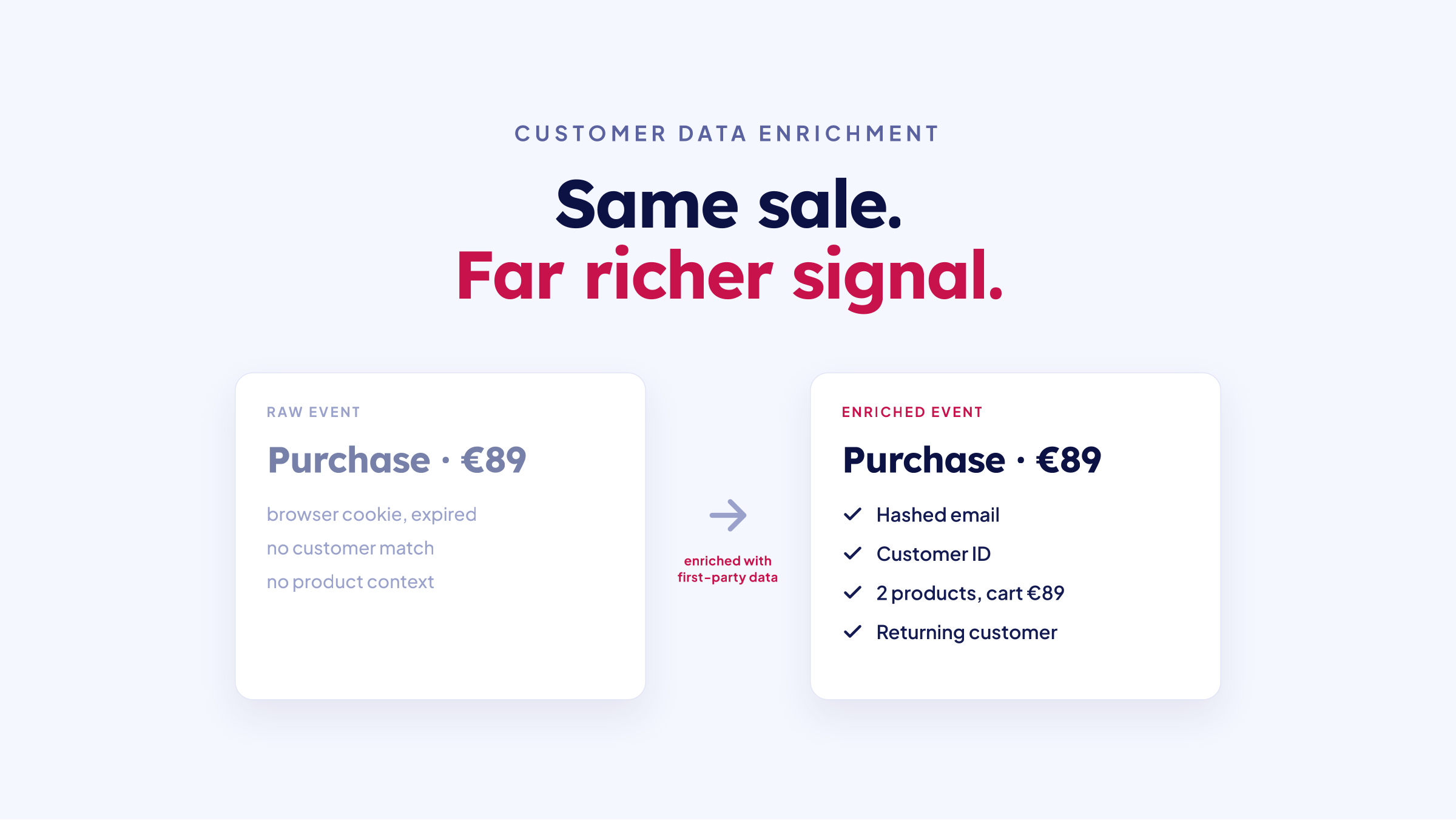
Solving unintended retargeting requires two things working together: automatic, real-time audience sync and complete conversion tracking.
Automatic audience sync
TrackBee's Custom Audience Sync updates your Meta customer audience every 5-15 minutes. A customer who purchases at 2pm is in your exclusion audience by 2:15pm. No CSV exports. No manual uploads. No Shopify Plus required.
What this enables:
-
Exclude existing customers from acquisition campaigns. Add the synced customer audience as an exclusion in your acquisition ad sets. As new customers purchase, they're automatically added to the exclusion audience within minutes - no manual action required.
-
Build accurate lookalike audiences. A larger, more current customer audience produces more accurate lookalikes. Instead of lookalikes built from a weeks-old export, you're working with a customer audience that reflects reality.
-
Separate new vs. returning customer metrics. With a properly maintained customer exclusion audience, you can track which conversions came from genuinely new customers versus returning customers who saw your acquisition campaign.
Setup takes less than one minute. Toggle on Meta Custom Audience Sync in your TrackBee dashboard. Accept the terms in the newly created custom audience in Meta. Done.
Complete conversion tracking
Real-time sync is only effective if every purchase event reaches the platform. If 30% of purchases are missing from your Meta data because browser pixels didn't fire, those 30% of customers are never added to your exclusion audience - and they continue receiving acquisition ads indefinitely.
Server-side tracking closes this gap. TrackBee captures purchase events from Shopify's backend, independent of browser conditions, and sends them via the Conversions API. Every purchase generates a conversion event; every converted customer is synced to the exclusion audience.
The combined effect: real-time sync plus complete tracking equals accurate, current exclusion audiences that actually prevent wasted spend.
NewCustomerPurchase and ReturningCustomerPurchase Events
Beyond audience exclusion, TrackBee sends two custom purchase events to Meta: NewCustomerPurchase and ReturningCustomerPurchase.
These events give you a revenue split between first-time and repeat buyers - directly inside Meta Ads Manager. You can see exactly how much acquisition revenue and how much retention revenue each campaign generates, without relying on third-party attribution tools.
How to use these events:
-
Optimize acquisition campaigns for NewCustomerPurchase. Instead of optimizing for general purchases (which includes returning customers), set your acquisition campaign conversion event to NewCustomerPurchase. This gives the algorithm a cleaner signal: find people who will buy for the first time.
-
Build exclusion audiences from ReturningCustomerPurchase. Identify and exclude users who already triggered a ReturningCustomerPurchase event, reinforcing your acquisition/retention separation.
-
Report accurately on true new customer CPA. When your campaign objective is NewCustomerPurchase, your reported CPA reflects the actual cost of acquiring a genuinely new customer - not a blended metric that includes returning buyers.
These events work alongside the Custom Audience Sync to give you full control over new vs. returning customer separation in your Meta campaigns. For a deeper dive into optimizing your acquisition funnel once new vs. returning separation is in place, see our guide on how to optimize conversions for new customers.
What to Do About Advantage+ Campaigns
Advantage+ campaigns - Meta's fully automated campaign format - present a complication. Meta's documentation acknowledges that Advantage+ campaigns may override audience exclusions when the algorithm determines that an excluded user has high purchase intent.
Why Meta does this:
Advantage+ is designed to maximize campaign performance by giving the algorithm maximum targeting flexibility. Strict exclusions limit that flexibility. When the algorithm determines an existing customer has high conversion intent, it may override the exclusion.
The practical recommendation:
Run separate campaigns for acquisition and retention. Use acquisition-focused Advantage+ campaigns with creative and copy clearly oriented toward first-time buyers. Run distinct retention campaigns with different objectives, messaging, and budgets to re-engage existing customers with repeat purchase offers.
This campaign separation provides cleaner optimization signals, more accurate attribution for each objective, and clearer budget allocation. Even in Advantage+ campaigns where exclusions may not be fully enforced, TrackBee's synced customer audience remains valuable for reporting and for building lookalike audiences from accurate customer data.
How to Use the Synced Audience Strategically
Beyond exclusion, the automatically maintained customer audience opens several strategic applications:
Retention campaigns.
Instead of relying on inexact interest targeting to reach past customers, your retention campaigns can target the exact customer audience directly. Offer them loyalty discounts, new product announcements, or repurchase incentives with creative that assumes brand familiarity.
New product launches.
When launching a new product, your existing customer base is typically your highest-conversion audience. Use the synced customer audience as the primary targeting for launch campaigns.
Lookalike seed audiences.
The highest-quality seed audiences for Meta lookalikes are your actual purchasers - people who have already demonstrated they're willing to buy from you. The more current and complete that audience is, the better your lookalike performance.
Cross-sell and upsell.
Target customers who bought from category A with ads for category B - a more relevant retention strategy than undifferentiated re-engagement.
For more on how accurate data improves your targeting capabilities across the full funnel, see: Full-funnel tracking for Shopify: how does it work?.
Cross-Platform: Meta, Google, TikTok, and Pinterest
While Meta is where most brands first encounter this problem, unintended retargeting of existing customers affects every ad platform.
Google Ads:
Google Customer Match audiences can be used as exclusions in search and shopping campaigns. The same principle applies - manual exports fall behind, automated sync keeps exclusions current. TrackBee sends NewCustomerPurchase and ReturningCustomerPurchase events to Google as well, enabling proper new vs. returning separation in your Google campaigns.
TikTok Ads:
TikTok's audience tools support customer exclusion lists. Without automatic updates, the same timing gap that affects Meta applies here. TrackBee's server-side integration ensures purchase events reach TikTok even when browser-side tracking fails.
Pinterest Ads:
Pinterest's longer consideration cycles - where conversions can happen days or weeks after the first pin - make accurate customer exclusion especially important. Without real-time updates, a customer who converted from a pin last week continues receiving acquisition ads.
The principle is the same across all platforms: if the platform doesn't know your customer already purchased, it will keep targeting them with acquisition ads. Complete server-side tracking combined with automated audience sync solves this everywhere, not just on Meta.
Frequently Asked Questions
Does TrackBee's customer audience sync work with all Shopify plans? Yes. Custom Audience Sync is available to all TrackBee users regardless of Shopify plan. You don't need Shopify Plus.
How long does the initial audience sync take? TrackBee syncs historical customer data during initial setup. The exact duration depends on your customer list size. After that, new customers are added within 5-15 minutes of their purchase.
Can I use the synced audience for retargeting as well as exclusion? Yes. The same audience can be used both as a targeting audience for retention campaigns and as an exclusion audience in acquisition campaigns. You can use it in multiple campaigns with different roles.
What customer data does TrackBee sync to Meta? TrackBee syncs customer purchase data to identify purchasers. Customer PII is hashed (SHA-256) before being sent to Meta, in compliance with Meta's data handling requirements. Meta never receives raw email addresses or names.
How do I know how much of my acquisition budget is being wasted on existing customers? There isn't a direct metric in platform reporting. An indirect approach: compare the size of your total acquisition campaign audience to the size of your customer exclusion audience. If your exclusion audience is significantly smaller than it should be based on total customers, that gap represents customers who are still in acquisition targeting.
Does this problem affect Google Ads as well? Yes. Google Customer Match audiences can be used as exclusions in search and shopping campaigns. The same principle applies: manual exports fall behind, automated sync keeps exclusions current.
What if I want to retarget existing customers? Isn't that sometimes valid? Absolutely - but as a separate strategy with appropriate creative and targeting. Retention campaigns targeting your customer base with new product announcements, loyalty offers, and cross-sell opportunities make sense. The problem is when acquisition campaigns designed for new customers reach existing ones. The solution is separation, not avoidance.
Will this affect my current campaign performance immediately? Once you apply the customer exclusion to your acquisition campaigns, your audience size may decrease slightly as existing customers are removed from targeting. This is expected and represents a quality improvement - you're now reaching only true non-customers. Performance metrics should improve as wasted spend on existing customers is eliminated.
Stop Paying for Customers You Already Have
Unintended retargeting is a budget leak that's largely invisible in standard reporting. It doesn't show up as a line item. It just shows up as acquisition campaigns that underperform their potential - because a percentage of every campaign's audience is customers who already converted.
The fix is straightforward: complete server-side conversion tracking so every purchase reaches your ad platforms, combined with real-time audience sync so every converted customer is excluded from acquisition targeting immediately.
TrackBee provides both - plus NewCustomerPurchase and ReturningCustomerPurchase events that let you optimize, report, and build audiences around true new customer acquisition. No Shopify Plus required. Setup in minutes.
Read next: Scaling Facebook ads without losing ROAS | How to improve Meta's Event Match Quality score | Why consistent data across all your ad channels is essential for performance


.png)