Short answer: When Meta, Google, TikTok, Pinterest and Klaviyo each see a different, uncoordinated version of the same customer, they make conflicting decisions: retargeting buyers, misattributing sales and emailing the wrong people. The result is wasted spend and broken attribution. A single source of complete, consistent first-party data across every channel fixes it.
Imagine the same customer exists in four different versions across your ad platforms:
-
Meta's version: She clicked an Instagram ad, browsed two product pages, and hasn't purchased yet
-
Google's version: She searched your brand name yesterday and made a purchase
-
TikTok's version: She watched a product video last week; unknown conversion status
-
Klaviyo's version: She's an email subscriber who triggered a browse abandonment flow but hasn't responded
These aren't four different people. They're the same customer - seen through four different, uncoordinated tracking systems. Each platform is making decisions based on its own incomplete data.
Meta retargets her with acquisition-focused ads - she already purchased. Google attributes the conversion entirely to branded search. TikTok continues showing prospecting ads to a customer. Klaviyo sends a browse abandonment email to someone who bought yesterday.
This is what fragmented cross-channel data looks like in practice. And the consequences are measurable: wasted ad spend, confused algorithms, contradictory reporting, and missed revenue.
The Problem: Platforms Operating in Isolation
Every ad platform you use - Meta, Google, TikTok, Pinterest - operates its own tracking system. Each one sees the customer interactions that happen within its ecosystem. None of them see the complete picture.
Meta sees Meta ad clicks, not Google searches. Google sees Google interactions, not social media behavior. Neither platform sees the customer's email history in Klaviyo. Klaviyo sees email engagement but not which ad campaigns are driving the web traffic.
When these fragmented views are the basis for targeting, bidding, and attribution decisions, every platform is making decisions based on an incomplete picture of your customers.
The Four Specific Costs of Inconsistent Data
1. Customers are retargeted after they've already purchased
Without a shared, current customer dataset across platforms, existing customers appear as "prospects" in acquisition campaigns. Meta retargets a customer who purchased yesterday. Google shows shopping ads to someone in your customer list. You pay to acquire customers you already have.

This is a direct budget waste - every impression served to an existing customer is an impression that could have reached a genuine new prospect.
For the specific mechanics of this problem and how to fix it: How to stop wasting Meta ad budget on returning customers.
2. Lookalike audiences are built on incomplete profiles
Meta's lookalike audience algorithm builds models from your customer data. If your customer data is days or weeks old (from a manual CSV export), lacks email matching data, or represents only the customers whose browser tracking worked correctly - your lookalikes are built from an incomplete, stale sample.
Lookalike quality scales directly with the completeness and recency of the source audience. Inconsistent data produces lower-quality lookalikes, which produces worse prospecting performance at higher CPMs.
3. Attribution reports contradict each other
Run multi-channel campaigns for any length of time and you'll encounter this: Meta reports 200 conversions for the month. Google reports 180. Shopify shows 250 orders. The numbers don't add up.
This happens because both platforms claim credit for the same conversions - customers who interacted with both platforms before purchasing. Each platform's attribution model counts the conversion in its own favor.
The practical consequence: you can't trust either platform's reported ROAS as an accurate measure of that channel's actual contribution. Budget decisions made on conflicting data are unreliable.
4. Campaigns compete for the same users, driving up costs
When Meta and Google are both targeting the same customer segment simultaneously - bidding against each other for the same impressions - your own campaigns compete against each other. CPMs rise. Your total spend to reach the same customer increases.
Coordinated targeting - where platforms know which customers have been targeted on other channels - reduces this self-competition. But coordination requires consistent data shared across platforms. Proper UTM parameter setup across all channels is the first step toward this coordination.
Why Inconsistency Is the Default
Each platform wants its tracking to be the authoritative source. There's no native mechanism for Meta to share conversion data with Google, or for Google to inform Meta which customers have already purchased. Each platform is designed to operate independently.

The result: the default state of running multi-channel campaigns is inconsistent data, contradictory attribution, and uncoordinated targeting. You have to actively work against the default to achieve consistency. This is compounded by Google's Consent Mode V2 enforcement (since July 2025), which requires compliant consent signals for EEA users - adding another layer where data consistency can break down across platforms if not handled centrally.
The historical solution - periodic CSV exports from Shopify, manual audience uploads - provides consistency, but only momentarily. A customer who purchases after your last export isn't reflected in the audiences until your next one. For stores without dedicated marketing operations resources, manual synchronization quickly falls behind.
What Consistent Cross-Channel Data Looks Like
Cross-channel data consistency means every platform has the same, current information about every customer:

-
Purchase history is current - a customer who bought this morning is flagged as an existing customer in Meta, Google, TikTok, and Pinterest audiences, not just in Shopify
-
Customer profiles are complete - each platform receives the same enriched customer data (hashed email, name, purchase value) that enables accurate matching and attribution
-
Identity is resolved across sessions - a customer who browsed on mobile and purchased on desktop is recognized as the same person across all platforms, not treated as separate users
-
Events are sent to all platforms simultaneously - a purchase event fires to Meta, Google, Klaviyo, and any other connected platform at the same time, from the same enriched data source
-
Campaign attribution is visible in one dashboard - TrackBee's real-time ad dashboard consolidates cross-channel performance into a single view using UTM-based attribution
When platforms share the same view of customers, decisions made in each platform compound rather than conflict.
How TrackBee Delivers Consistency Across Platforms
TrackBee works as a single data layer that receives events from your Shopify store and distributes them to all connected platforms simultaneously.

The flow:
-
A customer event occurs (purchase, cart addition, checkout, product view)
-
TrackBee captures it server-side - from Shopify's backend, not just from browser scripts
-
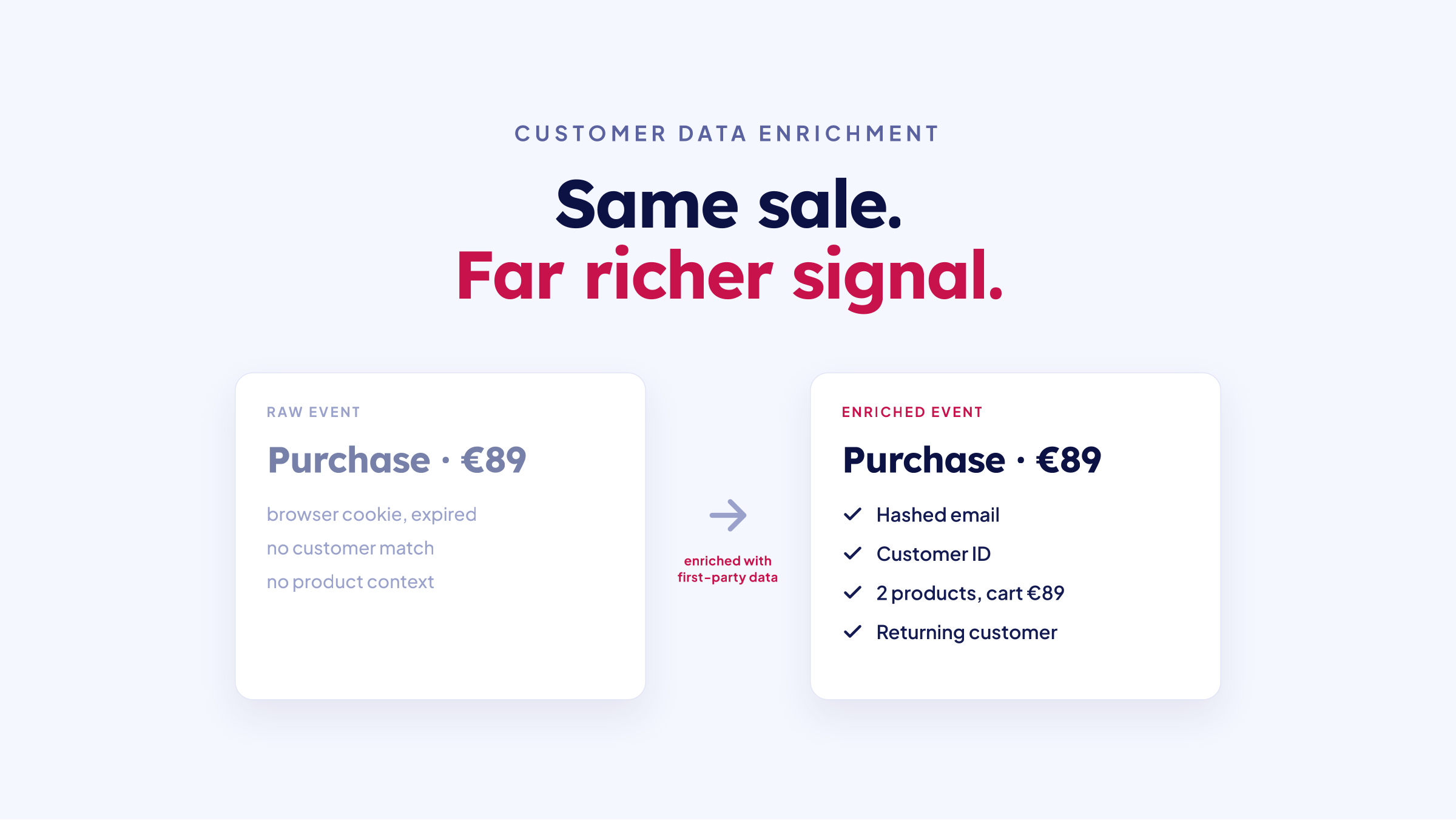
The event is enriched - TrackBee's Shopper Profile for this customer adds all available data: hashed email, name, click IDs, session history, IP address
-
The enriched event goes to all connected platforms simultaneously - Meta (via Conversions API), Google Ads (via Enhanced Conversions), Klaviyo, TikTok (via Events API), Pinterest (via Conversions API)
-
Deduplication runs - each platform receives the event exactly once, even if their client-side pixel also captured it
What changes:
-
Every platform sees the same customer data at the same time
-
Customer audiences in Meta are updated within 15 minutes of a purchase - not days or weeks
-
Every platform's algorithm learns from the same enriched, complete event data
-
Attribution data across platforms reflects the same underlying customer activity
The platform synchronization effect: When Google's Smart Bidding and Meta's Advantage+ are both learning from enriched, complete, and consistent event data, they build more accurate audience models. More accurate models mean more efficient spending - lower CPMs, higher match rates, and better targeting.
The Attribution Reality Check
Consistent cross-channel data improves attribution accuracy, but it's worth being realistic about one thing: even with perfect data consistency, Google and Meta will still claim some of the same conversions.

A customer who clicks a Meta ad and a Google Shopping ad before purchasing will appear in both platforms' reported conversions. This is inherent to the way platform attribution windows work - not a problem that data consistency alone can solve.
What consistent data does solve:
-
It eliminates attribution gaps (conversions that aren't recorded anywhere because the browser event didn't fire)
-
It improves each platform's attribution accuracy within its own model
-
It provides a more reliable foundation for comparing platform-reported conversions to Shopify actuals
What it doesn't solve:
- Cross-platform double-counting of conversions that genuinely involved multiple platform interactions
For the deeper picture on attribution models: Why you should switch from last-touch to data-driven attribution.
Frequently Asked Questions
Do I need to be running ads on all platforms for cross-channel data consistency to matter? No. Even with two platforms (Meta and Google), data inconsistency creates waste and conflicting attribution. The more platforms you add, the more coordination value there is - but consistency matters even at two.
Will consistent data reduce my reported ROAS? It may normalize ROAS numbers that were artificially high due to double-counting. A Meta campaign that was reporting 4x ROAS by claiming conversions that Google also claimed may report more accurately at 2.8x after deduplication. The campaign's actual contribution to revenue hasn't changed - the reporting has become more accurate.
How quickly do customer audiences update across platforms with TrackBee? TrackBee syncs customer purchase data to Meta Custom Audiences every 15 minutes. New purchasers are removed from acquisition targeting within 15 minutes of their order. Google Ads audiences update as new data flows through the Conversions API.
Does cross-channel data consistency affect Klaviyo as well? Yes. TrackBee sends enriched events to Klaviyo using the same Shopper Profile data that goes to ad platforms. Browse abandonment and cart abandonment triggers are sent with customer identity attached, improving Klaviyo flow trigger reliability. See: How to improve your Klaviyo abandoned cart flow.
What if I have first-party data in Shopify that's not reaching my ad platforms? This is the most common scenario. Customer emails, phone numbers, and purchase data stored in Shopify are often only partially shared with ad platforms - through periodic manual exports or limited native integrations. TrackBee's automated sync ensures Shopify's first-party data flows to all platforms continuously, without manual intervention.


.png)