

Short answer: New customers convert differently than returning ones, but most Shopify stores cannot tell them apart in their data, so reported new-customer ROAS is inflated when existing buyers slip into acquisition results. Fix it by distinguishing new from returning shoppers with persistent profiles and complete event tracking, then optimise creative and budget against real new-customer numbers.
New customers are harder to convert than returning ones. They don't know your brand. They haven't bought from you before. They're weighing you against alternatives they may be considering simultaneously.
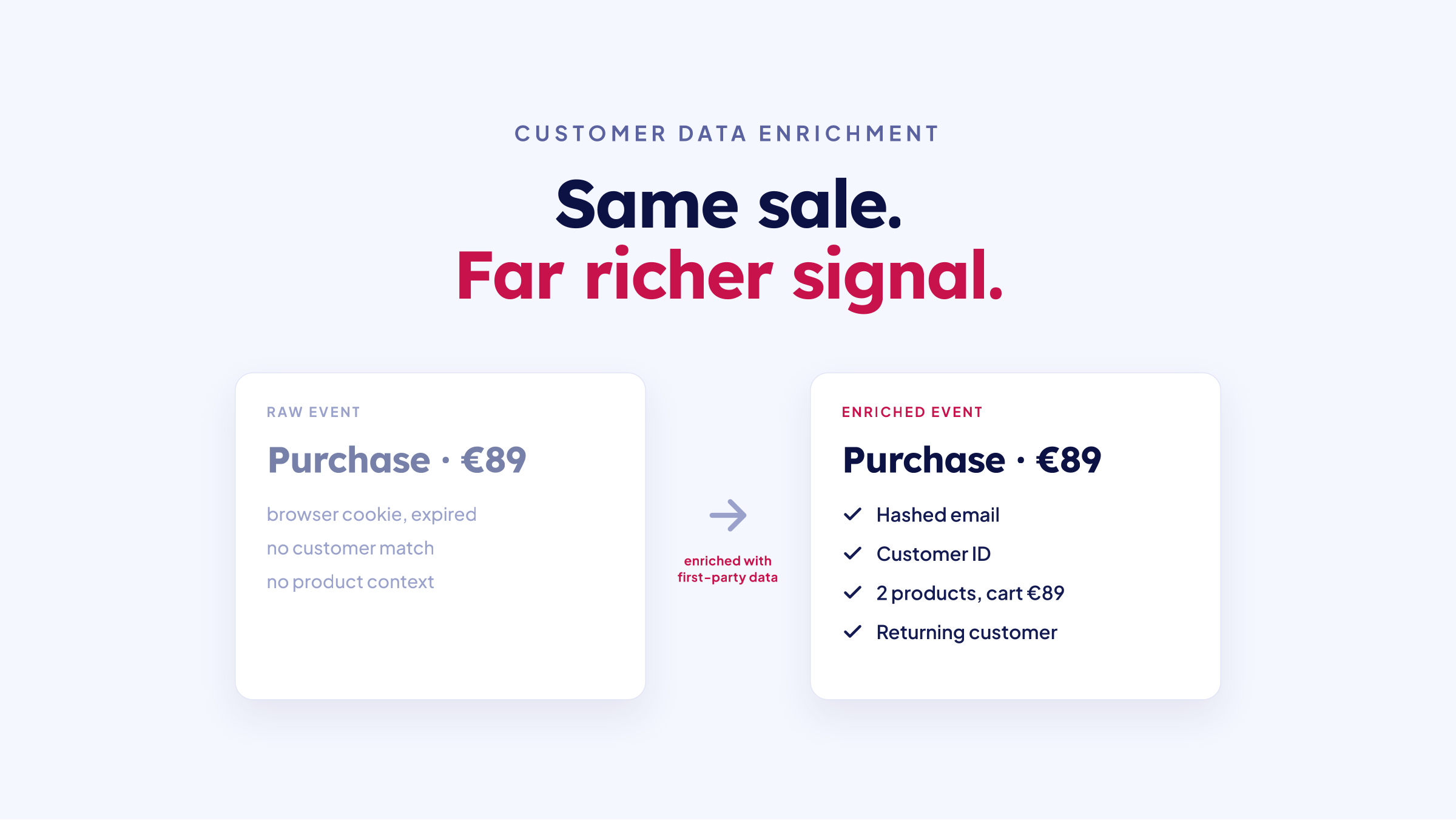
Optimizing for new customer conversions requires a different approach than retention marketing - different creative, different messaging, different expectations on conversion rate and CPA. But there's a fundamental problem that makes new customer optimization harder than it should be: most Shopify stores can't reliably distinguish new customer conversions from returning customer conversions in their data.
When your acquisition campaigns report 300 conversions last month, how many were genuinely new customers? If 20–30% of those conversions were existing customers who happened to see an acquisition ad and repurchased - which happens systematically without proper exclusion audiences - your new customer ROAS is significantly lower than reported, and your budget decisions are based on inflated numbers.
And that's before accounting for the conversion events that didn't fire at all.
The New Customer Conversion Challenge
New customers behave differently: A returning customer has already overcome the initial trust barrier. They know your brand, they've experienced your product, and they have a reference point for your pricing and quality. Their conversion rate is typically 2–3x higher than a first-time visitor's.
A new customer has none of that. They're evaluating your brand for the first time. They have questions about quality, shipping, returns. They're comparing you to alternatives. Their decision to purchase involves a higher perceived risk than a repeat purchase.
This means: your conversion optimization strategy for new customers isn't the same as your general conversion optimization. The levers are different.
Why this matters for campaign performance: If your ads are reaching a mix of potential new customers and existing customers - and you can't distinguish between them in your data - you can't accurately:
-
Calculate your true new customer CPA
-
Identify which campaigns are actually acquiring new customers vs. recapturing existing ones
-
Optimize bidding and creative for new customer acquisition specifically
The Tracking Problem: Why Your New Customer Data Is Wrong
Before optimizing new customer conversions, address the data quality problem.

Missing conversion events: Standard browser-based tracking loses 30–40% of conversion events to ad blockers, iOS restrictions, and cookie expiration. For new customers - who are more likely to be privacy-conscious first-time visitors - the missing conversion rate may be higher than average. New customers are more likely to have protective browser settings than loyal repeat customers who've opted into your communications.
The consequence: your new customer acquisition campaigns look less effective than they are. You're killing campaigns that actually work because the conversions aren't being tracked.
Existing customer contamination: Without real-time customer exclusion audiences, a portion of your "acquisition" conversions are from existing customers. This inflates reported ROAS and deflates apparent CPA - making acquisition look more efficient than it actually is for genuinely new customers.
Cross-device attribution failure: New customers are particularly likely to be in a discovery/consideration phase before converting. They may click a Meta ad on their phone, research on their laptop, and purchase days later. Without cross-device tracking, the final purchase appears unattributed. The acquisition campaign that drove the initial click gets no credit.
The fix:
-
Server-side tracking to capture conversion events that browser tracking misses
-
Real-time customer exclusion audiences to remove existing customers from acquisition targeting
-
Cross-device Shopper Profiles to attribute multi-session new customer conversions correctly
See: What is server-side tracking and how to install it for Shopify.
Building a Foundation for New Customer Measurement
Before you can optimize new customer conversions, you need to be able to measure them accurately.

Separate new customer and returning customer conversions: In Meta Ads Manager, you can view "First-Time Purchase" as a separate conversion event column. Use this alongside total purchases to see the split. If your campaigns show high total conversions but low first-time purchases, existing customers are being reached by your acquisition campaigns.
Apply customer exclusion audiences: Add your customer list as an exclusion to all acquisition campaigns. With TrackBee's real-time audience sync, this exclusion is updated every 15 minutes - ensuring new purchasers are excluded within minutes of their order. See: How to stop wasting Meta ad budget on returning customers.
Track new customer CPA separately: Calculate CPA specifically for first-time purchase conversions. If your target CPA is based on total purchases (including existing customers), it's artificially favorable. Real new customer CPA is higher - account for this in your targets.
What Actually Drives New Customer Conversions
With reliable measurement in place, what actually moves the needle on new customer conversion rates?

Speed: Page load time has an outsized impact on first-time visitors. A returning customer is motivated enough to wait. A new customer who's comparing you to competitors will leave for a faster site. The first 3 seconds matter most. See: Shopify speed optimization guide.
Clarity: New visitors don't know what you sell, who it's for, or why they should buy from you - not from your homepage. Your landing pages need to answer the most basic questions immediately: What is this? Is this for me? Why this brand over alternatives?
Ad creative → landing page message match is critical for new customers. If someone clicks an ad about a specific product benefit and lands on a generic homepage, the disconnect creates friction. Match the landing page to the specific claim in the ad.
Trust signals: A new customer has no purchase history with you. Their risk perception is higher than a returning customer's. Trust signals reduce this:
-
Social proof: genuine customer reviews, star ratings, number of reviews
-
Security indicators: recognized payment logos (Visa, Mastercard, PayPal, Shop Pay)
-
Return policy: prominently displayed, customer-friendly
-
Brand credibility: media coverage, certifications, partner logos if relevant
Frictionless checkout: Every form field is a potential exit point for a new customer who's still on the fence. Enable guest checkout. Minimize required fields. Add Apple Pay and Google Pay for one-tap checkout on mobile. See: Shopify CRO: tactics to increase conversions.
Optimizing Landing Pages for First-Time Visitors
Your landing page is where the purchase decision is made or lost for new customers. Specific optimization areas:
Above-the-fold clarity: Within 3 seconds of landing, a new visitor should know:
-
What product this is
-
What it does / why it matters to them
-
The price
-
That they can trust this site
If any of these require scrolling, your above-the-fold section needs work.
Product-specific landing pages: Send ad traffic to product-specific landing pages rather than your homepage. A visitor who clicked an ad for a specific product should land on that product's page - with reviews, product details, size/variant selection, and checkout within one or two clicks.
Social proof placement: Reviews near the add-to-cart button are more effective than reviews at the bottom of the page. A new customer hesitating at the decision point is reassured by seeing "4.8 stars, 2,400 reviews" immediately adjacent to the purchase button.
Mobile-first design: The majority of new customer discovery happens on mobile. If your product pages are difficult to navigate on mobile - small text, hard-to-tap buttons, slow load times - you're losing a significant portion of your potential new customers before they've given you a real shot.
Building Trust with Cold Audiences
New customers in acquisition campaigns are cold audiences - they don't know you. The creative and messaging approach needs to acknowledge this:
Education over promotion: Cold audience creative that leads with product education ("Here's what this product does and why it works") tends to outperform pure promotional creative ("Sale: 20% off") for first-time buyers. Promotional creative works for returning customers who already believe in the product. Cold audiences need to understand the product first.
Social proof in ad creative: UGC (user-generated content) and reviews in ad creative reduce the cold audience skepticism that professional-looking brand creative creates. A real customer talking about a product is more credible to a new prospect than polished brand photography.
Benefit-focused copy: Lead with outcomes, not features. "Wake up without the migraine fog" outperforms "Contains 500mg of magnesium" for cold audiences who haven't yet bought into the category.
Using Data to Segment and Optimize
Once your tracking is complete and your acquisition campaigns are clearly differentiated from retention, use the data:
Track new customer conversion rate by traffic source: Is your Meta prospecting converting new customers at 1.2%? Your Google Shopping at 2.1%? Organic at 0.8%? These rates tell you which acquisition channels are most efficient for first-time buyers - and where to allocate incremental budget.
Identify the first purchase products: What do new customers buy first? The products with the highest new-customer acquisition rate are your gateway products - the entries into your brand. These deserve disproportionate ad investment, email acquisition emphasis, and prominently featured inventory.
Analyze the new customer journey: How many touchpoints does a new customer average before purchasing? What content do they consume? Which channels do they encounter? GA4's path analysis and conversion funnel reports (with cross-channel context from UTM data) reveal the patterns. Optimize the most common paths.
Frequently Asked Questions
How do I track new customer conversions specifically in Meta? In Meta Ads Manager, add the "First-Time Purchase" column to your campaign view (customize columns → Conversions → First-time purchase). This shows how many conversions were from users making their first purchase on your store, as reported to Meta via your Pixel or Conversions API.
Is new customer CPA always higher than overall CPA? Yes, typically. Because existing customers convert at higher rates, including them in your total CPA calculation lowers the apparent CPA. Your true new customer CPA (cost to acquire a genuinely new customer) will be higher - and that's the number that matters for acquisition budgeting and ROAS targets.
Should I have separate campaigns for new customers and returning customers? Yes. Separate campaigns allow for:
-
Different creative messaging (education/trust for new customers, loyalty offers for existing)
-
Accurate attribution by campaign objective
-
Correct CPA targets (new customer acquisition vs. retention)
-
Proper exclusion audiences (existing customers excluded from acquisition campaigns)
How do I know if my tracking gaps are affecting my new customer data? Compare Meta's reported "First-time Purchase" conversion volume to your Shopify "New Customer" order count for the same period. A large gap (accounting for organic/direct attribution) indicates that new customer conversions from Meta traffic aren't being fully captured. Server-side tracking should close this gap.
What's the right CPA target for new customer acquisition? It depends on your customer lifetime value (LTV). A common framework: if your average customer LTV is $200 and your gross margin is 50%, the lifetime gross margin is $100. A new customer CPA under $100 is profitable at a single-order level. But if customers repeat purchase, your sustainable CPA can be higher - you can acquire at a loss on the first order if LTV justifies it. Build your CPA targets around LTV, not single-order profitability.


.png)