
Shopping Cart Abandonment: Why It Happens and Fixes

Nearly 70% of shopping carts are abandoned. Learn why it happens, what it costs, and the tracking gap that makes the problem worse.
March 18, 2026
Frank
Latest
Shopify

Shopping Cart Abandonment: Why It Happens and Fixes

A customer browses your store, finds a product they want, adds it to their cart, begins checkout - and then disappears.

This happens in nearly 70% of all shopping cart sessions. In fashion, beauty, and electronics, rates climb above 75%. For every 10 people who reach checkout on a typical Shopify store, 7 don't complete the purchase.

Cart abandonment is one of the most studied problems in e-commerce precisely because the cost is easy to quantify and the people abandoning have already demonstrated intent. They found your store, found your products, and started buying. Something stopped them.

This guide covers why abandonment happens, what it actually costs, and - critically - why the problem is larger than most retailers realize due to tracking gaps.

The Scale of the Cart Abandonment Problem

Industry data consistently places the average cart abandonment rate between 65–80%. The Baymard Institute, which aggregates data from dozens of studies, puts it at 70.19%.

To make that concrete: if your Shopify store had 10,000 sessions this month and 1,000 of those reached checkout, roughly 700 will leave without purchasing. Those 700 people saw your products, wanted them enough to start checkout, and didn't complete.

Abandonment rates vary by industry:

  • Fashion and apparel: 68–75%

  • Electronics: 74–80%

  • Beauty and personal care: 65–72%

  • Home furnishings: 72–78%

  • Food and grocery: 50–60%

Mobile abandonment rates are consistently higher than desktop - typically 10–15 percentage points higher - because mobile checkout experiences are more friction-prone.


What Causes Shoppers to Abandon Carts?

Baymard Institute research identifies the most common reasons customers give for abandoning checkouts:

Unexpected costs (shipping, taxes, fees) - the #1 cause Over 48% of abandoners cite unexpected costs at checkout as the primary reason. A customer who expects to pay €45 and sees €57 at checkout after shipping has their budget calculus disrupted. Even when the final price is acceptable, the surprise creates hesitation.

Not ready to purchase / just browsing About 34% of abandoners weren't genuinely ready to buy - they were researching, comparing, or saving for later. These abandoners aren't necessarily lost; they may return. But they represent purchases that happen on competitor sites if you don't stay top-of-mind.

Overly complicated checkout process Long, multi-step checkouts with excessive form fields produce abandonment. Research shows that the average checkout flow has 14.88 required form fields; the optimal number is closer to 7.

Couldn't trust the site with credit card information Missing trust signals (no SSL certificate indicator, no recognizable payment logos, no visible privacy policy) cause abandonment. This is particularly relevant for newer stores without established brand recognition.

No guest checkout available 27% of US online shoppers say they've abandoned checkout because they were required to create an account. Pre-purchase account creation is a known conversion killer.

Delivery too slow When estimated delivery times are longer than expected, customers abandon - particularly for purchases with time sensitivity (gifts, seasonal items).

Payment method not available A customer who uses Apple Pay or Klarna and finds those options absent may not complete the purchase with a manual card entry. The more payment options available, the lower the abandonment rate.


The Real Cost Calculation

The cost of abandoned carts extends beyond the immediate lost revenue:

Acquisition costs already spent The customer found your store. They may have clicked a Meta or Google ad. They browsed product pages. They added to cart and started checkout. You've spent acquisition budget to get them to this point - and they left.

The abandonment isn't a failed acquisition. It's an acquisition that succeeded up to the last step. Which makes the unit economics worse than a prospect who never engaged: you paid the acquisition cost without receiving the revenue.

Compounded opportunity cost A customer who abandons and purchases elsewhere may become a repeat customer there. Cart abandonment doesn't just cost you one sale - it can cost you the lifetime value of that customer.

Retargeting cost to recover Email recovery sequences, Meta retargeting campaigns, and SMS flows all cost money to run. The cost of recovery should be factored into the abandonment cost calculation.

A rough calculation: 500 abandoned carts per month × €80 average order value = €40,000 in abandoned cart revenue. Even a 5% recovery rate from an email sequence = €2,000/month recovered. Invest in the recovery infrastructure accordingly.


The Hidden Layer: Tracking Gaps Make Abandonment Worse

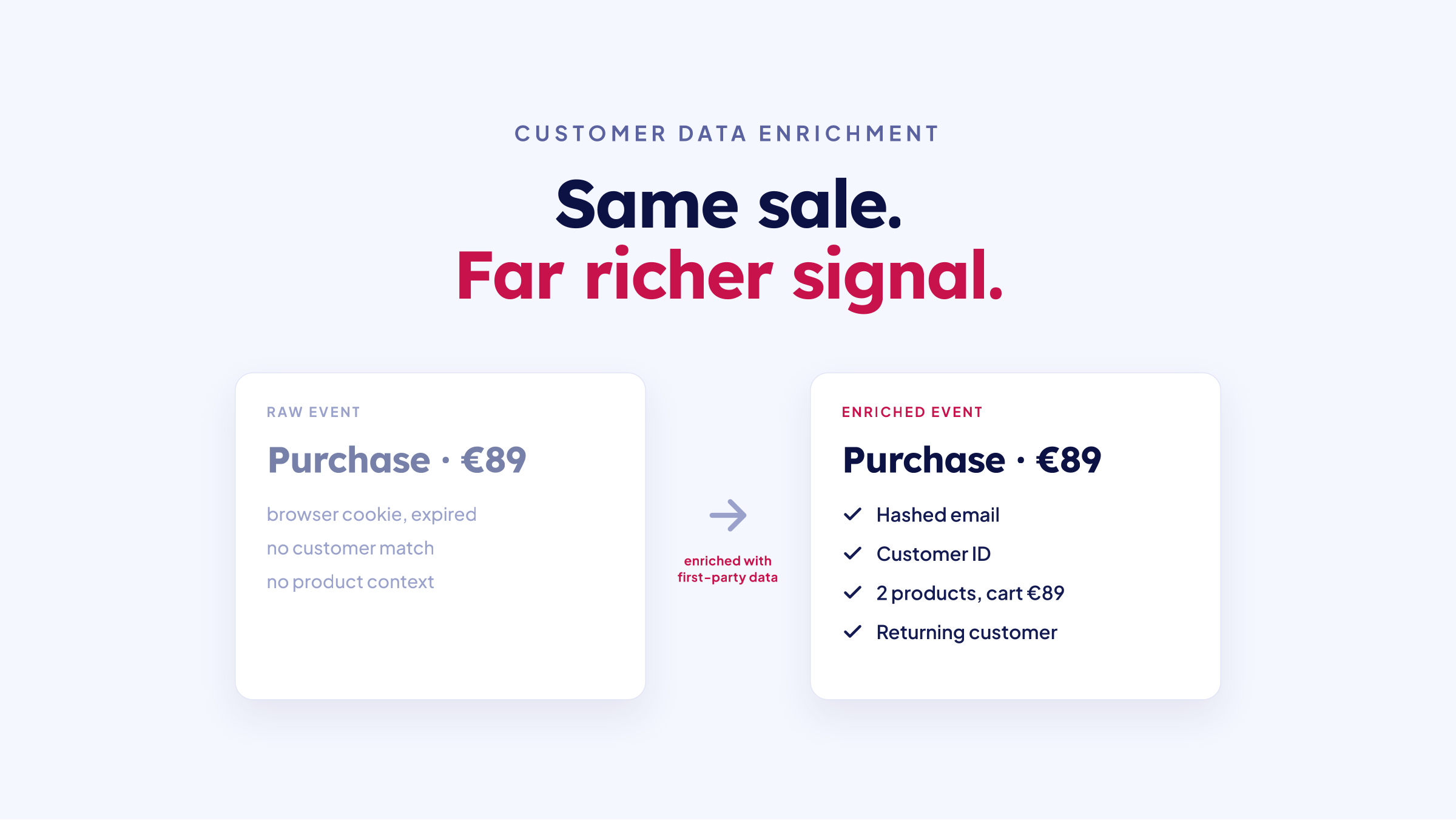
Here's the problem most retailers don't know about: a substantial share of cart abandonment events never reach the tools designed to recover them.

Your Klaviyo abandoned cart flow triggers when it receives a "Started Checkout" or "Added to Cart" event. Your Meta and Google retargeting audiences are built from customers who triggered those same checkout events.

But those events are sent by tracking scripts running in your customers' browsers. When those scripts fail - which happens for 30–40% of sessions due to ad blockers, iOS privacy restrictions, expired cookies, and cross-device journeys - the events never reach Klaviyo or your ad platforms.

The result:

  • Your Klaviyo flow triggers for less than 70% of actual abandonment events

  • Your Meta retargeting audience is smaller than it should be

  • Your recovery rate looks better than it actually is (because the denominator - total abandonment events - is understated)

This isn't a Klaviyo problem. It's a tracking infrastructure problem. The fix is server-side event capture: recording cart events at the server level, independent of browser conditions, and delivering them to Klaviyo and your ad platforms with customer identity attached.

HoneyBalm found that 74% of their Add to Cart events were missing. After fixing the tracking:

  • +171% more Add to Cart events captured in Klaviyo

  • +220% more abandoned cart flow triggers

  • +213% more abandonment revenue

Nothing else changed. Not the email copy, not the discount strategy, not the timing. The tracking got fixed, and the emails that should have been sending started sending. See: How to improve your Klaviyo abandoned cart flow.


How to Recover Abandoned Carts

With reliable tracking in place, the recovery strategy:

Email Sequences

A three-email sequence is the standard for most Shopify stores:

  • Email 1 (30 minutes after abandonment): Direct reminder, no incentive, dynamic cart contents

  • Email 2 (24 hours): Follow-up for non-responders, optional soft incentive (free shipping), social proof on abandoned products

  • Email 3 (48–72 hours): Final nudge with a time-limited discount for higher-value carts

40–45% of abandoned cart emails are opened - significantly higher than typical promotional emails. The high open rate reflects the inherent relevance of the message.

For a full breakdown of email sequence optimization: Best strategies for offering a Shopify abandoned cart discount.

Retargeting Ads

Meta and Google retargeting campaigns showing the specific products a customer abandoned are a powerful complement to email recovery. The combined effect - email reminder and ad retargeting - reaches abandoners across multiple touchpoints.

For this to work correctly, the "Started Checkout" event needs to reach your Meta Pixel and Google Tag. Server-side event capture ensures it does. See: How to stop wasting Meta ad budget on returning customers.

Push Notifications

For customers who've opted into browser push notifications, a recovery push within 30 minutes of abandonment can achieve high recovery rates. Push notifications have ~50% open rates and reach customers without requiring email.

SMS Recovery

One-tap cart recovery links via SMS reach customers who are more likely to read an SMS than check email. For stores with SMS opt-ins, a single SMS within the first hour post-abandonment is an effective first recovery touch.


UX Improvements That Reduce Abandonment Rate

Recovery is valuable. Prevention is better. Address the root causes:

Show total costs earlier Display shipping cost estimates on product pages and cart pages - before checkout begins. The shock of unexpected costs at checkout is the leading abandonment driver.

Simplify your checkout Reduce form fields to the minimum required to fulfill the order. Enable Shopify's one-page checkout. Use autofill for returning customers. See: Shopify's one-page checkout: what it means for your store.

Enable guest checkout Remove mandatory account creation before purchase. Offer account creation post-purchase when it provides clear value to the customer.

Add more payment options Apple Pay, Google Pay, PayPal, and Buy Now Pay Later options reduce the friction of manual card entry and serve customers who've opted out of traditional checkout flows.

Improve trust signals SSL certificate indicator, recognized payment logos (Visa, Mastercard, PayPal), prominent return policy link, and customer reviews near the checkout reduce trust-based hesitation.

Fix page load speed Slow checkout pages increase abandonment directly. A 1-second delay in checkout load time increases abandonment rates. See: Shopify speed optimization guide.


Building a Complete Abandonment Recovery System

Cart abandonment recovery has three layers, and all three need to be in place:

Layer 1: Reliable tracking infrastructure Ensure every cart abandonment event reaches Klaviyo and your ad platforms. Server-side tracking captures events that browser-based tracking misses. Without this layer, Layers 2 and 3 are working with incomplete data.

Layer 2: Email recovery flows A three-email Klaviyo sequence with product-specific content, appropriate timing, and conditional discounts for higher-value carts.

Layer 3: Paid retargeting Meta and Google campaigns targeting visitors who started checkout but didn't purchase, showing the specific products they abandoned.

Each layer recovers a different segment of abandoners. Email reaches customers whose identity Klaviyo knows. Retargeting reaches customers who were cookied or whose identity is resolved through ad platform matching. Together, they maximize recovery.


Frequently Asked Questions

What is a good cart abandonment rate? Lower is better. The industry average is ~70%. If your store's abandonment rate is significantly above your industry benchmark, investigate the root causes (unexpected costs, checkout friction, trust signals). If it's in line with benchmarks, focus on recovery optimization rather than abandonment reduction.

Why are my abandoned cart emails not triggering in Klaviyo? The most common cause is a tracking gap - the "Started Checkout" or "Added to Cart" event isn't reaching Klaviyo for a large percentage of your abandoners. Check your Klaviyo event volume and compare it to Shopify's checkout data in Shopify Analytics. A large gap indicates a tracking infrastructure problem, not a Klaviyo flow configuration problem.

How do I reduce cart abandonment on mobile? Mobile abandonment is higher because mobile checkout is more friction-prone. Enable Shop Pay (accelerated checkout for mobile), reduce form fields, and ensure tap targets are large enough for mobile use. Test your checkout on actual mobile devices - not just desktop browser emulation.

Should I send abandoned cart emails to every abandoner? Yes, but with appropriate smart sending filters. Exclude customers who purchased in the last 48 hours (they clearly converted). Exclude customers who received an abandoned cart email in the last 7 days (to avoid over-emailing). Klaviyo's smart sending handles the former automatically.

How long should my abandoned cart email sequence run? Three emails over 48–72 hours is the standard. Extending beyond 72 hours yields diminishing returns as purchase intent fades. The exception is high-consideration purchases (high ticket items, major home goods) where customers may research for longer before deciding.

In this article
Boost Your Revenue
Track Missing Conversion Data
Lorem Ipsum

Boost Your Revenue

Track & Enrich
Missing Conversion Data

Try for free
Share this:

A customer browses your store, finds a product they want, adds it to their cart, begins checkout - and then disappears.

This happens in nearly 70% of all shopping cart sessions. In fashion, beauty, and electronics, rates climb above 75%. For every 10 people who reach checkout on a typical Shopify store, 7 don't complete the purchase.

Cart abandonment is one of the most studied problems in e-commerce precisely because the cost is easy to quantify and the people abandoning have already demonstrated intent. They found your store, found your products, and started buying. Something stopped them.

This guide covers why abandonment happens, what it actually costs, and - critically - why the problem is larger than most retailers realize due to tracking gaps.

The Scale of the Cart Abandonment Problem

Industry data consistently places the average cart abandonment rate between 65–80%. The Baymard Institute, which aggregates data from dozens of studies, puts it at 70.19%.

To make that concrete: if your Shopify store had 10,000 sessions this month and 1,000 of those reached checkout, roughly 700 will leave without purchasing. Those 700 people saw your products, wanted them enough to start checkout, and didn't complete.

Abandonment rates vary by industry:

  • Fashion and apparel: 68–75%

  • Electronics: 74–80%

  • Beauty and personal care: 65–72%

  • Home furnishings: 72–78%

  • Food and grocery: 50–60%

Mobile abandonment rates are consistently higher than desktop - typically 10–15 percentage points higher - because mobile checkout experiences are more friction-prone.


What Causes Shoppers to Abandon Carts?

Baymard Institute research identifies the most common reasons customers give for abandoning checkouts:

Unexpected costs (shipping, taxes, fees) - the #1 cause Over 48% of abandoners cite unexpected costs at checkout as the primary reason. A customer who expects to pay €45 and sees €57 at checkout after shipping has their budget calculus disrupted. Even when the final price is acceptable, the surprise creates hesitation.

Not ready to purchase / just browsing About 34% of abandoners weren't genuinely ready to buy - they were researching, comparing, or saving for later. These abandoners aren't necessarily lost; they may return. But they represent purchases that happen on competitor sites if you don't stay top-of-mind.

Overly complicated checkout process Long, multi-step checkouts with excessive form fields produce abandonment. Research shows that the average checkout flow has 14.88 required form fields; the optimal number is closer to 7.

Couldn't trust the site with credit card information Missing trust signals (no SSL certificate indicator, no recognizable payment logos, no visible privacy policy) cause abandonment. This is particularly relevant for newer stores without established brand recognition.

No guest checkout available 27% of US online shoppers say they've abandoned checkout because they were required to create an account. Pre-purchase account creation is a known conversion killer.

Delivery too slow When estimated delivery times are longer than expected, customers abandon - particularly for purchases with time sensitivity (gifts, seasonal items).

Payment method not available A customer who uses Apple Pay or Klarna and finds those options absent may not complete the purchase with a manual card entry. The more payment options available, the lower the abandonment rate.


The Real Cost Calculation

The cost of abandoned carts extends beyond the immediate lost revenue:

Acquisition costs already spent The customer found your store. They may have clicked a Meta or Google ad. They browsed product pages. They added to cart and started checkout. You've spent acquisition budget to get them to this point - and they left.

The abandonment isn't a failed acquisition. It's an acquisition that succeeded up to the last step. Which makes the unit economics worse than a prospect who never engaged: you paid the acquisition cost without receiving the revenue.

Compounded opportunity cost A customer who abandons and purchases elsewhere may become a repeat customer there. Cart abandonment doesn't just cost you one sale - it can cost you the lifetime value of that customer.

Retargeting cost to recover Email recovery sequences, Meta retargeting campaigns, and SMS flows all cost money to run. The cost of recovery should be factored into the abandonment cost calculation.

A rough calculation: 500 abandoned carts per month × €80 average order value = €40,000 in abandoned cart revenue. Even a 5% recovery rate from an email sequence = €2,000/month recovered. Invest in the recovery infrastructure accordingly.


The Hidden Layer: Tracking Gaps Make Abandonment Worse

Here's the problem most retailers don't know about: a substantial share of cart abandonment events never reach the tools designed to recover them.

Your Klaviyo abandoned cart flow triggers when it receives a "Started Checkout" or "Added to Cart" event. Your Meta and Google retargeting audiences are built from customers who triggered those same checkout events.

But those events are sent by tracking scripts running in your customers' browsers. When those scripts fail - which happens for 30–40% of sessions due to ad blockers, iOS privacy restrictions, expired cookies, and cross-device journeys - the events never reach Klaviyo or your ad platforms.

The result:

  • Your Klaviyo flow triggers for less than 70% of actual abandonment events

  • Your Meta retargeting audience is smaller than it should be

  • Your recovery rate looks better than it actually is (because the denominator - total abandonment events - is understated)

This isn't a Klaviyo problem. It's a tracking infrastructure problem. The fix is server-side event capture: recording cart events at the server level, independent of browser conditions, and delivering them to Klaviyo and your ad platforms with customer identity attached.

HoneyBalm found that 74% of their Add to Cart events were missing. After fixing the tracking:

  • +171% more Add to Cart events captured in Klaviyo

  • +220% more abandoned cart flow triggers

  • +213% more abandonment revenue

Nothing else changed. Not the email copy, not the discount strategy, not the timing. The tracking got fixed, and the emails that should have been sending started sending. See: How to improve your Klaviyo abandoned cart flow.


How to Recover Abandoned Carts

With reliable tracking in place, the recovery strategy:

Email Sequences

A three-email sequence is the standard for most Shopify stores:

  • Email 1 (30 minutes after abandonment): Direct reminder, no incentive, dynamic cart contents

  • Email 2 (24 hours): Follow-up for non-responders, optional soft incentive (free shipping), social proof on abandoned products

  • Email 3 (48–72 hours): Final nudge with a time-limited discount for higher-value carts

40–45% of abandoned cart emails are opened - significantly higher than typical promotional emails. The high open rate reflects the inherent relevance of the message.

For a full breakdown of email sequence optimization: Best strategies for offering a Shopify abandoned cart discount.

Retargeting Ads

Meta and Google retargeting campaigns showing the specific products a customer abandoned are a powerful complement to email recovery. The combined effect - email reminder and ad retargeting - reaches abandoners across multiple touchpoints.

For this to work correctly, the "Started Checkout" event needs to reach your Meta Pixel and Google Tag. Server-side event capture ensures it does. See: How to stop wasting Meta ad budget on returning customers.

Push Notifications

For customers who've opted into browser push notifications, a recovery push within 30 minutes of abandonment can achieve high recovery rates. Push notifications have ~50% open rates and reach customers without requiring email.

SMS Recovery

One-tap cart recovery links via SMS reach customers who are more likely to read an SMS than check email. For stores with SMS opt-ins, a single SMS within the first hour post-abandonment is an effective first recovery touch.


UX Improvements That Reduce Abandonment Rate

Recovery is valuable. Prevention is better. Address the root causes:

Show total costs earlier Display shipping cost estimates on product pages and cart pages - before checkout begins. The shock of unexpected costs at checkout is the leading abandonment driver.

Simplify your checkout Reduce form fields to the minimum required to fulfill the order. Enable Shopify's one-page checkout. Use autofill for returning customers. See: Shopify's one-page checkout: what it means for your store.

Enable guest checkout Remove mandatory account creation before purchase. Offer account creation post-purchase when it provides clear value to the customer.

Add more payment options Apple Pay, Google Pay, PayPal, and Buy Now Pay Later options reduce the friction of manual card entry and serve customers who've opted out of traditional checkout flows.

Improve trust signals SSL certificate indicator, recognized payment logos (Visa, Mastercard, PayPal), prominent return policy link, and customer reviews near the checkout reduce trust-based hesitation.

Fix page load speed Slow checkout pages increase abandonment directly. A 1-second delay in checkout load time increases abandonment rates. See: Shopify speed optimization guide.


Building a Complete Abandonment Recovery System

Cart abandonment recovery has three layers, and all three need to be in place:

Layer 1: Reliable tracking infrastructure Ensure every cart abandonment event reaches Klaviyo and your ad platforms. Server-side tracking captures events that browser-based tracking misses. Without this layer, Layers 2 and 3 are working with incomplete data.

Layer 2: Email recovery flows A three-email Klaviyo sequence with product-specific content, appropriate timing, and conditional discounts for higher-value carts.

Layer 3: Paid retargeting Meta and Google campaigns targeting visitors who started checkout but didn't purchase, showing the specific products they abandoned.

Each layer recovers a different segment of abandoners. Email reaches customers whose identity Klaviyo knows. Retargeting reaches customers who were cookied or whose identity is resolved through ad platform matching. Together, they maximize recovery.


Frequently Asked Questions

What is a good cart abandonment rate? Lower is better. The industry average is ~70%. If your store's abandonment rate is significantly above your industry benchmark, investigate the root causes (unexpected costs, checkout friction, trust signals). If it's in line with benchmarks, focus on recovery optimization rather than abandonment reduction.

Why are my abandoned cart emails not triggering in Klaviyo? The most common cause is a tracking gap - the "Started Checkout" or "Added to Cart" event isn't reaching Klaviyo for a large percentage of your abandoners. Check your Klaviyo event volume and compare it to Shopify's checkout data in Shopify Analytics. A large gap indicates a tracking infrastructure problem, not a Klaviyo flow configuration problem.

How do I reduce cart abandonment on mobile? Mobile abandonment is higher because mobile checkout is more friction-prone. Enable Shop Pay (accelerated checkout for mobile), reduce form fields, and ensure tap targets are large enough for mobile use. Test your checkout on actual mobile devices - not just desktop browser emulation.

Should I send abandoned cart emails to every abandoner? Yes, but with appropriate smart sending filters. Exclude customers who purchased in the last 48 hours (they clearly converted). Exclude customers who received an abandoned cart email in the last 7 days (to avoid over-emailing). Klaviyo's smart sending handles the former automatically.

How long should my abandoned cart email sequence run? Three emails over 48–72 hours is the standard. Extending beyond 72 hours yields diminishing returns as purchase intent fades. The exception is high-consideration purchases (high ticket items, major home goods) where customers may research for longer before deciding.

Latest

Discover other Blogs

Explore our collection of informative and engaging blog posts.

Why Your Shopify Sales Don't Match Meta and Google Ads
Frank
Frank
9
min read
Shopify Conversion Rate Drop? Check Your Tracking
Frank
Frank
10
min read
How to Fix Underreported Conversions on Shopify
Frank
Frank
10
min read