.png)


Short answer: Cross-device journeys break cookie-based tracking because each device gets its own cookie, so a mobile ad click and a desktop purchase look like two unconnected visitors. Meta loses the credit, Google over-attributes, and Klaviyo flows misfire. Persistent shopper profiles link sessions across devices to rebuild one complete customer view.
A customer discovers your store through a Meta ad on their iPhone during a commute. They add a product to their cart. Three days later, they're at their desk, search your brand on Google, and complete the purchase on their laptop.
From your tracking infrastructure's perspective: two separate, unconnected visitors. The iPhone session has no purchase. The laptop session has no ad click. Your Meta ad gets no conversion credit. Your Google branded search gets full attribution. Your Klaviyo abandoned cart flow may or may not have fired for the mobile session - depending on whether the event reached Klaviyo before the laptop purchase.
This is cross-device fragmentation. And it's not an edge case. E-commerce customers routinely browse on mobile and purchase on desktop. For Shopify stores with meaningful iOS traffic, cross-device purchase paths are a significant portion of total conversions.
Why Cross-Device Journeys Break Standard Tracking
Standard cookie-based tracking is device-specific. When a user visits your store on their iPhone, your tracking scripts drop a cookie in that browser. When the same user visits on their laptop, a different cookie is set in that browser. Unless the user logs into an account on your store - creating a common identifier - these two cookies have no way to know they belong to the same person.
The three failure modes:
1. No ad click attribution on the purchase device The iPhone session had the Meta ad click. The laptop session is organic (branded search) or direct. Meta's pixel on the laptop session doesn't see the original ad click. The conversion appears unattributed to Meta - even though Meta's ad drove the initial visit. This problem is worsening: iOS 17+ Link Tracking Protection strips click IDs (fbclid, gclid) from URLs, and iOS 26 expands this stripping to more browsing contexts - making cross-device attribution even more dependent on server-side solutions. For a complete breakdown of iOS privacy changes and their impact, see our guide to iOS-proofing your ads.
2. Cart abandonment email doesn't trigger or goes to wrong destination If the customer added to cart on iPhone and your Klaviyo session only exists on that device, the "Started Checkout" event may not be associated with a known profile. Or it may trigger correctly on the iPhone session - but the customer has since purchased on their laptop. Smart sending may or may not catch this correctly depending on timing.
3. Retargeting audiences are incomplete Your "browsed product but didn't purchase" retargeting audience is built from your pixel events. Sessions without cross-device matching are treated as separate visitors - someone who browsed on mobile and purchased on desktop might appear as an unconverted mobile visitor in your retargeting pool, leading to retargeting ads served after purchase.
The Impact on Your Ads, Attribution, and Email Flows
Attribution accuracy: Cross-device fragmentation artificially deflates reported ROAS for the channels that typically drive the first interaction (prospecting campaigns, social discovery) and inflates it for the channels that intercept the final purchase (branded search, direct).


The Meta prospecting campaign that actually drove awareness gets no credit for the laptop purchase. Google's branded search gets full credit for a purchase that Google didn't create demand for. Budget flows toward the wrong channels.
Smart Bidding efficiency: Google and Meta's algorithms learn what a high-value customer looks like from the conversion data they receive. If cross-device purchases arrive without the identifying information that connects them to the original ad interactions, the algorithm builds models from fragmented data. It learns from a distorted picture of who converts.
Klaviyo flow reliability: If your Klaviyo session is tied to a mobile browser that no longer shows as an active session - because the customer purchased on their desktop - your abandoned cart flow may trigger and send an email to a customer who already purchased, or it may not trigger at all because the session profile isn't being updated.
Retargeting waste: Without cross-device identity resolution, customers who've purchased on one device can continue receiving retargeting ads on another device. This wastes ad spend on non-prospects. See: How to stop wasting Meta ad budget on returning customers.
Two Approaches to Cross-Device Tracking
Deterministic matching


uses definitive identifiers - email addresses, account logins, click IDs - to connect sessions. When a customer logs into their account on both their iPhone and laptop, both sessions are definitively connected to the same identity. When a customer enters their email at checkout on one device, that email can be used to match future sessions on other devices.
Deterministic matching is accurate but requires an identifier to exist - it only works for sessions where the user has authenticated or provided PII at some point.
Probabilistic matching
uses device fingerprinting, IP addresses, behavioral patterns, and statistical modeling to estimate whether two sessions likely belong to the same person. No definitive identifier is required. Probabilistic matching can connect anonymous sessions, but with lower confidence than deterministic matching.
The most effective cross-device tracking combines both: deterministic when identifiers are available, probabilistic to fill in the gaps.
How Persistent Shopper Profiles Solve the Problem
TrackBee builds persistent Shopper Profiles for every visitor to your Shopify store. These profiles accumulate data across all sessions - devices, browsers, time gaps - and serve as the connective tissue between fragmented sessions.

.png)
How a profile connects cross-device sessions:
-
First iPhone visit: TrackBee creates a profile. Records the Meta click ID (fbclid) from the ad, the session behavior, the IP address, and any device identifiers.
-
Cart addition on iPhone: The "Added to Cart" event is recorded against this profile and sent to Klaviyo - with the profile's identifying data attached.
-
Laptop visit (days later): TrackBee's script runs. It attempts to match this session to an existing profile using available identifiers: IP address, behavioral patterns, any shared identifiers.
-
Email entered at checkout on laptop: An email address is now available - and it matches the profile from the iPhone session. The two sessions are definitively connected. TrackBee's profile is updated with the laptop session's data.
-
Purchase completes: The purchase event is sent to Meta with the fbclid from the original iPhone ad click attached - correctly attributing the conversion to the Meta prospecting campaign. The purchase event is sent to Klaviyo, correctly closing out the abandoned cart flow that triggered from the iPhone session.
What this fixes:
-
Meta receives the purchase with its original click ID attached → correct ad attribution
-
Klaviyo's smart sending receives the purchase event → correctly suppresses the abandoned cart email
-
Google receives the purchase with enriched user data → more accurate DDA
-
Retargeting audiences are updated correctly → the customer is excluded from non-customer audiences
What Cross-Device Tracking Enables
Beyond fixing the problems it solves, cross-device tracking opens capabilities:

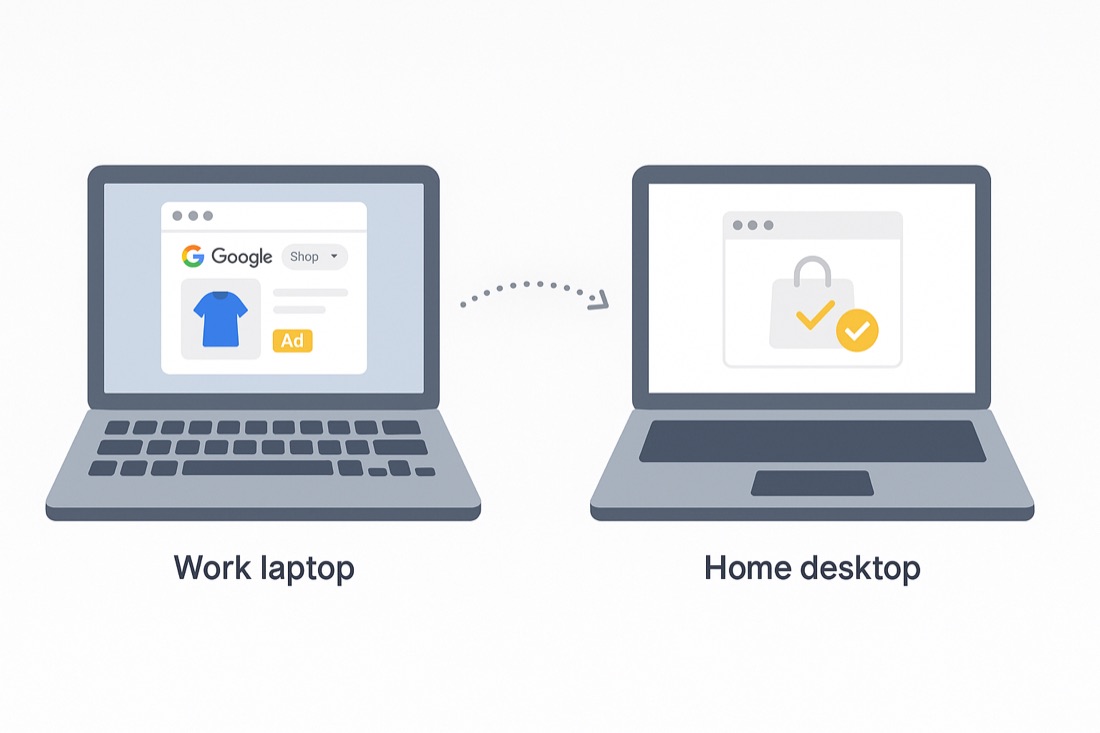
Accurate attribution across the full customer journey When the laptop purchase is connected to the iPhone ad click, your attribution data reflects the actual contribution of the Meta prospecting campaign. Budget decisions based on this data direct spend toward channels that actually create demand. TrackBee's real-time ad dashboard makes these cross-device insights visible across all connected platforms in a single view.
Better lookalike audiences Meta's lookalike algorithm builds models from your customer audience. A customer audience built from cross-device-resolved profiles is more complete than one built from device-specific sessions - giving Meta more accurate purchaser profiles to model from.
Email flows that work correctly Klaviyo's abandoned cart and browse abandonment flows trigger based on events. When those events are connected to a unified Shopper Profile (not fragmented device-specific sessions), flow triggers and suppressions work correctly across device switches.
Consistent retargeting across devices When a customer is added to a "purchased customers" audience on their laptop, that audience update can propagate to their mobile identity - suppressing retargeting ads on mobile as well as desktop.
Frequently Asked Questions
Is cross-device tracking GDPR compliant? Cross-device tracking using first-party data (email addresses, account logins) that the customer has provided is compliant when handled correctly. Probabilistic matching requires careful legal assessment in GDPR jurisdictions. TrackBee uses first-party data principles and processes data in compliance with applicable privacy regulations. TrackBee also supports Google's Consent Mode V2 (enforced since July 2025), ensuring consent signals are respected automatically across all platforms.


Does cross-device tracking require customers to log in? Deterministic cross-device matching requires a shared identifier - typically an email address, which becomes available at checkout or account login. Before email is provided, probabilistic matching can help but with lower confidence. The most valuable cross-device connections happen around checkout, when email is captured.
How does this affect customers who share devices? Shared devices (family members using the same laptop) can create false profile merges. This is an inherent limitation of cross-device tracking. In practice, the accuracy gains from connecting genuine cross-device customer journeys substantially outweigh the noise from shared-device edge cases.
Will I see a difference in my Meta ROAS reporting after implementing cross-device tracking? Potentially yes - in both directions. If Meta has been under-attributing purchases from customers who clicked mobile ads and purchased on desktop, you may see Meta ROAS improve as those conversions are correctly attributed. If Meta has been over-attributing (claiming conversions that were primarily driven by other channels), your reported ROAS may normalize. The goal is accuracy, not a higher number.
Does cross-device tracking help with Google's Enhanced Conversions? Yes. Enhanced Conversions match hashed email addresses to Google's logged-in user database. A cross-device Shopper Profile that preserves the customer's email from checkout and attaches it to conversion events improves the Enhanced Conversions match rate - since the email is available even for conversion paths that started on a different device. See: The ultimate guide to Google Enhanced Conversions.


.png)